
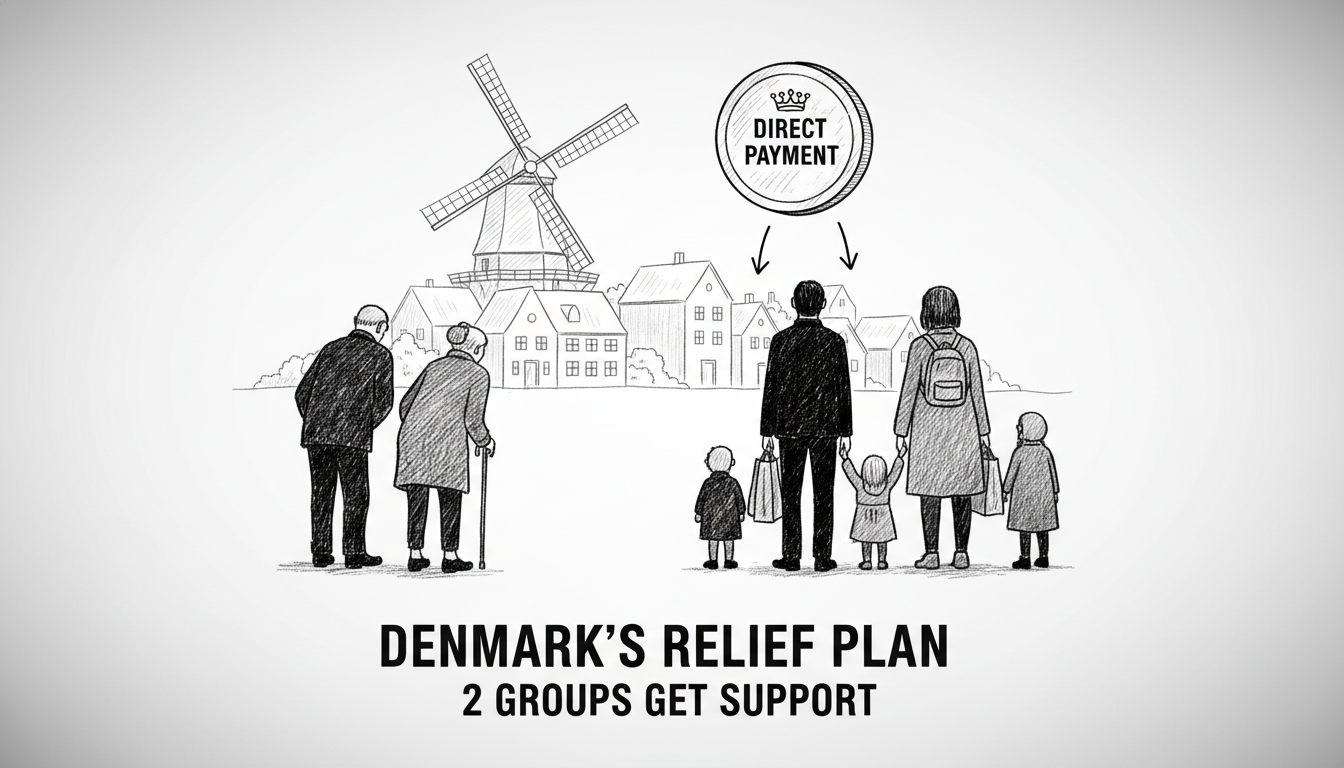
Denmark's Prime Minister Mette Frederiksen has announced a targeted financial relief plan, bowing to political pressure over the cost of living crisis. In her New Year's address from Marienborg, Frederiksen proposed sending direct payments to low-income families with children and economically vulnerable elderly citizens to compensate for soaring food prices. This marks a significant policy shift for the Social Democratic government, which has faced growing calls for action as inflation squeezes household budgets across the Nordic nation.
The proposal, light on immediate details regarding payment amounts, signals a move towards direct cash transfers over broader systemic reforms. It comes after a year where Denmark's inflation rate surpassed 10%, driven by energy and food costs that have disproportionately impacted those on fixed or lower incomes. With approximately 11% of Danes at risk of poverty, the government is attempting a surgical strike on economic hardship.
A Shift in Social Democratic Strategy
Mette Frederiksen's announcement represents a notable pivot. Traditionally, Danish social policy has focused on strengthening universal welfare benefits and public services. Direct, means-tested cash payments of this kind are a more Anglo-Saxon style of intervention. "The government is choosing a quick, visible fix," said Karen Møller, a political economist at the University of Copenhagen. "It addresses immediate pain but sidesteps longer debates about benefit levels, minimum wages, or market regulation. Politically, it's a response to the loudest current pressure."
The targeted approach aims to shore up the government's core constituencies. Low-income families and pensioners are key voter groups for the Social Democrats, and both have felt the sharp end of inflation. The move can be seen as an attempt to stabilize support while navigating a complex parliamentary landscape. However, it immediately raises questions about who exactly qualifies and whether the payments will be a one-off or a recurring measure.
The Economic Reality Behind the Checks
Denmark's economy, while strong overall, has not shielded its most vulnerable from global price shocks. Food inflation has been particularly stubborn, with basic staples like dairy, bread, and vegetables seeing significant price hikes. For a low-income family, the monthly grocery bill has become a major source of financial stress. Similarly, elderly citizens living on the basic state pension have seen their carefully calculated budgets upended.
"The value of the state pension has been eroded by inflation," noted Henrik Thierlein, chief analyst at a major Copenhagen pension fund. "While indexation provides some protection, it lags behind real-time price surges. A direct payment can bridge that gap, but it's a reactive tool, not a proactive solution to income adequacy." The Danish Chamber of Commerce expressed cautious support, emphasizing the need for any measure to be temporary and targeted to avoid fueling further inflation through broad-based consumer stimulus.
Expert Debate: Short-Term Relief vs. Long-Term Reform
The policy has ignited a familiar debate among economists and social policy experts. Proponents argue that cash transfers are efficient, putting money directly into the hands of those who need it most without bureaucratic overhead. They provide immediate dignity and choice, allowing families to decide whether to spend on food, heating, or children's necessities.
Critics, however, see it as a plaster on a deeper wound. "Direct payments are politically popular but economically fleeting," argued Professor Lars Bo Andersen of Aarhus University. "They do nothing to increase structural income, improve job skills, or address the root causes of poverty. When the check is spent, the underlying problem remains. We should be discussing why certain groups are so vulnerable to begin with."
Other suggested alternatives include permanent increases to child benefits and the lowest pension rates, expanded housing subsidies, or stronger price controls on essential goods. The government's choice of direct payments suggests a priority for speed and political impact over systemic change.
The Broader Nordic Context
Denmark's move places it within a wider Scandinavian response to the cost-of-living crisis. Sweden and Norway have also implemented various support packages, though with different emphases. Sweden focused more on broad-based energy cost subsidies, while Norway leveraged its sovereign wealth fund to fund public spending. Denmark's targeted cash approach is distinct, reflecting its particular political pressures and social contract.
The plan also tests the limits of Denmark's famed flexicurity model. The model combines a flexible labor market with strong unemployment benefits and active retraining policies. However, it is less designed to protect those outside the workforce—like pensioners—or working poor families from commodity price inflation. This intervention highlights a gap in the model when external shocks hit basic living costs.
What Comes Next: Implementation and Impact
The announcement is just the first step. The proposal must be formalized into legislation, negotiated with supporting parties in parliament, and passed. The specifics—the payment amount, the exact income thresholds, and the delivery mechanism—will be critical. Will the money arrive as a bank transfer, a tax rebate, or a physical voucher? The administration cost and efficiency will be scrutinized.
Business leaders in Copenhagen are watching closely. Consumer spending in key sectors like retail and services could get a localized boost from the payments. However, there is concern about the precedent. "Business needs stability and predictability," said the CEO of a major Danish retail association. "We hope this is a one-time measure to handle an extraordinary crisis, not a sign of permanent, ad-hoc fiscal policy."
For the average Dane, the reaction is mixed. Those who qualify will welcome the relief. Those who don't—the so-called 'squeezed middle'—may feel overlooked, having also struggled with rising costs but earning just above the aid threshold. This creates a potential political vulnerability for Frederiksen.
Ultimately, Denmark's direct payment plan is a political solution to an economic problem. It acknowledges real suffering and attempts to alleviate it quickly. Yet, it leaves the structural questions about inequality, social safety nets, and economic resilience for another day. As the checks are prepared, the debate over what constitutes true social security in a volatile world is only just beginning.