
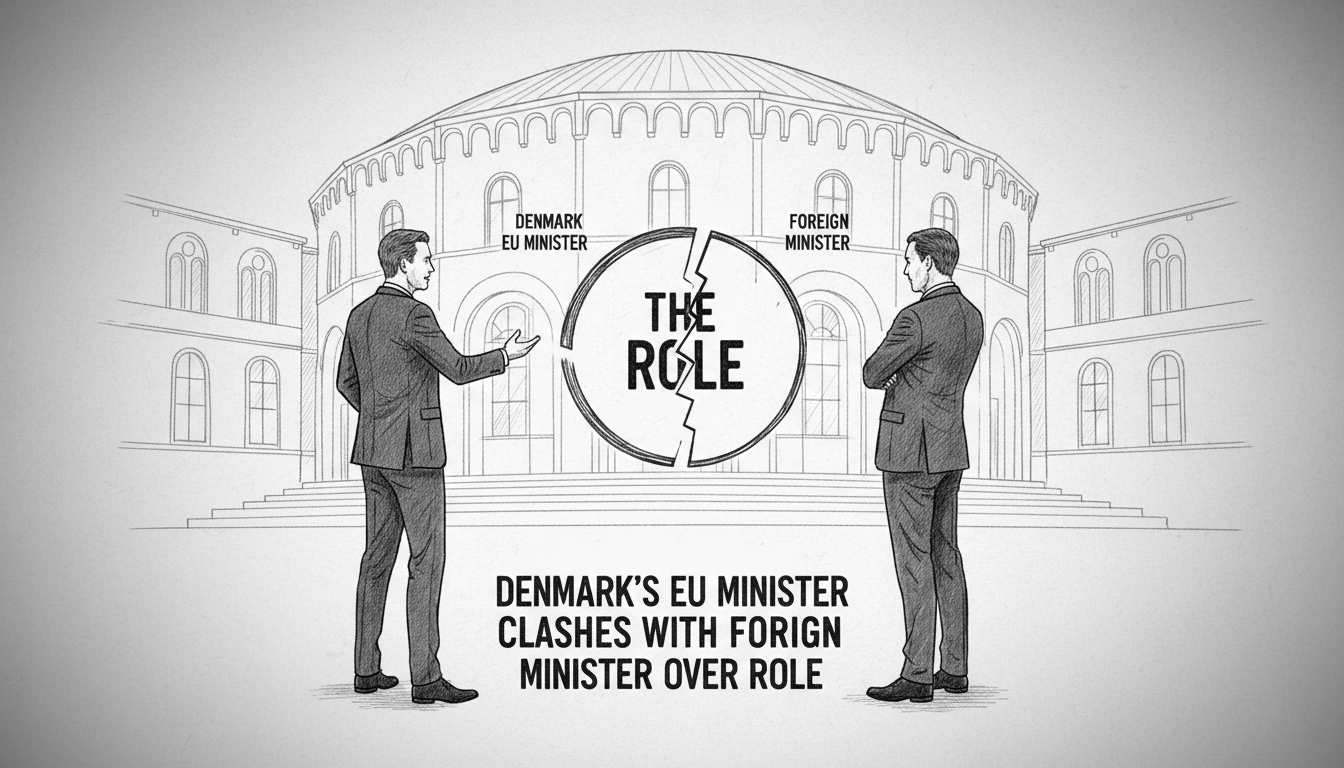
Denmark's Europaminister Marie Bjerre has publicly corrected Foreign Minister Lars Løkke Rasmussen over the nature of her role, rejecting his characterization that her job is to 'aflaste' or relieve him. The disagreement emerged after Rasmussen suggested Bjerre's position, created to handle Denmark's recently concluded EU Council presidency, included lightening his workload. Bjerre firmly countered this narrative, emphasizing her post is a permanent and independent part of Denmark's EU strategy, not a temporary support role for the foreign ministry.
This public clarification exposes underlying tensions about the structure of Danish foreign policy and the weight given to European affairs within the government. It raises questions about whether the Europaminister position will survive beyond the current administration or be dissolved as it was after the 2012 presidency. The dispute is not merely about semantics but about institutional power and the long-term vision for Denmark's engagement with Brussels.
A Public Correction Over a Key Word
The conflict centers on the Danish word 'aflastning,' which translates to relief or easing of a burden. When asked about Europaminister Marie Bjerre's duties now that Denmark's EU presidency has ended, Foreign Minister Lars Løkke Rasmussen stated her tasks included participating in the General Affairs Council (GAC). 'There is, of course, also a relief element to it,' Rasmussen said. 'I myself participated in these general meetings in the first couple of years as foreign minister.' He noted that few foreign ministers regularly attend these preparatory meetings.
Bjerre responded directly to this framing hours later. 'It is because it is not a relief task, because that is wrong. And in that way, I take issue with what was said,' she stated. 'I am not to relieve Lars Løkke. That has not been the task at any point.' She stressed that her role was communicated as permanent from its creation a year and a half ago, driven by the growing importance of EU policy for Denmark. Her insistence seeks to establish the role's legitimacy and separate mandate from the traditional foreign ministry hierarchy.
The Battle for a Permanent EU Voice
The heart of the disagreement is the future of the Europaminister post itself. Denmark last created a similar role during its 2012 EU presidency, only to abolish it after the 2015 election. Bjerre is now fighting to prevent history from repeating. 'We have always said it was a permanent post,' she argued, pointing to the expanded scope of EU influence over domestic Danish policy in areas from climate to digital regulation. Her portfolio is intended to ensure dedicated, high-level focus on EU negotiations that directly impact Danish society and the welfare system.
Experts see this as a classic struggle between established institutions and new political creations. The Foreign Ministry, led by Rasmussen, has traditionally held the lead on all external affairs, including EU relations. The creation of a separate minister with a specific EU mandate can be perceived as diluting that authority. Rasmussen's 'aflastning' comment can be interpreted as an attempt to frame the new role as an administrative helper within his domain, rather than an autonomous actor. Bjerre's rejection is a claim for equal standing and a distinct political voice on the European stage.
The Practical Work of EU Coordination
Beyond the political sparring, the role involves concrete responsibilities. The General Affairs Council (GAC) that Bjerre attends is a crucial EU body. It prepares the agendas for meetings of the European Council, where EU heads of state make major decisions. It also works to coordinate complex policy files across different ministerial councils. By taking this seat, Bjerre ensures Denmark has a dedicated representative in the room for detailed negotiations that set the stage for summit outcomes.
This is more than a technicality. Having a minister focused solely on EU affairs allows for deeper specialization and continuous engagement with Brussels machinery, which operates on its own complex timeline separate from Danish domestic politics. For a country like Denmark, which has multiple opt-outs from EU treaties, this nuanced and constant attention is critical. It allows for proactive shaping of proposals rather than reactive responses, protecting national interests in areas like justice and home affairs where Denmark does not participate fully.
A Question for the Next Government
The ultimate fate of the Europaminister position rests with the next government formed after the coming election. Bjerre, a member of Venstre, has stated her clear desire for the post to continue. Whether it does will be a signal of Denmark's future EU priorities. Maintaining the role would indicate a commitment to treating the EU as a top-tier, standalone policy area requiring dedicated ministerial attention. Abolishing it would suggest a return to a more traditional model where EU affairs are subsumed into the broader foreign policy agenda.
This decision carries symbolic and practical weight. Domestically, it signals to voters and the business community how seriously the government takes the EU relationship. In Brussels, a permanent Europaminister gives Denmark a consistent, recognizable point of contact, potentially increasing its influence. The current public disagreement between Bjerre and Rasmussen may actually strengthen the case for permanence by highlighting that EU affairs generate enough substantive work and political importance to warrant its own dedicated minister, separate from the foreign policy portfolio.
The Personal and Political Dimensions
The dynamic between Bjerre and Rasmussen adds a personal layer to the institutional debate. Rasmussen is a former Prime Minister and a seasoned political operator leading the Moderaterne party. Bjerre is a younger minister from the larger Venstre party, asserting her authority in a significant portfolio. Their exchange reflects the ongoing power negotiations within the multi-party coalition government. By publicly defining her own role, Bjerre is establishing her political territory and autonomy within the cabinet.
This is not just about one job description. It is about how a small but influential Nordic nation organizes itself to wield power in a vast multinational union. Denmark's social policy, environmental standards, and economic regulations are increasingly shaped in Brussels. The question is whether managing that influence is a subset of foreign policy or a core function of domestic governance. Bjerre's argument frames it as the latter, suggesting the lines between 'foreign' and 'domestic' policy have blurred irreversibly due to European integration. Her fight to keep her job is a fight for a specific vision of Danish sovereignty in the 21st century—one that engages deeply with the EU through a specialized, permanent voice at the cabinet table.
As Denmark's EU presidency passes to Cyprus, the nation faces a choice. Will it dismantle the specialized structure it built for a six-month leadership term, or will it institutionalize that focus for the long term? The public disagreement between two senior ministers reveals that the answer is still contested. The outcome will determine not just who sits in which meeting in Brussels, but how Denmark prioritizes and projects its interests in an ever-closer European Union. The debate over a single word—'aflastning'—has opened a window into a much larger conversation about Danish power and identity in Europe.