
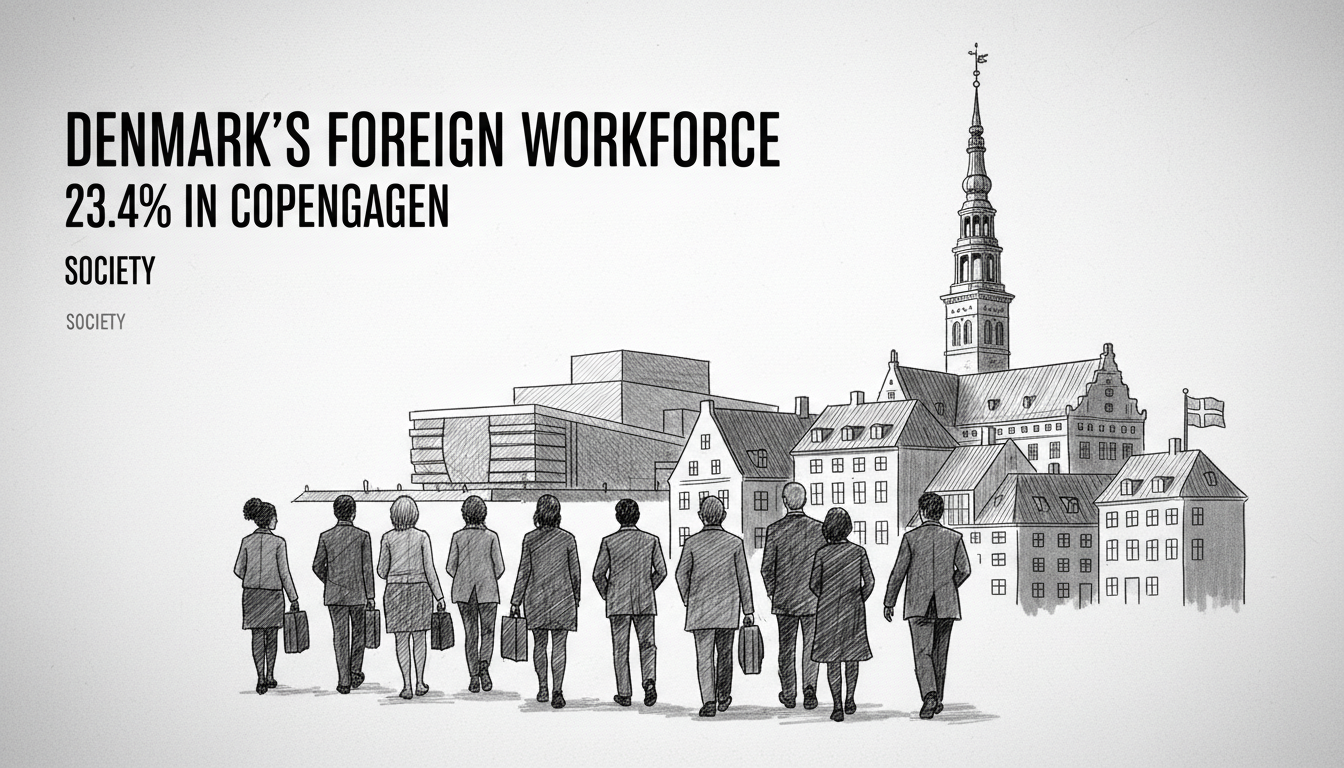
Denmark's capital region now relies on foreign workers for nearly a quarter of its labor force, a transformation reshaping the nation's economy and social fabric. The proportion of foreign wage earners in the Copenhagen area has more than doubled since 2008, climbing from 10.5% to 23.4% in 2025, according to new analysis. This shift means that out of approximately 932,000 wage earners in the metropolitan area, around 233,000 are foreign nationals. The data reveals a stark geographic divide: while Copenhagen's service sector is powered by international talent, the rest of Denmark depends on foreign labor in agriculture, industry, and construction.
The Engine of Copenhagen's Growth
Foreign workers have been the primary driver of job creation in the capital for nearly two decades. Since 2008, they have accounted for a staggering 70% of all job growth in the Copenhagen area. This statistic underscores a critical reality: the sustained economic expansion of Denmark's premier business hub would not have been possible without this influx of international labor. The concentration is particularly acute in specific sectors. More than half of all foreign employees in Copenhagen work in trade, transport, hotels, restaurants, and business services—the backbone of the city's service-oriented economy.
"We are looking at a fundamental restructuring of the Copenhagen labor market," said Karen Mikkelsen, a labor economist at the Copenhagen Business School. "The numbers tell a clear story. Domestic birth rates are not supplying enough new workers, and Danes are increasingly educated for different types of jobs. The hospitality, logistics, and many business service roles are being filled by a willing and able international workforce. This isn't a temporary trend; it's the new operational model for a global city."
The figures highlight Copenhagen's evolution into a truly international metropolis, akin to London or Amsterdam. The Øresund region, with its cross-border flow of talent between Denmark and Sweden, acts as a further catalyst. Companies in districts like Ørestad, Nordhavn, and the traditional city center now build their staffing models with an expectation of accessing this international pool.
A Nation of Two Labor Markets
While Copenhagen's story is one of service-sector integration, the pattern across the rest of Denmark follows a different, yet equally dependent, path. Outside the capital, foreign labor is heavily concentrated in agriculture, industry, and construction. These sectors, often located in rural areas or smaller cities, face acute demographic challenges and have long relied on seasonal and permanent workers from other EU countries and beyond.
A pork processing plant in Jutland or a greenhouse in Funen is now just as likely to be staffed by Polish, Romanian, or Ukrainian workers as by Danes. This division of labor creates two parallel narratives about foreign workers in Denmark: one of cosmopolitan career professionals in Copenhagen, and another of essential, often physically demanding, work that supports Denmark's export-heavy primary and secondary industries.
"We must avoid creating a simplistic narrative," cautioned Henrik Sørensen, a policy analyst at the Danish Confederation of Trade Unions (FH). "The foreign engineer at a clean-tech startup in Copenhagen and the foreign machine operator at a dairy plant in West Jutland are both vital. But their experiences, career trajectories, and integration challenges can be worlds apart. Policy needs to address the full spectrum, from ensuring fair wages and conditions in slaughterhouses to helping highly skilled immigrants navigate the housing market and professional networks in the city."
Economic Imperative vs. Social Integration
The rising numbers bring undeniable economic benefits but also fuel ongoing political and social debates. Economists point to the clear advantage: foreign labor fills gaps, supports growth, and allows Danish companies to scale operations they otherwise could not. It keeps sectors competitive and mitigates the pressures of an aging native population.
However, the rapid change prompts questions about community cohesion, wage pressure, and the capacity of public services. Some argue that a heavy reliance on foreign labor can disincentivize investment in automation or the upskilling of the domestic workforce. Others focus on the risk of creating a two-tier labor market if integration efforts fail.
"The economic case is robust, but it cannot be the only consideration," said Immigration Minister Kaare Dybvad in a recent parliamentary debate. "Our task is to manage this development intelligently. That means having rules that attract the skills we need, firm enforcement against social dumping to protect all workers, and a much stronger focus on successful integration—including Danish language learning—from day one. The goal is inclusion, not just filling jobs."
The government's "Fair Work and Tight Rules" strategy aims to address these tensions, combining stricter controls on work permit compliance with initiatives to improve integration. The balance is delicate: making Denmark attractive for needed talent while maintaining public trust in the system.
The Future of Work in Denmark
Looking ahead, all indicators suggest foreign labor's role will continue to expand. Demographic projections show a shrinking native working-age population, while key growth sectors like technology, life sciences, and the green transition increasingly compete for global talent. The challenge for Denmark is to systematize what has so far been an organic, market-driven process.
Business leaders argue for smoother administrative procedures. "To win the race for talent, especially in STEM fields, we need to be faster and more welcoming," said Thomas Hofman-Bang, CEO of the Danish Chamber of Commerce. "The time from job offer to work permit and CPR number is a critical metric. Our competitors in Sweden, Germany, and the Netherlands are constantly improving their systems. Copenhagen's success as a business hub depends on it."
Simultaneously, there is a push to better align foreign worker recruitment with long-term national interests. This includes not only high-skilled roles but also a structured approach to sectors with persistent shortages, potentially through expanded bilateral agreements.
The transformation of the Danish workforce is irreversible. The figure of 23.4% in Copenhagen is less an endpoint and more a milestone on a continuing journey. How Denmark navigates the next phase—harnessing economic opportunity while fostering social unity—will define the country's competitiveness and character for decades to come. The question is no longer if foreign workers are needed, but how Denmark can build a sustainable model that works for everyone who calls it home.