
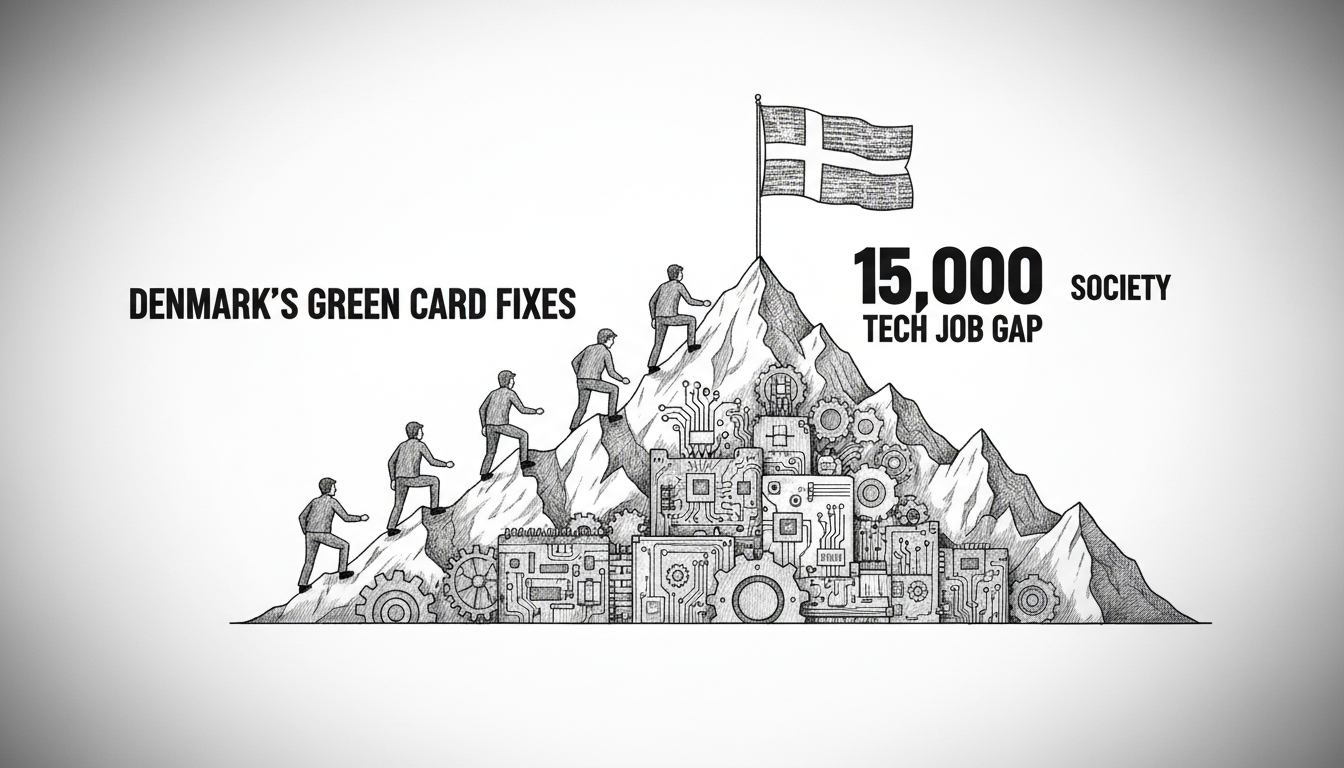
Denmark's Green Card Scheme offers a direct immigration path for skilled non-EU professionals as companies like Novo Nordisk and Ørsted urgently need an estimated 15,000 more engineers. This points-based Denmark work permit bypasses the need for prior employer sponsorship, representing a strategic tool in the nation's bid to maintain its competitive edge in green tech and pharmaceuticals amid a tightening global race for talent. The policy reflects a calculated move to address demographic pressures and sector-specific shortages that could stifle growth in Copenhagen’s Nordhavn district and beyond.
A Points-Based Gateway to Copenhagen
At its core, the Denmark Green Card functions as a meritocratic filter. Applicants must secure a minimum of 100 points across categories measuring education, language skills, work experience, and adaptability. A master’s degree grants 60 points, a PhD adds 30, while proven proficiency in Danish nets another 20. Work experience in fields on the national shortage list, which is dominated by IT, engineering, and life sciences, contributes 15 points. The system is transparent but demanding, designed to select individuals likely to integrate and contribute quickly. “It’s a self-selection mechanism for high-potential candidates,” notes a Copenhagen-based immigration lawyer. “The government is essentially pre-approving talent and letting the market do the rest.”
The Economic Imperative Behind the Policy
The scheme is not an act of charity but a response to acute economic pressure. Denmark's population is aging, and domestic graduation rates in STEM fields are insufficient to fuel the ambitions of its corporate champions. Wind giant Ørsted is scaling global projects, pharmaceutical leader Novo Nordisk is expanding production to meet overwhelming demand for its weight-loss drugs, and the broader tech hub in Copenhagen’s Inner Østerbro and Islands Brygge areas is hungry for software developers. This labor deficit poses a direct threat to GDP growth and export revenues. The Green Card, therefore, is a plug for this leak. It allows companies to tap into a global pool without navigating the more protracted and employer-bound Pay Limit Scheme. For the applicant, it offers a rare commodity in European immigration: flexibility. Holders can work for any employer, change jobs, or even start a business from day one of their residency.
Navigating Costs, Timelines, and Market Realities
The opportunity comes with clear financial and procedural requirements. The application fee is 6,500 DKK (approximately 870 EUR), and the critical hurdle is proving financial self-sufficiency. A single applicant must show access to roughly 150,000 DKK (about 20,100 EUR) to support themselves initially. Processing by the Danish Agency for International Recruitment and Integration (SIRI) typically takes three to four months. Once granted, the permit is valid for three years, renewable for up to four more, setting a path to permanent residency after eight years. However, securing the card is only the first step. “The Green Card gets you in the door, but it doesn’t guarantee a job,” says a career advisor at International House Copenhagen. “The Danish labor market values specialization, Danish language skills, and network.”
| Consideration | Detail |
|---|---|
| Application Cost | 6,500 DKK |
| Proof of Funds | 150,000 DKK for single applicant |
| Initial Permit Validity | 3 years |
| Typical Processing Time | 3-4 months |
| Key Target Sectors | IT, Engineering, Life Sciences |
From Permit to Paycheck: Integration is Key
Experts consistently emphasize that successful long-term settlement depends on proactive integration. This means engaging with the job market on platforms like Jobindex.dk while building a localized LinkedIn profile. It involves preparing for the case-study interviews favored by Danish firms like Maersk and Vestas. Financially, newcomers should expect living costs in Copenhagen to be high and salaries to reflect that. Monthly gross salaries for tech roles can range from 45,000 DKK for juniors to over 80,000 DKK for senior engineers. While the Green Card itself has no salary threshold, demonstrating sustainable employment is crucial for renewal. Learning Danish, even at a basic level through municipal language schools (Sprogcentre), is repeatedly cited as the single most important factor for improving job prospects and social cohesion. “It signals commitment,” one HR director at a clean-tech firm commented. “We value that immensely.”
A Strategic Choice in a Competitive Landscape
Denmark's scheme sits within a broader, fiercely competitive European landscape vying for the same skilled professionals. Compared to the Netherlands’ highly skilled migrant permit or Germany’s Chancenkarte, the Danish model’s lack of employer sponsorship requirement is its unique selling point. However, this also places more initial risk and responsibility on the immigrant. The scheme’s future is also subject to political winds; intake numbers and point requirements can shift based on prevailing labor market needs and coalition agreements. For now, it remains a strategic, if underutilized, channel. For Denmark, it represents a bet that attracting self-sufficient, highly educated individuals will yield long-term economic dividends and innovation. For the skilled professional, it offers a controlled yet direct route into one of the world’s most productive and balanced economies. The ultimate question is whether enough global talent will choose the Danish path over other destinations, and whether those who do can bridge the 15,000-person gap that makes this scheme so vital to Copenhagen's boardrooms.