
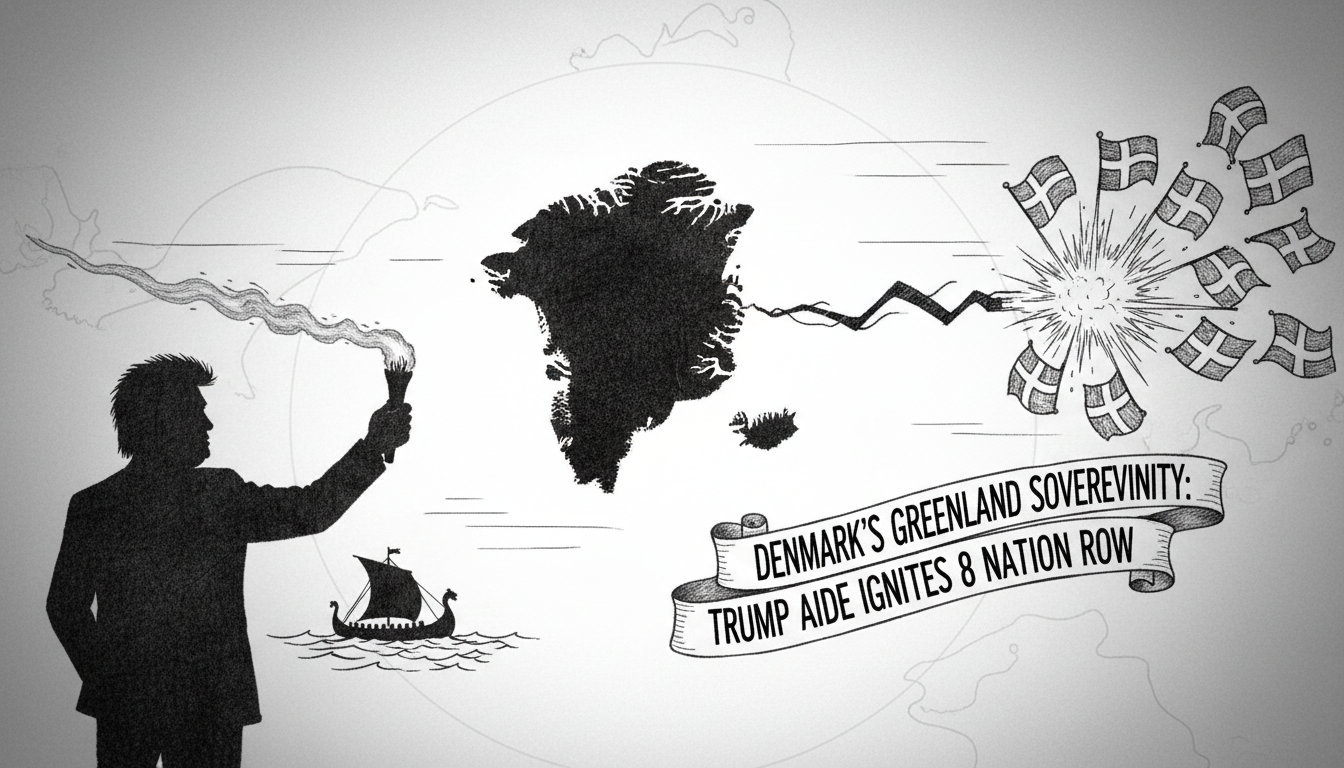
Denmark's sovereignty over Greenland faces a political challenge from an unexpected source: the campaign of former US President Donald Trump. A senior Trump aide recently asserted that the vast Arctic territory belongs to the United States, sparking formal outrage from leaders of eight European nations. This statement directly questions Denmark's constitutional authority over the world's largest island, a claim that has remained settled in international law for over a century. The incident reveals how foreign policy can become entangled in domestic electoral politics overseas, forcing Copenhagen into a defensive diplomatic posture. As a reporter covering Danish society and integration, I see this as more than a geopolitical spat. It touches on core questions of national identity and the complex, post-colonial relationship between Denmark and Greenland itself.
A Sovereignty Claim from the Campaign Trail
The assertion came not from an official government communiqué but from a Trump campaign advisor speaking to European media. The aide reportedly framed the potential acquisition of Greenland as a matter of US national and economic security, echoing sentiments Trump himself voiced while in office. In 2019, Trump's confirmed interest in purchasing Greenland was met with a swift and definitive rejection from the Danish government, which labeled the idea "absurd." The re-emergence of this theme, framed now as an issue of rightful ownership rather than a purchase, escalates the rhetoric significantly. It moves the discussion from a transactional proposal to a fundamental challenge of territorial integrity.
This campaign-trail rhetoric provoked an immediate and unified response from European capitals. Diplomats from eight EU member states, including traditional Danish allies, conveyed their astonishment and firm support for Danish sovereignty. Such a collective, rapid response to a non-state actor's comment is unusual. It underscores the level of alarm in European diplomatic circles about the potential return of an administration that views international borders as negotiable. For Denmark, a nation that often punches above its weight in foreign policy through alliance-building, this support is crucial but also highlights its vulnerability.
Greenland's Perspective: Autonomy, Not Transfer
Any discussion about Greenland's status is incomplete without hearing from the 56,000 people who call it home. Greenland is a self-governing territory within the Kingdom of Denmark. It gained home rule in 1979 and self-government in 2009, controlling most of its own affairs. Denmark retains authority over foreign, security, and financial policy, but the path to full independence is legally open. The real political conversation in Nuuk, Greenland's capital, revolves around managing this relationship and achieving economic self-sufficiency, not a transfer to another power.
"The future of Greenland will be decided in Greenland, by the people of Greenland," a representative from a major Greenlandic political party told me, echoing a near-universal sentiment in local politics. The recent controversy is seen by many there as a distant debate between external powers, one that treats their homeland as a commodity or a strategic asset rather than a nation-in-the-making. This incident may well fuel further discussions in Greenland about accelerating the path to full sovereignty, simply to control its own destiny more completely.
Danish Society's Reaction: Bafflement and Resolve
Within Danish society, the reaction has blended bafflement with firm resolve. For most Danes, Greenland's status is not a topic of daily debate but a settled constitutional fact taught in schools. The idea that it could be claimed by another country feels both archaic and deeply offensive. It strikes at the heart of the modern Danish state's identity, which is intertwined with its status as a Greenlandic and Faroese nation as much as a European one.
Social policy and integration experts I speak with note an interesting paradox. Denmark fiercely protects its own sovereignty and cultural cohesion, principles that guide its often-debated immigration policies. This event forces the country to look outward, defending the right to self-determination of the Greenlandic people within its kingdom. It is a reminder that sovereignty and integration are two-sided concepts, applicable both within a nation's borders and in its external relationships. The incident has, temporarily, united the Danish political spectrum, from left to right, in a rare show of absolute consensus on a foreign policy matter.
The Broader European and Arctic Context
The European solidarity shown towards Denmark is about more than just bilateral friendship. It is a defense of the post-war international order where borders are not changed by force or fanciful claim. Eastern European nations, in particular, are sensitive to any rhetoric that normalizes territorial claims against sovereign states. Furthermore, the Arctic is becoming an increasingly contested region due to climate change opening new shipping routes and access to resources. Russia and China are expanding their interests there, and the US views the area as a strategic priority.
In this context, stable, predictable governance in Greenland is seen as vital by NATO allies. Denmark, as a NATO member governing Greenland, is considered a reliable steward. Unsettling this arrangement with volatile claims introduces unnecessary risk into a already delicate strategic environment. The Danish military's recent increased investments in Arctic capabilities and the opening of the Danish Arctic Command underscore the region's growing importance to national security policy.
Looking Ahead: Diplomacy in an Unpredictable Era
For the Danish Ministry of Foreign Affairs, the episode is a stark lesson in 21st-century diplomacy. They must now engage with the possibility that a major ally's future administration might fundamentally question a pillar of the Danish state. This requires careful, quiet diplomacy with both US political parties and sustained reinforcement of the legal and historical facts for the international community. It also means deepening the partnership with Greenland's government, ensuring that the path forward is charted cooperatively from Nuuk and Copenhagen, not dictated from outside.
The ultimate impact may be a subtle but significant shift in Denmark's foreign policy posture. The country may seek to embed its Arctic interests even more deeply within NATO and EU frameworks, creating multilayered defenses for its sovereignty. It may also accelerate efforts to finalize maritime border delimitations and economic agreements in the region, further solidifying the legal architecture around its position. For a small kingdom, the rule of law and strong alliances are not just ideals; they are existential necessities.
As the world watches the US electoral process, Denmark finds itself in an uncomfortable position. Its national integrity has become a talking point in a foreign political campaign. The firm response from Copenhagen and its European partners was necessary and correct. Yet, the event leaves a lingering question: in an era where populist narratives can challenge settled international facts overnight, how does a nation built on consensus and law defend what it has always assumed was secure? The answer lies not in outrage, but in the relentless, quiet work of diplomacy and the unwavering commitment to the partnerships, both within the Kingdom and beyond, that truly define its strength.