
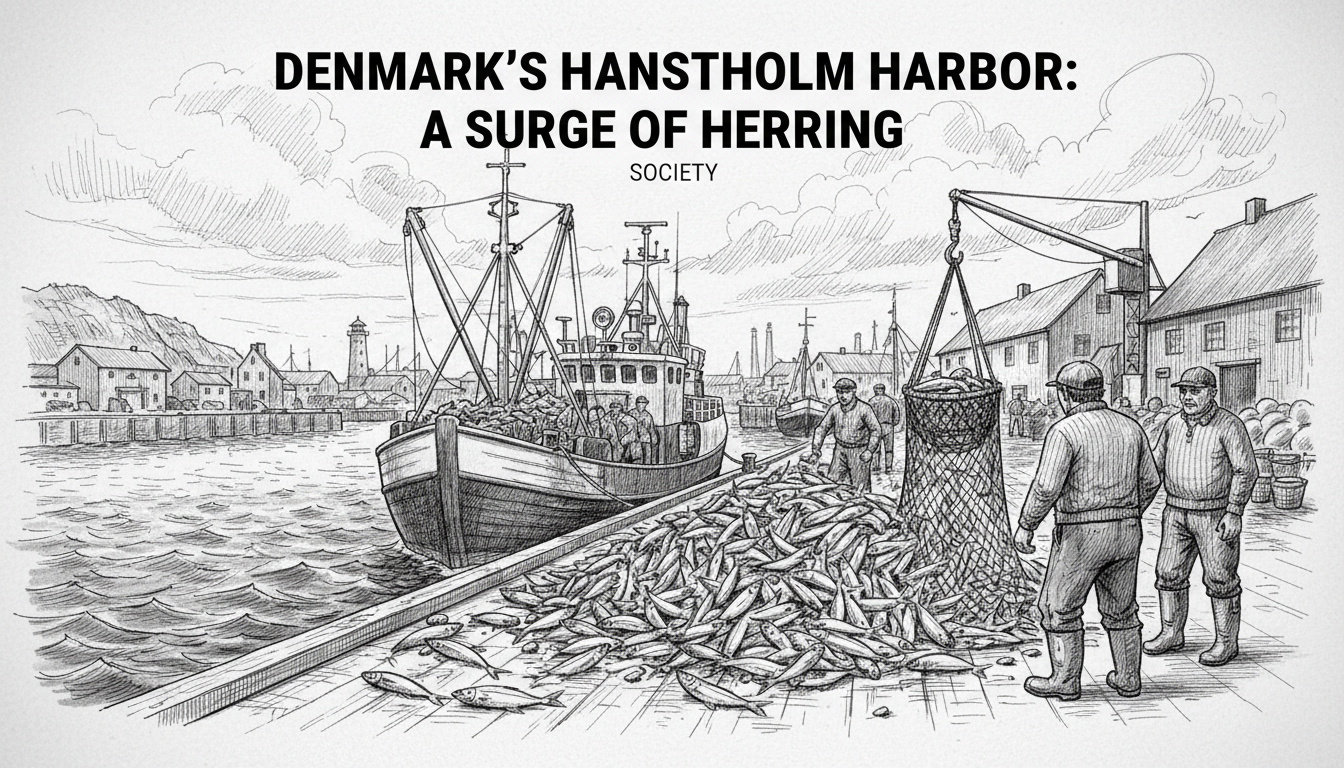
Hanstholm Harbor, a cornerstone of Danish fishing, is experiencing an unprecedented event that has veteran anglers in awe. The North Sea port's inner basins are now teeming with thousands of herring, or sild, creating a spectacle not seen in generations of local memory. This sudden abundance is reshaping weekend routines and sparking theories about its link to major harbor expansion works. For families like the Iversens, it has become a chance to connect over a shared passion, casting lines where industrial trawlers usually dominate.
A Fisherman’s Lifetime, Rewritten
Morten Iversen has cast his line into these waters since he was a boy, learning every contour of Denmark's most important fishing harbor. "I have fished in the harbor since I was a child, and I have never experienced it before," Iversen states, his disbelief palpable. The scale of the herring influx has surprised even the most experienced local anglers, transforming the working port into a vibrant hub for recreational fishing. For Iversen, the phenomenon carries a personal significance that extends beyond the catch.
His 15-year-old daughter, Lina, now joins him regularly. She has grown up with fishing as a family tradition, a thread woven into their daily lives. "I love it. It's just something we have together," Lina says of their trips. For Morten, this shared time represents a success deeper than any haul. Passing on this connection to the sea and the simple joy of the catch is a profound point of pride, a personal victory in a rapidly changing world.
A Theory Forged by Experience
While marine biologists might cite factors like water temperature, currents, or baitfish movements, Morten Iversen has his own hypothesis. He points directly to the harbor's recent and significant physical expansion. The project extended and realigned the outer breakwaters, a major infrastructure effort to accommodate larger commercial vessels.
Iversen theorizes these new structures now act like a giant funnel, subtly altering currents and guiding schools of herring into the sheltered inner basins. "It is, at least, my theory," he says, drawing on decades of observation. His perspective highlights how major construction can have unintended ecological consequences, creating new habitats where industry and nature unexpectedly intersect.
The All-Access Angling Event
The herring run has democratized fishing in Hanstholm. Herring are plentiful, easy to catch, and require minimal specialist gear, making the activity highly accessible. "If you can cast a fishing rod without tangling the line, it is an opportunity for everyone," Iversen explains. He emphasizes it is a safe, family-friendly activity happening within the harbor's protected walls, away from the dangerous waves of the outer moles.
This has drawn enthusiasts from across the region, creating a temporary but vibrant community at the water's edge. The event underlines how public infrastructure, even when designed for heavy industry, can serve broader social and recreational purposes. It brings a touch of communal celebration to a town whose identity is fundamentally linked to the sea.
More Than Just Fish: Community and Economy
The surge in anglers provides a subtle economic ripple for local businesses selling bait, tackle, and snacks. More importantly, it reinforces a cultural cornerstone. In towns like Hanstholm, fishing is not just an industry; it is a heritage. Events like this strengthen the bond between the community and its maritime environment, engaging a new generation.
Lina Iversen represents that generation. Her participation ensures these traditions and this specific local knowledge are not lost. The sight of families fishing together in a major commercial port is a powerful image of continuity. It shows how industrial and recreational uses of the sea can coexist, even flourish, side by side.
Expert Perspective on Harbor Impacts
While Morten Iversen's theory is born of local wisdom, marine ecologists would examine the mechanistic links. Large-scale harbor modifications invariably change local hydrodynamics—the flow of water and sediments. New breakwaters can create calmer, shadow zones where plankton, the herring's food source, may concentrate.
They can also alter predator-prey dynamics, making the basins a temporary refuge. "Infrastructure projects of this scale are ecosystems in themselves," a fisheries expert might note, requesting anonymity as they were not part of the official study. "The new structures create novel habitats. It is entirely plausible they are influencing fish behavior and distribution in ways that were not the primary engineering goal."
This aligns with global observations where artificial structures, from piers to offshore wind farms, often attract marine life. The Hanstholm event is a visible, concentrated example of this effect. It raises interesting questions for port planners and ecologists about designing with multiple purposes in mind, balancing economic output with ecological and social value.
A Look at Sustainability and Regulation
The joyful frenzy does not occur in a regulatory vacuum. There is no closed season for herring in Denmark, but minimum size limits are enforced: 20 centimeters in the North Sea and 18 centimeters in the Skagerrak and Kattegat. Furthermore, all recreational anglers over 18 must possess a valid national fishing license, the statens lystfiskertegn, with funds directed toward fishery management and conservation.
The North Sea herring stock is currently considered healthy and well-managed through international quotas. This sustainable status is what allows for such abundant recreational fishing moments. It serves as a real-time lesson for participants on the importance of sound fisheries management. The healthy population visible in Hanstholm is a direct result of international cooperation and science-based quota setting.
The Lasting Ripple Effect
As suddenly as the herring arrived, they will likely depart, following their ancient migratory patterns. The memory of this season, however, will linger in Hanstholm. For Morten Iversen, it has already gifted irreplaceable hours with his daughter, strengthening a family bond forged by saltwater and shared focus. For the community, it was a reminder of the sea's capacity for surprise and generosity.
The event also offers a case study. It demonstrates how multi-million dollar industrial development can have positive, if unplanned, spillover effects for civic life and local ecology. It proves that even in a landscape dominated by large-scale commerce, there is room for simple, personal joy. The question now hanging in the salty air is not just when the herring will return, but how future development can consciously preserve space for these unexpected moments of connection between people and the natural world.