
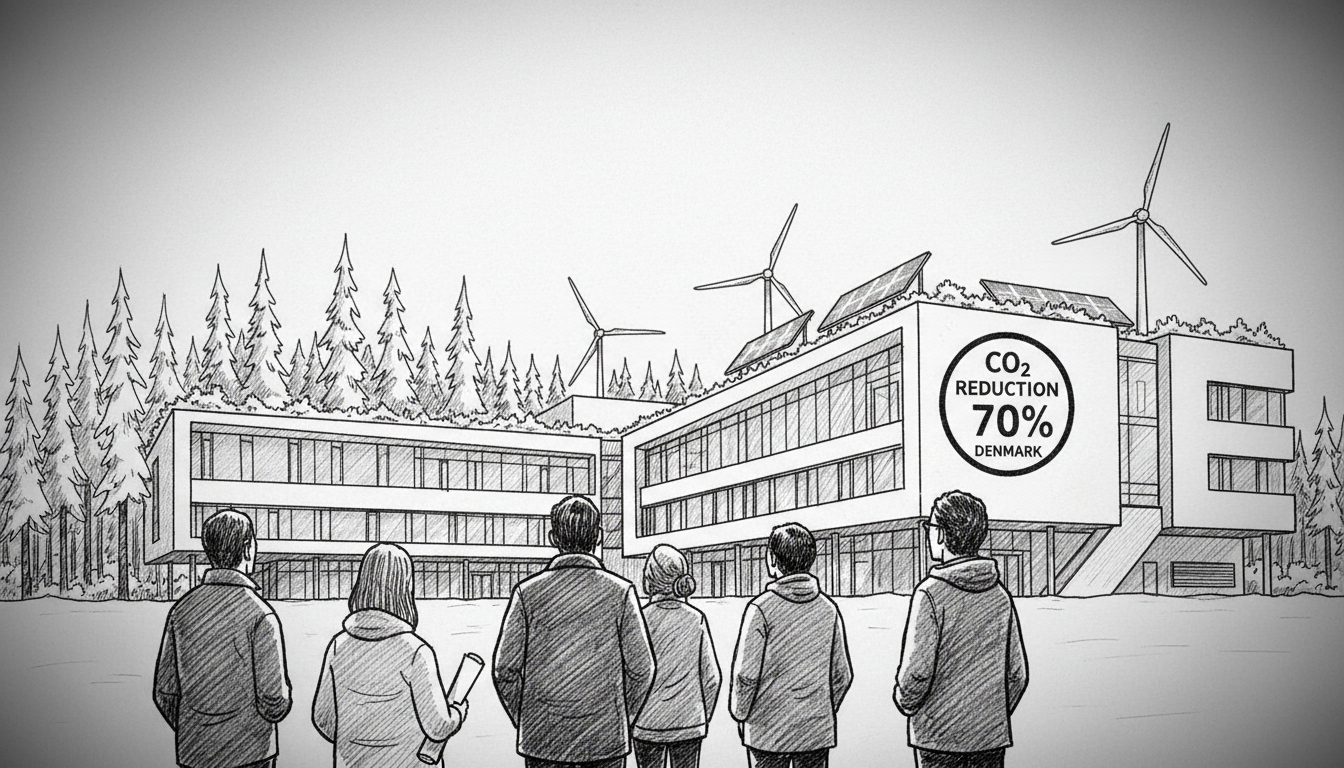
Denmark's newest public building weaves bird nests and bee hotels directly into its brick facade. The Fælleshuset education center at Copenhagen's historic Bispebjerg Hospital is a physical statement of the country's aggressive climate goals. Its large circular windows peer out from walls made of recycled stone, designed to house starlings, swifts, and solitary bees. This project represents a tangible shift in Danish construction, where sustainability is measured in both carbon savings and biodiversity gains.
A Building That Breathes
Walking around Fælleshuset, the integration with nature is immediate and deliberate. The thin outer shell wall is not just a barrier but a habitat. Specially designed cavities and recesses provide safe nesting spaces for urban bird populations, which have faced declining habitats across Danish cities. Native climbing plants are intended to eventually scale sections of the recycled-brick exterior. This approach moves beyond simply reducing harm to actively regenerating local ecosystems. It turns the building's surface into a living, breathing component of the Copenhagen cityscape.
Architects point to this as the new standard for state-funded projects. “We are moving from an era of efficiency to one of ecological contribution,” said a lead architect involved in the project, speaking on the broader trend. The design directly supports Denmark's biodiversity strategy, which calls for integrating natural elements into urban planning. Municipalities across the country are now encouraged to include such features in public tenders.
Bricks with a Past
The commitment is visible in the very materials. Using recycled bricks represents a significant CO2 saving compared to manufacturing new ones. This choice reflects a core principle of Denmark's circular economy ambitions: extending the lifecycle of construction materials. Each repurposed brick carries a history, linking the new education center to the architectural heritage of the region while minimizing its carbon footprint. The project team conducted thorough life-cycle assessments to quantify this benefit.
This material strategy is not merely aesthetic. It is a calculated environmental decision. The production of new building materials is a major source of global carbon emissions. By prioritizing recycled content, Fælleshuset reduces its embodied carbon—the total emissions from manufacturing, transportation, and construction. This focus on the entire supply chain is central for Denmark to meet its target of a 70% reduction in greenhouse gas emissions by 2030.
Denmark's Green Building Ambition
Fælleshuset sits within a broader national framework. Denmark’s climate law mandates the 70% reduction target, making sustainable construction non-negotiable for public works. The building serves as a pilot for techniques that may become mandatory. Its features offer a blueprint for how hospitals, schools, and other public institutions can fulfill their functional roles while acting as sanctuaries for urban wildlife. Copenhagen’s municipality has several similar projects in development, aiming to set a benchmark for other cities.
Experts in urban planning see this as an essential evolution. “The cities of the future must be biophilic,” noted a sustainability researcher at a Danish university. “They must satisfy human needs and support other species. A building like this demonstrates it’s possible without sacrificing modern design or utility.” The Danish Society for Nature Conservation has praised the project, highlighting how it makes biodiversity a visible, celebrated part of daily life.
The Human and Policy Impact
For the staff and students who will use Fælleshuset, the environment is designed to be inherently educational. The building itself is a teaching tool about resource cycles and coexistence. This aligns with Denmark's social policy model, which emphasizes public institutions as drivers of positive societal change. The welfare system is now being evaluated through an environmental lens, asking how hospitals and schools can contribute to planetary health.
Integration in Danish society often focuses on social and economic dimensions. Projects like this introduce a third pillar: ecological belonging. Community centers and social housing projects are next in line to adopt these principles. The knowledge gained here will inform guidelines for green roofs, rainwater management, and native planting in dense urban areas across the country. It’s a practical example of policy made visible in brick and mortar.
A Model for the Future
The true test will be scalability. Can the methods used at a flagship hospital project in Copenhagen be applied to a renovation in Aarhus or a new library in Odense? The involved architects believe so, stating the techniques are transferable. The challenge lies in shifting industry standards and municipal procurement rules to favor recycled materials and integrated biodiversity as default options, not premium add-ons.
Fælleshuset is more than an education center. It is a declaration that Danish building practices are undergoing a profound change. It answers the national climate goals with physical form, showing that sustainability can be woven into the fabric of our cities. As Denmark pushes toward its 2030 target, each new public building will be scrutinized not just for its function, but for its contribution to the ecosystem it occupies. This project raises a compelling question for planners worldwide: Can our buildings give back more than they take?