
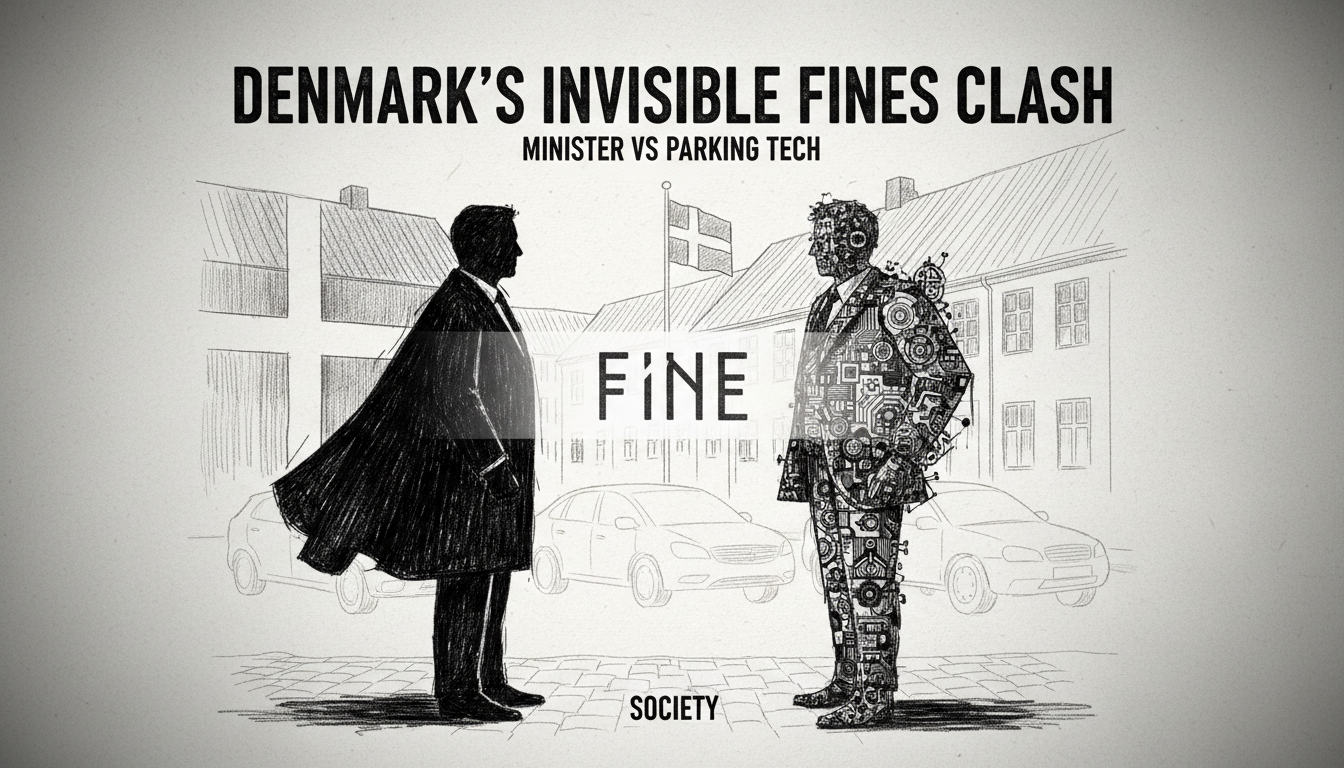
Denmark's parking fine debate ignited this year as drivers reported thousands of invisible tickets arriving by mail without physical notice. Transport Minister Thomas Danielsen is now locked in a war of words with digital parking companies, promising to make their operations "virtually impossible" and raising fundamental questions about technology, regulation, and consumer fairness in Danish society news.
For companies like OPARKO, founded by Kasper Daae, the minister’s crusade threatens to undo a modern camera-based system. They argue it will force a costly and inefficient return to traditional parking attendants. The Danish welfare system is often praised for its social trust, but this conflict reveals a fault line where private enterprise and public oversight collide, testing the rules of Denmark's social contract.
A Modern Parking Clash
At the heart of the issue is a technical loophole. Private parking firms have legal access to a closed vehicle registry at the national Motorstyrelsen to issue traditional fines. However, firms increasingly use this access to send initial fee notices and administrative charges directly to car owners, bypassing the windscreen ticket. The Danish interest organization for motorists, FDM, calls this a creative interpretation of the rules.
Transport Minister Thomas Danielsen sees it as an illegal use. He opened a direct email hotline for complaints and pledged a crackdown. The minister’s recent statement was unequivocal. He aims to eliminate the practice of sending charges without prior agreement or a physical notice on the car. This policy shift, framed as consumer protection, directly challenges the business model of fully digital operators.
The Camera Company's Defense
Kasper Daae, the founder of OPARKO, argues the minister misunderstands the market. His company operates solely with automatic license plate recognition cameras, eliminating the need for roaming attendants. This model, he contends, reduces operational costs—a saving potentially passed to consumers through lower parking rates. By outlawing the digital-first approach, Daae warns the minister will degrade the final product for the ordinary driver.
One could flip the argument and say the transport minister is making it unnecessarily difficult to offer parking," Daae told Jyllands-Posten. He added the focus should be on the end-user who will face a poorer service. His stance highlights a recurring tension in Denmark immigration policy and business regulation: how to integrate new technological efficiencies while maintaining established protections and transparency.
Consumer Trust and Legal Grey Zones
The debate transcends parking meters. It touches on core principles of legal certainty in Copenhagen integration and beyond. A physical ticket on a windshield provides immediate, undeniable proof of a violation. A letter arriving days or weeks later can feel arbitrary, sparking disputes over time, location, and validity. This erodes the trust that Danish society news often highlights as a social cornerstone.
FDM consistently advocates for drivers facing these opaque charges. The organization's role is crucial, as individual motorists often lack the resources to challenge large companies. The situation reveals how Denmark social policy must constantly adapt to commercial innovations that test the boundaries of existing frameworks. The lack of clear, updated regulations for digital enforcement creates a grey zone that companies exploit and citizens suffer within.
The Minister's Enforcement Gambit
Thomas Danielsen's strategy is two-fold: public pressure and regulatory threat. By publicly condemning the practice and inviting citizens to email their complaints to a ministerial address, he signals serious intent. His statement about making it "virtually impossible to run a parking company" that operates this way is a clear warning shot aimed at changing industry behavior before new laws are drafted.
However, this aggressive posture carries risk. If enforcement leads to a significant reduction in privately managed parking spaces, it could exacerbate parking shortages in urban areas. Municipalities often rely on these private partnerships to manage public space. The minister’s move could inadvertently complicate local governance and city planning, areas typically managed with quiet efficiency within the Danish welfare system.
A Broader Societal Pattern
This conflict mirrors larger discussions in Denmark about digitization and fairness. Similar debates occur over digital subscription traps, automated debt collection, and algorithm-based public service decisions. The question is always the same: does efficiency justify reduced human oversight and immediate transparency? Denmark immigration policy and integration efforts also grapple with balancing streamlined systems with individual rights.
Experts in consumer law suggest the solution lies not in banning technology but in regulating its use with clear, fair rules. Mandating instantaneous digital notification via a registered app at the moment of violation, for instance, could maintain efficiency while restoring transparency. Such a model would require cooperation between the state, which controls vehicle data, and private operators—a test of public-private partnership.
The Road Ahead for Danish Parking
The immediate future hinges on the Transport Ministry's next move. Will it issue stricter administrative guidelines or propose new legislation to parliament? The outcome will set a precedent for how Denmark governs other automated enforcement and surveillance-based services. The principle at stake is notification: the right to know you are incurring a charge at the moment it happens, not long after.
For now, Danish drivers remain in the middle. They may benefit from a crackdown on perceived predatory practices, or they may face reduced parking options and higher fees if companies like OPARKO are forced into a more costly operational model. The battle between Minister Danielsen and the parking industry is more than a spat over fines. It is a live case study in how a society celebrated for trust and fairness navigates the disruptive and often opaque wave of digital automation.
Will Denmark's approach to invisible fines become a model for consumer protection in the digital age, or will it stifle innovation that could ultimately benefit citizens? The answer will be written in the coming months, one parking space at a time.