
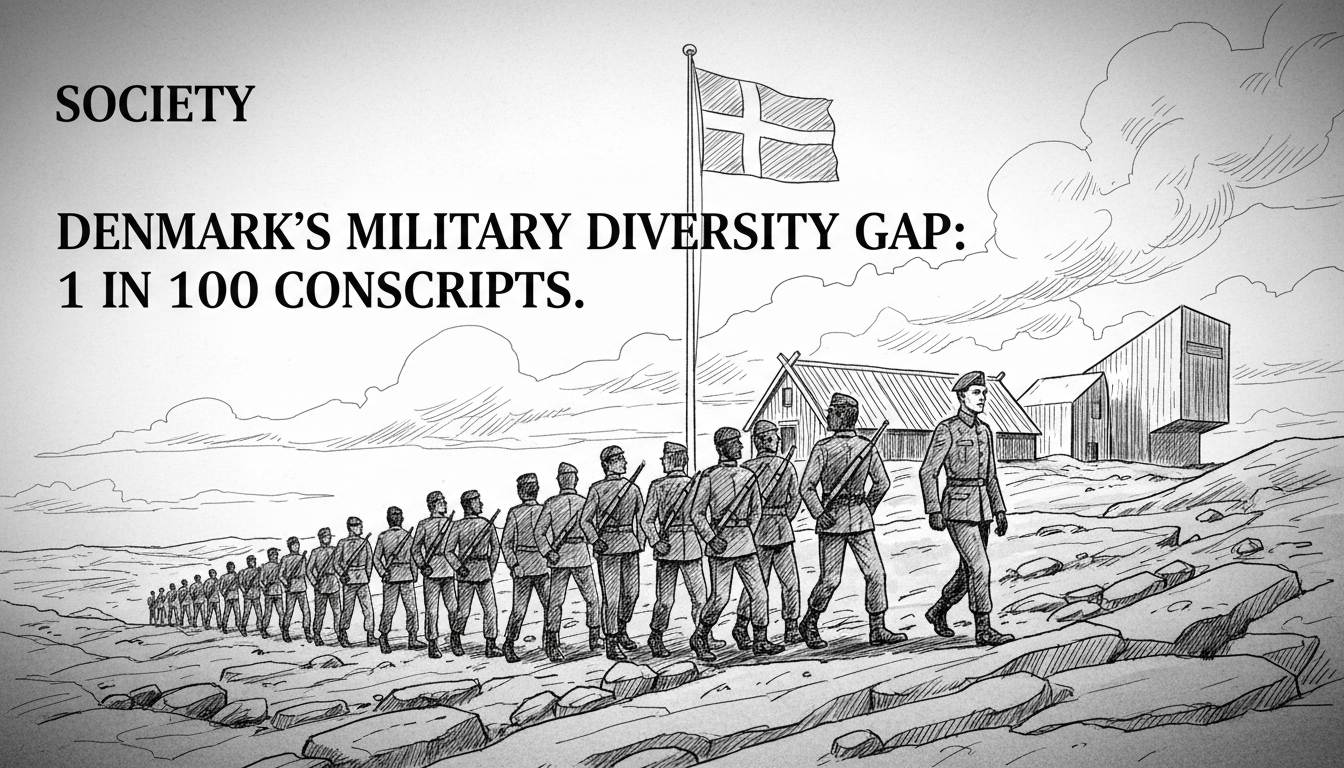
Denmark's conscription system reveals a stark ethnic homogeneity that contradicts the nation's broader demographic reality. When Haseeb Hussain began his compulsory military service last February, he immediately noticed he was part of a tiny minority. Out of 100 fellow conscripts at Vordingborg Barracks, only a small handful shared his non-Danish ethnic background. His experience is not an anomaly but a systemic feature of Danish military service, raising urgent questions about integration, equality, and national identity in a changing society. This underrepresentation persists despite Denmark having a significant population with immigrant backgrounds, particularly in urban areas like Copenhagen. The gap highlights a disconnect between the military as a core national institution and the diverse society it is meant to serve and protect.
A Conscript's Isolating Experience
Haseeb Hussain's story provides a human face to the statistics. His arrival at the barracks was a visual lesson in disparity. The near-uniform ethnic Danish composition of his unit made his own presence feel exceptional. This isolation can shape the entire service experience, affecting camaraderie, belonging, and the perception of the military as an inclusive national institution. For young men like Hussain, completing værnepligt is often framed as a rite of passage into Danish society. Yet when that passage is walked almost exclusively by ethnic Danes, its unifying power is diminished. The experience can inadvertently reinforce a sense of 'otherness' for those from minority backgrounds who do serve. Military service is intended to foster shared citizenship, but its current demographic makeup may be sending a different, more exclusionary message.
How Denmark's Conscription System Works
The roots of this issue are embedded in the mechanics of Danish conscription. The system is based on the constitutional principle of universal conscription for men. In practice, however, only a fraction are called to serve through a lottery. Each year, approximately 5,000 conscripts are enlisted from a cohort of over 40,000 young men. Women have been able to volunteer for service on equal terms since 1998, but their numbers also remain low. The selection process begins when all young men, upon turning 18, are required to complete a questionnaire for the Danish Defence. A physical and psychological screening follows for those deemed potentially fit. The final selection is made by a lottery draw. Experts point out that socio-economic factors and cultural attitudes significantly influence who proceeds through each stage. Young men from immigrant families may be less aware of the process or may perceive the military as an unwelcoming environment. There is also ongoing debate about potential unconscious biases within the recruitment and selection machinery itself, though the Defence Ministry maintains its processes are neutral.
The Integration Paradox in Danish Society
This military diversity gap exists alongside Denmark's often ambitious integration policies. The country has implemented some of Europe's strictest immigration laws and emphasizes assimilation into Danish values. Key integration metrics focus on education, employment, and language acquisition. According to Statistics Denmark, individuals of non-Western origin have significantly higher unemployment rates and lower educational attainment on average than ethnic Danes. The military, as a major state employer and trainer, could theoretically be a powerful engine for integration. It provides structured discipline, technical skills, Danish language practice in a professional setting, and a clear pathway to citizenship for those who complete service. Yet its failure to attract a representative cross-section of youth means this potential is largely untapped. This creates a paradox: a society striving for integration overlooks one of its most potent tools for achieving it. The military's homogeneity stands in contrast to other Nordic nations, like Sweden, which have made more concerted efforts to diversify their armed forces.
Voices from Community and Command
Community leaders express frustration at the missed opportunity. "When young people from minority backgrounds do not see themselves represented in the armed forces, it reinforces a perception that this is not their country to defend," says a Copenhagen-based integration consultant who works with youth. She argues that visible diversity in uniform would strengthen social cohesion and national security. Within the military, some officers acknowledge the problem but cite complex causes. A retired colonel noted, "The will to serve is deeply connected to one's sense of belonging and ownership of the national project. If segments of society feel marginalized, that will is naturally weaker." The Danish Defence has launched initiatives to increase recruitment from all parts of society, including outreach in diverse neighborhoods and informational campaigns in multiple languages. However, these efforts have yet to produce a dramatic shift in the composition of the conscript ranks. The challenge is cultural as much as procedural, requiring a shift in perception both within the military and among the communities it hopes to attract.
The Road to a More Representative Force
Addressing the representation gap requires a multi-faceted approach. First, transparency in the conscription lottery and selection data is needed to identify where in the pipeline diversity drops off. Second, targeted outreach must move beyond brochures to include meaningful engagement with parents, schools, and cultural centers in diverse communities. Third, the military must critically examine its internal culture to ensure it is genuinely welcoming and equitable for all who serve. This includes addressing any instances of discrimination and promoting minority role models within the officer corps. Finally, there is a policy question: should Denmark move toward a model of mandatory service for all young people, regardless of gender or background, as a universal civic duty? Such a system could fundamentally alter the demographic makeup of service personnel and strengthen the bond between citizenship and service. The current model, reliant on a lottery and volunteers, appears to perpetuate the status quo.
Denmark's military diversity deficit is more than a personnel issue; it is a mirror held up to Danish society. The uniform ranks of conscripts tell a story of a nation still grappling with what it means to be Danish in the 21st century. As demographic change continues, the institutions that define the state must evolve to reflect the people they serve. The armed forces, with their deep symbolic power, have a crucial role to play. Closing the representation gap is not just about fairness—it is about building a stronger, more cohesive, and truly resilient Denmark for the future. The question remains: is Denmark ready to have its military reflect its changing face?