
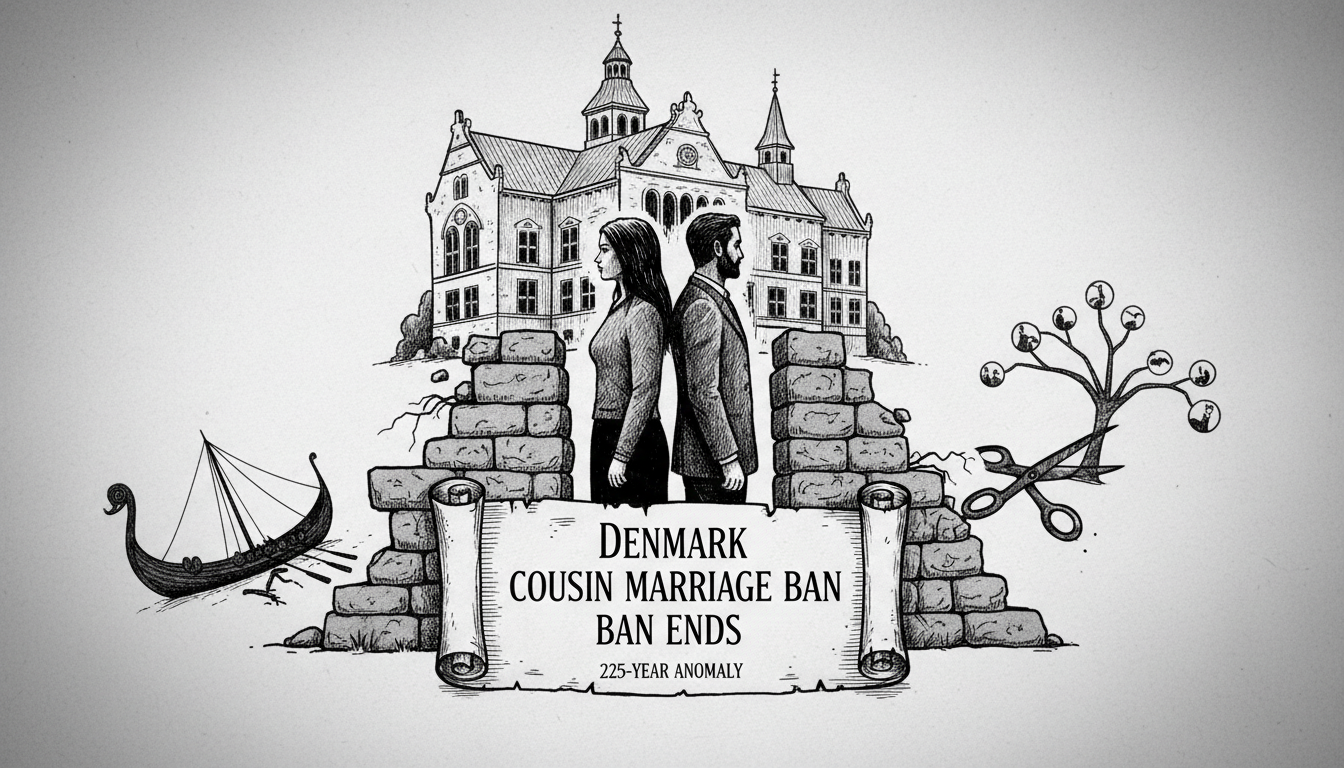
Denmark is ending a 225-year historical anomaly by reinstating a ban on marriages between first cousins. This move aligns the nation with the majority of its own history, where such unions were prohibited for centuries. The new law, passed with broad political support, targets the prevention of genetic disorders and aims to strengthen integration policies. It marks a significant shift in Danish social policy, directly affecting immigrant communities where these marriages are more prevalent.
A Return to Historical Norms
For over two centuries, Danish law has permitted marriages between first cousins, a period historians now describe as a lengthy parenthesis. Prior to 1790, such marriages were forbidden, primarily due to religious objections deeply embedded in Lutheran doctrine. The upcoming prohibition represents a return to a long-standing historical norm, not a novel social experiment. "The resistance for centuries, grounded in religion, has settled deep into the culture," explains a Danish historian specializing in family law. This cyclical pattern highlights how marriage laws often reflect broader societal values concerning family, health, and community cohesion.
Health and Integration: The Dual Rationale
The legislation is driven by two core concerns from Danish policymakers. The primary public argument centers on genetics. Children born to closely related parents have a statistically higher risk of recessive genetic disorders. The ban seeks to mitigate these health risks for future generations. The secondary, and politically potent, rationale involves integration. Danish authorities have long expressed concern that cousin marriages, more common in some immigrant communities, can hinder social integration. They argue these marriages may limit Danish language acquisition and reinforce parallel societal structures. A 2020 report from the Ministry of Immigration and Integration noted clusters of such marriages in specific municipalities, linking them to challenges in educational and labor market integration.
Voices from Affected Communities
Reaction within communities where cousin marriages are a cultural practice has been mixed and emotionally charged. For some, the law is seen as a targeted intervention that stigmatizes their family traditions and religious practices. "This feels like the state is dictating who we can love and build a family with," said one Copenhagen resident, who asked not to be named due to the sensitivity of the topic. "They frame it as health and integration, but it feels like control." Community leaders argue that education and genetic counseling, rather than an outright ban, would be a more respectful and effective approach. Others, however, acknowledge the complex dynamics. A social worker in Aarhus noted that some young people, particularly women, have expressed private relief. "They feel pressure from families to marry a cousin from the home country," she said. "This law gives them a legitimate reason to say no."
The Legal and Social Landscape
The ban places Denmark among a group of European nations, including Germany and Sweden, that prohibit first-cousin marriages. It reflects a broader Western trend toward stricter regulation of marriage and family formation based on public health considerations. The law will be enforced through the civil registration system. Clergy in the state church are also expected to follow the civil code. Existing cousin marriages will remain legally recognized, but no new ones will be registered after the law takes effect. Critics within legal circles question whether the ban could face challenges on human rights grounds, particularly the right to family and private life. Proponents counter that the state has a compelling interest in protecting public health and promoting social cohesion, arguments they believe will withstand legal scrutiny.
Beyond the Ban: A Broader Policy Shift
This legislation cannot be viewed in isolation. It is a component of Denmark's evolving and often strict immigration and integration policy framework. Over the past decade, policies have included measures like the "ghetto package," which imposed special rules on certain residential areas, and requirements for mandatory handshakes at citizenship ceremonies. The cousin marriage ban fits this pattern of using social policy to enforce specific norms of assimilation. Supporters see it as a necessary step to protect the Danish welfare model, which relies on high labor participation and social trust. Detractors view it as another example of majoritarian cultural norms being legislated onto minority communities. The success of the ban will likely be measured not just in prevented marriages, but in its downstream effects on community relations and trust in public institutions.
Looking Ahead: Implementation and Impact
As municipalities and social centers prepare to implement the new rules, practical questions remain. How will authorities handle marriages contracted abroad? What support will be offered for genetic counseling? The human impact will be very real for potentially hundreds of families each year. The long-term effect on genetic health outcomes may be measurable over generations. The impact on social integration, however, is far more complex to quantify. Will it encourage broader social networks, as intended? Or could it deepen feelings of alienation within certain communities? The law represents a decisive answer to a centuries-old question that Denmark had left open for 225 years. Its legacy will be written in the lives of families, the health of children, and the ongoing, delicate balance between cultural tradition and societal cohesion in modern Denmark.