
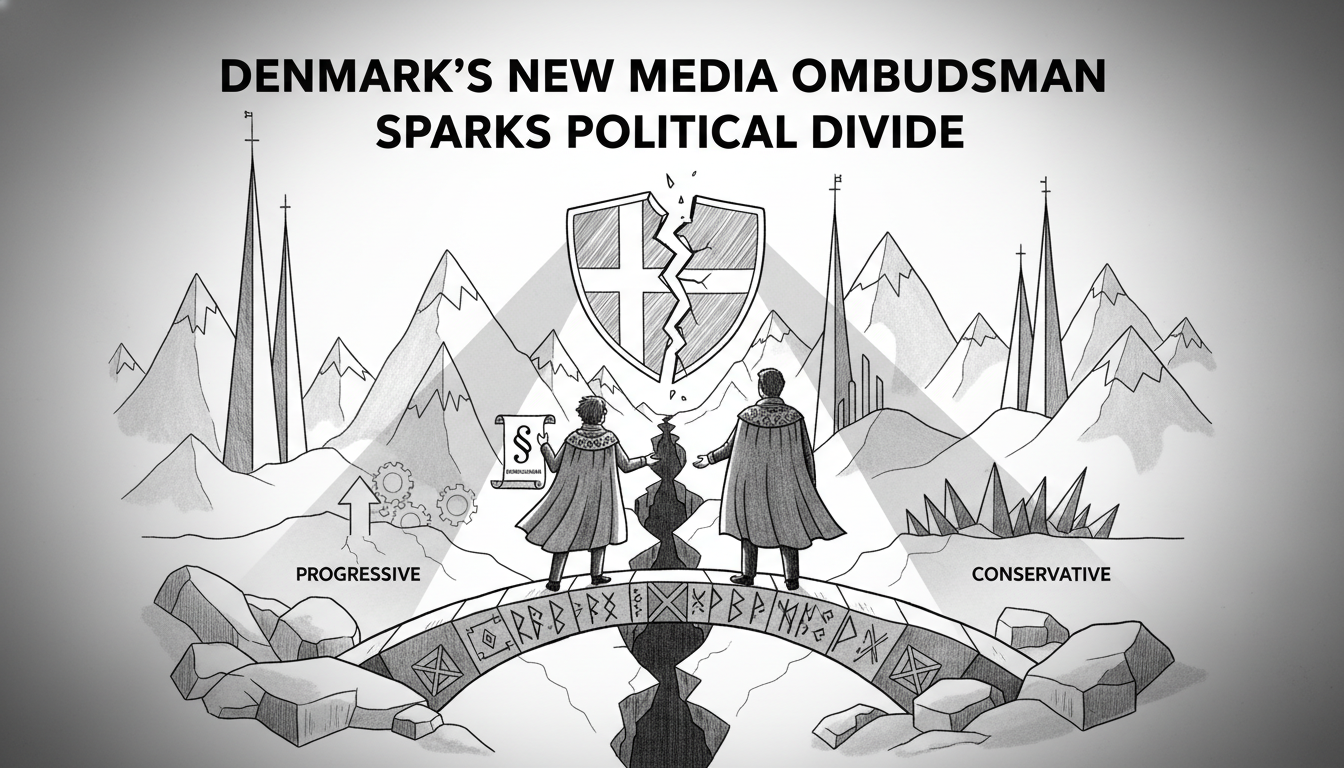
Denmark's political landscape has produced a new media ombudsman, but the agreement reveals a deep partisan split. The role was created by a deal involving only the government, Socialistisk Folkeparti (SF), and Enhedslisten (The Unity List), with Venstre as the sole non-left party participant. This limited coalition has raised immediate questions about the position's future credibility and its potential to become a politically charged institution rather than a neutral arbiter. The Conservative People's Party, notably absent from the talks, had expressed significant concerns about the proposal's implications for press freedom. Their fears, however, have been met with reassurances from those who crafted the deal, who argue the ombudsman's mandate is carefully constrained. The establishment of this figure touches a nerve in a country where a free press is considered a cornerstone of the welfare state, yet media trust faces modern challenges. This development is not merely an administrative change but a reflection of the ongoing struggle to define media's role in Danish democracy.
A Fragile Consensus on a Sensitive Role
The creation of a media ombudsman in Denmark required navigating a minefield of political sensitivities. Media policy often acts as a proxy for deeper ideological battles about state influence and public discourse. In the Nordic multi-party system, broad agreements are typically sought for such foundational institutions to ensure longevity and public trust. The current deal, described by observers as "almost a completely red circle of consensus," breaks from that tradition. It sidelines major center-right parties like the Conservatives and the Danish People's Party, who were critical of the initial proposal. This narrow base of support suggests the role was born from political compromise within the left-leaning bloc rather than a wider societal accord. The absence of a broader coalition may leave the ombudsman vulnerable to future political shifts and accusations of partiality.
Defining the Mandate: Power and Limitations
Critical to understanding the debate is the ombudsman's precise function. According to the agreement, the position is designed to monitor media diversity and pluralism, acting as a watchdog for the media landscape's overall health. Proponents stress it is not an editorial supervisor or a censor. The ombudsman will not intervene in individual news stories or dictate content to journalists or editors. Instead, the role focuses on systemic issues, such as market concentration and the availability of varied news sources across Denmark. This limited scope is the primary argument used by supporters to counter claims of overreach. "The media ombudsman is 'not so dangerous'," one negotiator stated, directly addressing the Conservative party's anxieties. They argue the position is an analytical and advisory body, not an enforcement agency with punitive powers.
Expert Analysis: A Symbolic Step or a Slippery Slope?
Media scholars and political analysts are divided on the long-term impact. Some view the ombudsman as a largely symbolic gesture, a response to public concerns about misinformation and media bias without granting real power to interfere. "The mandate appears deliberately weak," notes a professor of media studies at the University of Copenhagen. "It's a political solution to a political problem—the perception of media bias—rather than a tool with sharp teeth." Others express deeper concern about the precedent. They argue that even a monitoring role, established by a partisan agreement, creates a framework for future expansion of state influence. "The institutional footprint is now there," warns a think-tank analyst specializing in democratic institutions. "What a left-wing coalition creates today, a right-wing coalition could empower tomorrow under a different political climate. The principle of a state-appointed media monitor is now established."
The Political Fallout and Future Challenges
The political reaction has been swift and revealing. The Conservative People's Party, despite their initial "worst fears," now face a fait accompli. Their challenge will be to engage with the new institution while holding it to account, ensuring it operates within its stated narrow confines. Venstre's participation, as the only traditionally center-right party in the agreement, is particularly significant. It provides a veneer of cross-bloc support but also opens them to criticism from their right flank for legitimizing what opponents may label a "leftist media watchdog." The success or failure of the media ombudsman will depend heavily on its first appointee. The selection process will be a critical test, requiring a candidate perceived as fiercely independent and non-partisan to build legitimacy across the political spectrum. The ombudsman's reports and recommendations will be scrutinized for any hint of political alignment.
A Nordic Perspective on Media Governance
Denmark's move can be viewed within a broader Nordic context. Neighboring countries like Norway and Sweden have long-standing systems for press ethics and self-regulation, often through industry-led bodies like the Press Councils. The Danish model, introducing a state-associated ombudsman, represents a different philosophical approach. It leans slightly more toward a formalized, systemic oversight model rather than pure industry self-regulation. This experiment will be watched closely across the region, where balancing media freedom with accountability remains a constant, delicate endeavor. The Danish solution reflects a specific moment of political negotiation, not necessarily a regional trend, but its implementation may influence debates elsewhere.
The Road Ahead for Danish Media
The creation of the media ombudsman is more than a political footnote. It is a symptom of the tensions in contemporary democracies between press freedom and the demand for accountable, trustworthy journalism. For Danish media houses, the new role presents both a potential ally in advocating for a diverse media landscape and a new entity to be watched. Their independence will hinge on the ombudsman's adherence to its monitoring-only mandate. The true test will come when the ombudsman's first major report touches on a politically sensitive topic. Will its analysis be accepted as objective, or dismissed as the product of its partisan origins? Denmark has established a new player in its democratic ecosystem. The coming years will determine whether this player becomes a respected referee or a permanent political pawn, and whether the Conservatives' fears were premature or prescient.