
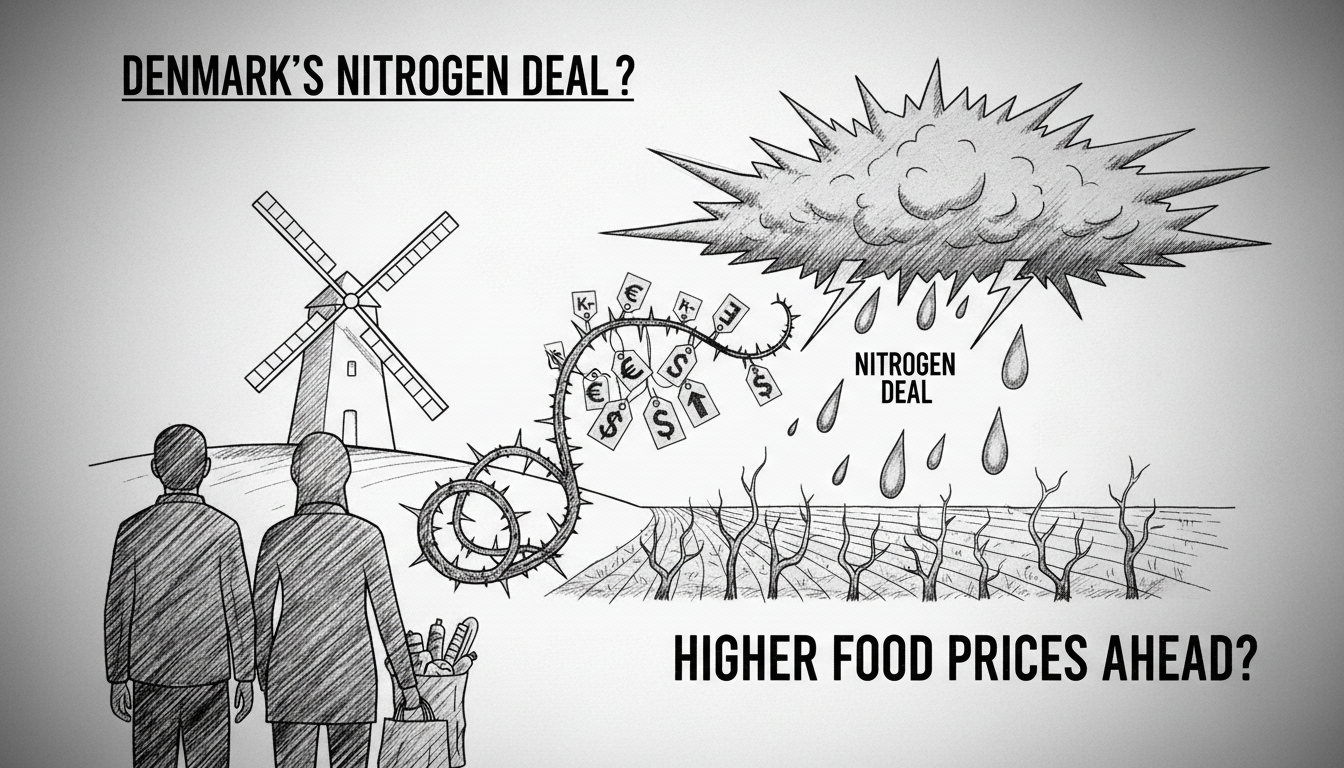
Denmark's landmark nitrogen agreement aims to cut 9,600 tons of farm pollution but may push food costs higher for consumers. The new Green Tripartite Agreement forces a historic transformation of Danish agriculture, balancing environmental restoration with economic reality. Farmers now face a complex system of nitrogen quotas, a pioneering CO2e tax on livestock, and incentives to take land out of production. This policy shift, designed to rescue Denmark's coastal waters, places a significant new financial burden on the agricultural sector. Industry representatives warn these costs will inevitably filter down to supermarket shelves, raising the price of Danish meat and dairy.
The Cost of Cleaner Water
For decades, Denmark has struggled with the environmental fallout from its world-leading agricultural sector. Intensive farming and heavy fertilizer use have caused severe nitrogen runoff, polluting fjords, coastal waters, and groundwater. Public pressure mounted as scientists documented dead zones and declining biodiversity, with Denmark consistently missing its reduction targets under EU law. The 2024 Green Tripartite Agreement represents a hard-won political compromise, a classic example of Danish consensus politics in action. The deal brings together the government, farming lobby, and environmental groups to chart a new course. Its core is a mandatory farm-level nitrogen quota system starting in 2027, backed by a 40-billion-kroner Green Land Fund to rewet peatlands and create forests. Minister for Food, Agriculture and Fisheries, Jeppe Bruus, has called it a major step, but not the final solution. The policy's success hinges on its implementation across Denmark's municipalities, where local agricultural advisors will work directly with farmers to meet the new limits.
The Numbers Behind the Nitrogen Quotas
The agreement's targets are ambitious, yet scientists argue they are insufficient. The mandated 9,600-ton annual nitrogen reduction addresses only about two-thirds of the estimated 14,800 tons needed to restore good ecological status in Danish waters. This shortfall highlights the tension between political feasibility and scientific necessity. The following table outlines the key metrics of the deal:
| Metric | Value | Context |
|---|---|---|
| Nitrogen Reduction Target | 9,600 tons/year | Mandatory cut from agriculture starting 2027. |
| Nitrogen Needed for Healthy Waters | 14,800 tons/year | Scientific estimate for full ecosystem recovery. |
| AFOLU Sector Emissions Cut | 55–65% by 2030 | Target for agriculture & land use greenhouse gases. |
| Green Land Fund | 40 billion DKK (~5.4B EUR) | For afforestation, rewetting, and land set-aside. |
| Long-Term Land Goal | 10% of total area | Land to be converted to nature and forests. |
Alongside the quotas, Denmark will become the first nation to impose a CO2e tax on agriculture, covering livestock emissions and fertilizer use. Farmers will receive approximately $100 per ton for reducing nitrogen-related greenhouse gas emissions, funded through redirected EU Common Agricultural Policy subsidies. This carrot-and-stick approach defines the entire agreement: strict regulation paired with substantial financial support for transition.
Expert Analysis: A Necessary but Painful Shift
Environmental experts acknowledge the agreement's significance while noting its compromises. "The 9,600-ton reduction is a substantial political achievement, but it is a compromise figure," says a water quality researcher familiar with the negotiations. "Our models show we need closer to 14,800 tons to truly heal our coastal ecosystems. This gets us moving in the right direction, but the pace and final destination remain uncertain." The agricultural perspective focuses on viability. An economist specializing in the sector explains the cost pressure. "You have three converging forces: less available land due to the Green Fund, a new tax on emissions, and the cost of adapting practices to meet stricter quotas," they said. "For many farms, especially mid-sized operations, these are not marginal changes. They require significant investment in new technology and management. Without a corresponding increase in product value, these costs will be passed along the chain." This analysis points directly to the consumer's wallet. The Liberal Alliance (LA) party has been vocal, warning that the policy could lead to noticeably higher prices for staples like pork, butter, and cheese. Their concern resonates in a country with a high cost of living, where the welfare model assumes accessible, affordable food.
Implications for Danish Society and Beyond
The policy's ripple effects will touch every part of Danish society. Farmers face a stark choice: invest heavily in precision farming and biogas technology to produce more with less, or reduce their scale of operation. Rural communities worry about the knock-on effects if farms consolidate or close, impacting local suppliers and services. For urban consumers, the most immediate impact may be a gradual increase in food prices, testing public support for environmental goals. In the long term, the agreement aims to reshape Danish agriculture into a high-tech, high-value, and low-emission industry. If successful, it could provide a blueprint for other nations grappling with the same trade-offs. The international context is instructive. The Netherlands attempted a similar crackdown on nitrogen pollution, triggering massive farmer protests and political crisis. Denmark's tripartite model seeks to avoid such conflict through negotiated compromise and transition support. The Danish experience will be closely watched across the EU, particularly in countries like Germany and France where agricultural emissions are a growing political issue.
A Nordic Model for Green Transition?
This agreement tests the core tenets of the Nordic model: consensus, high trust in institutions, and a collective willingness to pay for public goods. It asks whether Danish society will accept higher food prices as the cost of cleaner water and climate action. The coming years will reveal if the support structures—the Green Fund, the innovation grants, the advisory services—are robust enough to carry the farming sector through this transition without severe economic damage or social unrest. The path forward is set, but the journey will define Danish agriculture for a generation. The success of this ambitious policy hinges not just on regulation, but on sustained collaboration between policymakers, scientists, farmers, and consumers. The true cost of Denmark's nitrogen deal, both financial and social, is only beginning to be calculated.