
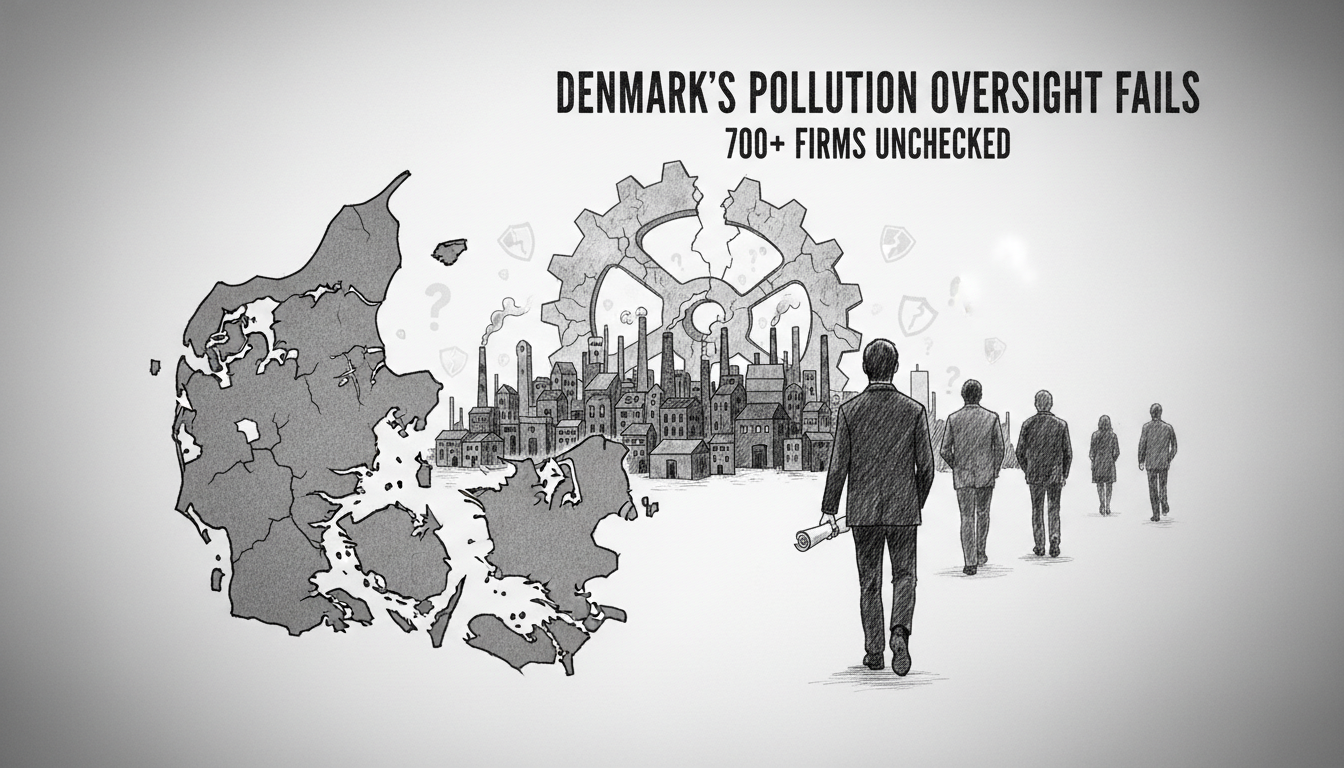
Danish environmental authorities are failing to properly monitor and control the country's most polluting companies, a situation the national auditor calls "deeply worrying" for citizens and nature. The blistering new report from Statsrevisorerne, presented at Christiansborg, finds the Ministry of Environment and the Environmental Protection Agency are not complying with legal requirements for permitting and reviewing major polluters.
The audit reveals a system plagued by significant delays, missing data, and insufficient follow-up. Permits for hundreds of high-impact industrial sites are outdated, sometimes by decades, meaning they operate under environmental standards from a different era. "It is ultimately Danes and Danish nature that pay the price for the inadequate pollution control," said the Chairman of the National Auditors in a statement accompanying the report.
A System in Paralysis
The core failure lies in the mandated process of reviewing and updating permits for so-called 'specially polluting enterprises.' Danish law requires these permits to be reassessed regularly to ensure they reflect the latest scientific knowledge and the 'Best Available Techniques' (BAT). This is not happening. The audit found that the Environmental Protection Agency (Miljøstyrelsen) has a massive backlog and lacks a systematic overview of which permits are due for revision.
Without timely revisions, companies continue to operate under outdated limits for emissions to air, water, and soil. This directly contravenes both Danish environmental law and Denmark's commitments under various EU directives. The report points to a lack of resources, poor internal prioritization, and inadequate management as key drivers of the systemic breakdown.
The Green Paradox
This failure creates a stark paradox for a nation that brands itself as a global green leader. Denmark ranked 4th worldwide in the 2022 Environmental Performance Index and has set a legally binding target to reduce greenhouse gas emissions by 70% by 2030. Yet, domestically, the machinery for controlling industrial pollution is seizing up.
"It's a severe credibility gap," says Karen Nielsen, an environmental law professor at the University of Copenhagen. "We champion ambitious climate goals on the international stage, but if we cannot perform the basic, regulated oversight of our own industrial backyard, those pledges ring hollow. Public trust is eroded when enforcement is weak."
The report suggests the problem is not new but has been allowed to fester. The ministry and agency have been aware of the growing backlog for years but have not implemented effective solutions. This has allowed potentially significant pollution to continue unchecked, with the associated health and environmental risks being borne locally.
The Business and Reputational Cost
For the business community, the audit presents a dual-edged sword. On one hand, companies operating with outdated permits face uncertainty; a sudden enforcement push could lead to costly mandatory upgrades. On the other, competitors investing in cleaner technologies are disadvantaged if others are not held to the same modern standards.
"It creates an unlevel playing field," notes Lars Bo Bertelsen, a director at the Confederation of Danish Industry with a focus on energy and climate. "Predictable and fair regulation is key. Most responsible companies want clear rules applied consistently. This administrative failure hurts those who are compliant and prepared."
Internationally, Denmark's reputation as a hub for clean technology and sustainable solutions could be tarnished. The country is home to pioneering companies in wind energy, water technology, and circular economy solutions. Persistent news of failed pollution control at home is an unhelpful counter-narrative for the green brand.
A Call for Immediate Action
The National Audit Office does not mince words. Its report is a direct call for the Ministry of Environment to take immediate control of the situation. Key recommendations include conducting a comprehensive mapping of all outdated permits, establishing a transparent and enforceable timetable for revisions, and ensuring the Environmental Protection Agency has the necessary resources and management tools to fulfill its legal obligations.
Minister for the Environment Magnus Heunicke has acknowledged the critique. In a response, he stated the ministry takes the findings "very seriously" and has already initiated work on a plan to address the backlog. He pointed to recent increases in funding for the agency but conceded that more structural changes are needed. Critics await concrete timelines and measurable goals.
The Path Forward
Experts argue that fixing this requires more than just hiring a few more caseworkers. It demands a digital transformation of how permits are tracked and managed, a clear political prioritization of enforcement alongside policy-making, and potentially a review of the complexity of the permit system itself.
"This is about effective governance," says Professor Nielsen. "It's a classic implementation deficit. The laws are good, the intentions are high, but the administrative execution has collapsed. Repairing it is urgent, not just for the environment, but for the rule of law."
The coming months will be a critical test. The audit has placed the issue squarely on the political agenda. The government's ability to swiftly and effectively rectify this failure will be closely watched by municipalities, industry, environmental NGOs, and Denmark's international partners. The price of inaction, as the auditors starkly noted, is already being paid by Danish citizens and the natural environment they cherish. Can a nation renowned for green ambition muster the administrative will to clean up its own oversight?