
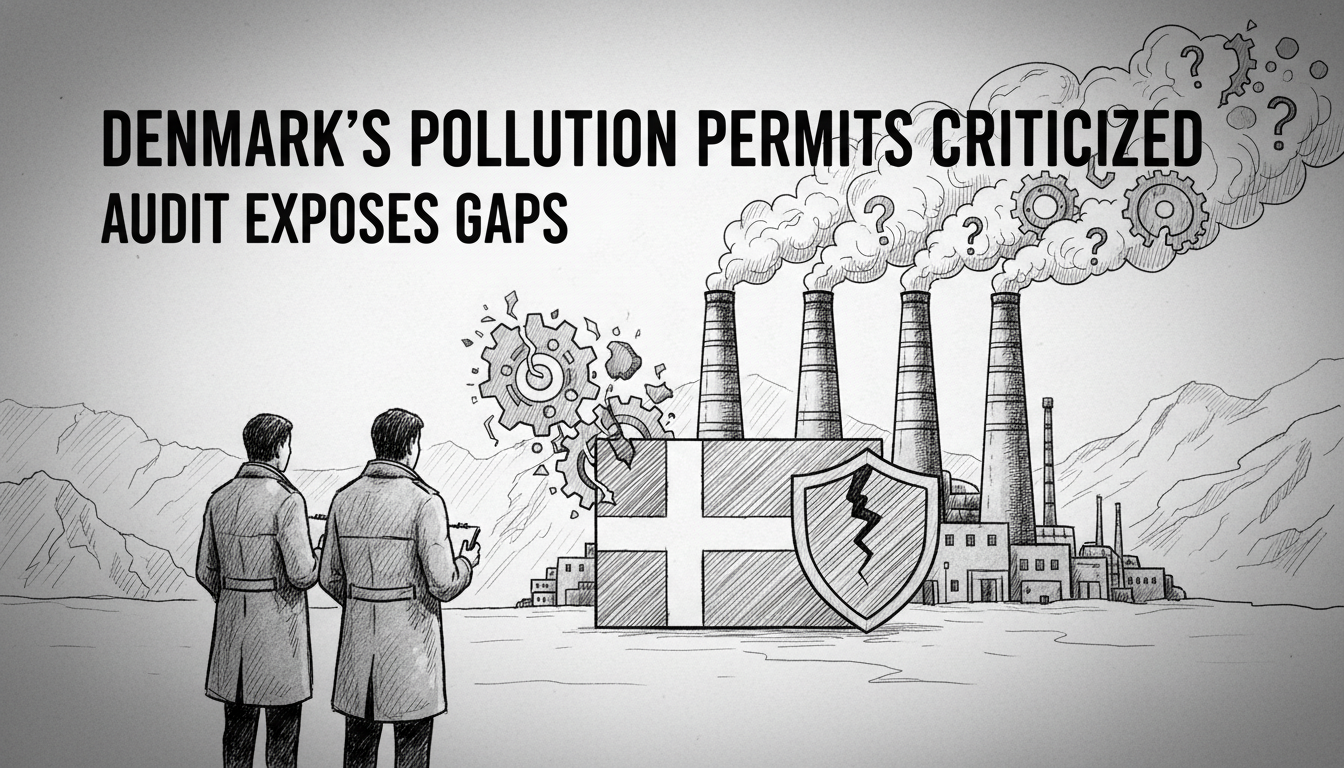
Denmark's environmental watchdog has delivered a sharp critique of how the government manages permits for the country's most polluting industries. Statsrevisorerne, the independent auditor for the Danish parliament, found significant shortcomings in the Ministry of Environment and Equality's oversight, allowing companies to operate with outdated permits and potentially exceed pollution limits. The report raises urgent questions about the enforcement of Denmark's green ambitions in its industrial sector.
A System Under Scrutiny
The core of the issue lies with environmental permits, known as miljøgodkendelser. These are legally binding documents required for businesses whose operations could cause significant pollution. They set strict limits on emissions to air, water, and soil, and mandate specific monitoring and control measures. The Ministry of Environment and Equality is responsible for issuing and, crucially, enforcing these permits. However, the audit reveals a system where renewal processes are delayed, and compliance checks are insufficient. "The ministry's administration does not ensure that companies have up-to-date permits," the auditors stated, highlighting a fundamental breakdown in regulatory oversight.
This failure has direct consequences. Companies operating under old permits may be using outdated technology and emission standards. In a rapidly evolving field like environmental science, where understanding of pollutants and their impacts constantly improves, this lag means Denmark's industrial landscape is not being held to the current best practices. For a nation that brands itself as a green frontrunner, this gap between policy and practice is particularly damaging.
The Economic and Environmental Cost of Inaction
The audit's findings strike at the heart of Denmark's dual identity as an advanced industrial economy and a climate leader. Major Danish export industries, including pharmaceuticals, agriculture, and energy production, are subject to these permits. Inconsistent enforcement creates an uneven playing field, potentially rewarding companies that delay compliance investments and punishing those that proactively meet higher standards.
"This isn't just an environmental issue; it's a matter of economic fairness and long-term competitiveness," said Karen Højgaard, a senior analyst at the Copenhagen-based Green Transition Hub. "When the state does not enforce its own rules, it undermines the businesses that have invested heavily in clean technology. It also exposes Denmark to potential infringement procedures from the EU, which has its own stringent environmental directives that member states are obligated to enforce."
Furthermore, the report suggests that the ministry lacks a comprehensive overview of which companies are operating with expired permits and what the associated environmental risks are. This data gap makes strategic enforcement and resource allocation nearly impossible. The auditors pointed out that without systematic follow-up, there is no effective check to ensure that conditions in the permits are actually being met on the ground, near communities and sensitive ecosystems.
Strained Resources and Political Priorities
Experts point to a likely combination of factors behind the administrative failure. Chronic under-resourcing of environmental agencies is a common challenge across many governments. The detailed technical work of reviewing permit applications, conducting site inspections, and analyzing monitoring data is resource-intensive. The audit implies that the ministry may be prioritizing the processing of new applications over the diligent management and renewal of existing ones.
There is also a political dimension. Stricter enforcement often meets resistance from industry groups concerned about compliance costs. The ministry, therefore, may face pressure to adopt a lenient approach, especially for economically significant companies. The audit from Statsrevisorerne, as an arm of the parliament, serves as a crucial counterbalance to this pressure, holding the executive branch accountable to the laws passed by legislators.
"The report from Statsrevisorerne is a wake-up call," said Professor Lars Kjær of the University of Copenhagen's Department of Food and Resource Economics. "It highlights the classic implementation deficit. Denmark has ambitious environmental laws on the books, but they are only as good as their administration. Effective regulation requires consistent monitoring, transparency, and the political will to act when violations occur. This audit suggests weaknesses in all three areas."
The Path to Stronger Enforcement
The National Audit Office did not merely identify problems; it also issued recommendations for improvement. Key suggestions include establishing a systematic and timely process for permit renewals, developing a robust risk-based model for inspections to target the most polluting activities, and creating a transparent registry so the public and policymakers can track the status of environmental permits across the country.
Implementing these changes will require a committed allocation of staff and funding to the ministry's enforcement divisions. It may also necessitate a cultural shift towards a more assertive regulatory stance. Technology could play a role, with increased use of continuous emission monitoring systems that provide real-time data to regulators, reducing reliance on company self-reporting.
The business community's response will be critical. While some may resist tighter controls, industry leaders recognize that Denmark's global brand is tied to sustainability. "A predictable and firmly enforced regulatory framework is better for planning and investment than a lax one that invites sudden crackdowns or reputational damage," noted the CEO of a major Danish chemical company, speaking on background. "We need clarity and consistency."
A Test for Denmark's Green Ambitions
This audit arrives at a pivotal moment. Denmark has committed to a 70% reduction in greenhouse gas emissions by 2030 and climate neutrality by 2050. While much focus is on the energy transition, controlling industrial pollution is an indispensable part of this equation. The findings expose a soft underbelly in Denmark's environmental governance, suggesting that lofty national targets can be undermined by mundane administrative failures.
The ball is now in the court of the Ministry of Environment and Equality and the politicians who oversee it. They must respond to the audit with a concrete action plan. Will they allocate the necessary resources and political capital to fix the system, or will enforcement remain the weak link in Denmark's green chain? The credibility of Denmark's environmental leadership, both for its citizens and its international partners, may depend on the answer. The world is watching not just the promises Denmark makes, but the permits it actually enforces.