
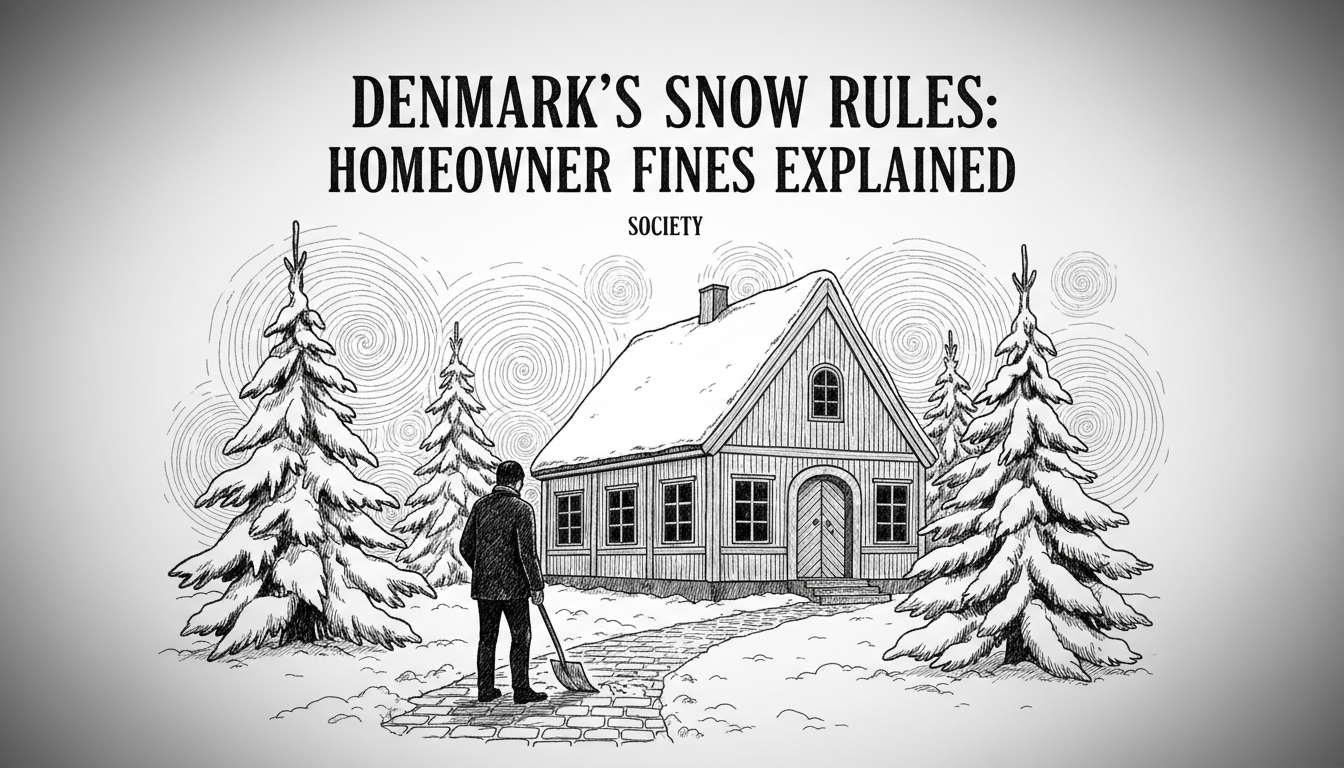
Denmark's winter maintenance obligations assign sidewalk snow clearance to over 1.8 million homeowners each year. For Copenhagen resident Mette Larsen, this responsibility became a costly legal lesson last winter. She received a 750-kroner fine from the municipality after a light overnight snowfall left a thin, unshoveled layer on her Østerbro pavement by 8 AM. "I was going to do it after my first coffee," she explains. "The fine arrived two weeks later. They called it a failure to act 'hurtigst muligt.' That phrase is now etched in my memory."
Her experience underscores a widespread, often misunderstood, civic duty woven into Danish property ownership. The system is a cornerstone of Denmark's social contract, distributing public safety tasks to individuals. Yet its legal flexibility creates a perennial grey zone where good intentions can collide with municipal enforcement.
The Legal Framework of 'Hurtigst Muligt'
Danish municipalities universally delegate sidewalk snow and ice clearance to adjacent property owners. This obligation typically covers the pavement directly fronting a property and often extends to pedestrian crossings at corners. The core legal instruction is to clear snow and apply salt or grit 'hurtigst muligt' – as soon as possible. This phrase, however, lacks a fixed hourly definition. Legal precedent suggests it means within a reasonable time after snowfall ends, considering factors like the time of day and the property owner's capacity.
"It is a practical rule designed for common sense, but that very flexibility is its challenge," says Jens Peder Kristensen, a legal advisor specializing in municipal law. "A heavy snowfall overnight gives more leeway than a light dusting during business hours. The key is demonstrating a proactive effort. Documenting that you cleared snow twice in a day can be crucial if a dispute arises." He notes that elderly or disabled homeowners can often arrange for municipal assistance, but must apply for it in advance.
Financial Risks and Accident Liability
Fines for non-compliance vary by municipality but commonly range from 500 to 1,500 Danish kroner for a first offense. The more significant financial threat lies in civil liability. If a pedestrian slips and suffers injury on an uncleared sidewalk, the property owner can be held responsible for damages. Danish insurance companies process thousands of such claims annually. Homeowner insurance policies usually include third-party liability, but premiums can rise following a claim.
Insurance firm Tryg's data indicates a 15-20% annual increase in slip-and-fall claims during icy periods. "The primary question in any claim is whether the property owner fulfilled their duty of care within a reasonable timeframe," states a Tryg spokesperson. "Photographs, weather reports, and witness statements all become evidence. Simply being at work is rarely a sufficient defense if the sidewalk was neglected."
Municipal Enforcement and Social Trust
Enforcement is complaint-driven in many districts, with municipal officers responding to reports from the public. In high-traffic urban areas, systematic patrols are more common. Copenhagen Municipality alone issues several thousand reminders and fines each winter. The approach balances enforcement with public education. "Our goal is safe sidewalks, not collecting fines," says a Copenhagen city official. "We often issue a warning for a first-time lapse, especially during extreme weather. But repeated negligence or clear disregard for public safety will result in penalties."
This system relies heavily on social trust and collective responsibility, a concept deeply embedded in Danish welfare models. The individual performs a public service, freeing municipal resources for roadways and public spaces. When it functions well, it creates a self-regulating network of clear pathways. Its fragility appears during heavy snowfalls or when individual adherence falters, creating hazardous patches that endanger the elderly and disabled disproportionately.
Preparing for the Inevitable Winter
As climate patterns shift, Danish winters have become more unpredictable, alternating between mild rain and sudden, intense snow dumps. This variability makes preparedness more critical. Experts advise homeowners to have proper shovels and a supply of salt or gravel ready by November. Establishing a plan with neighbors for coverage during holidays or work trips is a practical strategy that strengthens community bonds.
For new residents, particularly international transplants, this obligation can be a surprising introduction to Danish societal norms. Integration programs run by municipalities and volunteer organizations now frequently include segments on practical winter responsibilities. They explain that clearing snow is not just a chore, but a direct contribution to communal safety and the functioning of society.
The coming winter will test this system once again. For Mette Larsen, it means setting an earlier alarm. "I see my neighbor, an 80-year-old man, out there without fail at 7 AM," she says. "It shamed me into understanding. This isn't bureaucracy. It's about making sure no one falls on my doorstep." Her reflection captures the essence of the rule: a personal duty with a profoundly public purpose, where a shovel's scrape against concrete is the sound of a social contract being honored.