
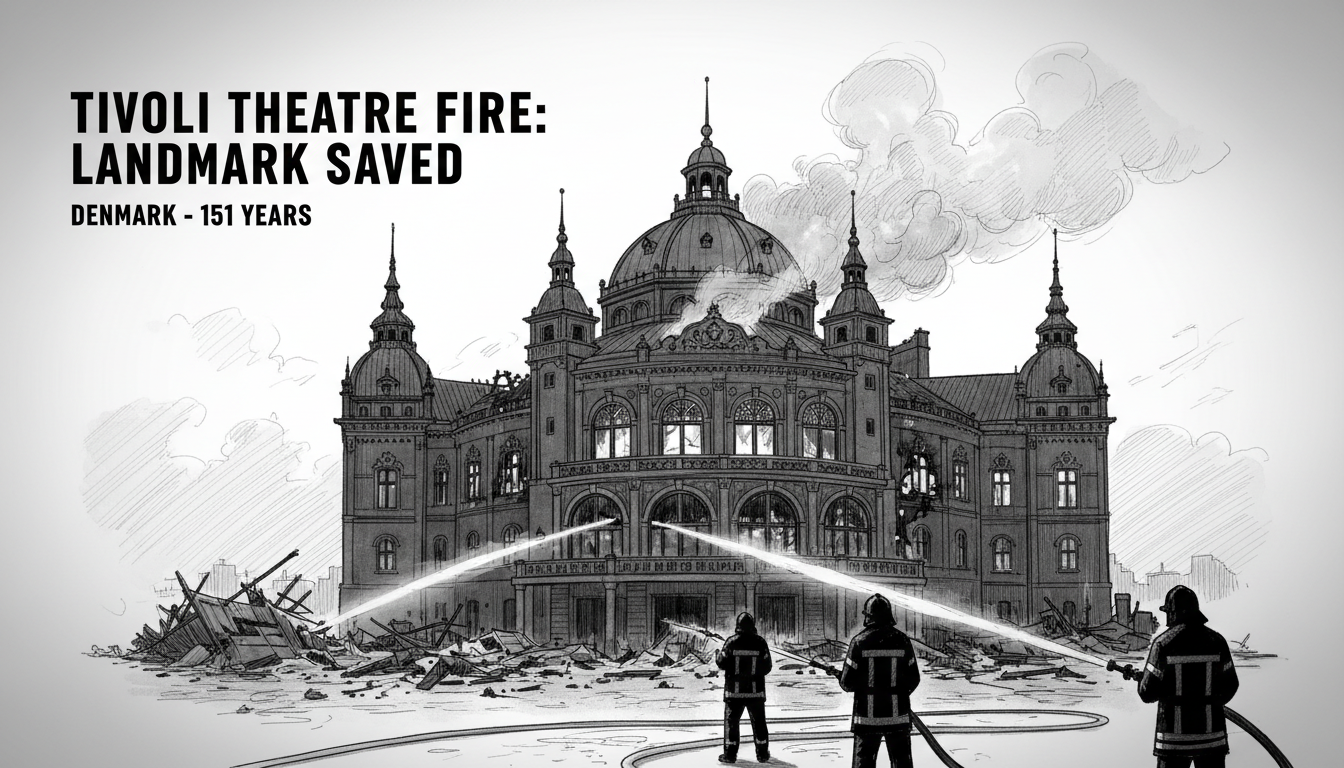
Denmark's historic Pantomime Theatre in Tivoli Gardens survived a fire scare Wednesday afternoon after emergency services mounted a major response. Copenhagen Fire and Rescue dispatched multiple units to the world-famous amusement park following reports of smoke in the 151-year-old theatre building. The incident, described by Tivoli management as a "minor fire," concluded without damage to the culturally significant structure, though it sparked immediate concerns about preserving one of the city's most cherished landmarks.
Firefighters contained the blaze quickly, preventing it from spreading to the theatre's ornate interior or its famed mechanical peacock curtain. The emergency operation has now concluded, with investigators working to determine the exact cause. This event highlights the constant vigilance required to protect aging wooden structures within living heritage sites. For Copenhagen, where Tivoli is both a major tourist draw and a local institution, the scare was a stark reminder of the fragility of shared cultural history.
A Swift Response Averts Cultural Loss
Copenhagen's fire services arrived at Tivoli Gardens shortly after midday on Wednesday. Their rapid deployment underscored the site's priority status within the city's emergency planning framework. Tivoli, which first opened its gates in 1843, is not merely an amusement park but a dense collection of historical buildings, gardens, and pathways in the heart of the capital. The Pantomime Theatre, built in 1874, is among its oldest and most architecturally distinctive venues.
"The coordination between our on-site security and the Copenhagen Fire and Rescue was immediate and effective," a Tivoli spokesperson said in a statement. "Our primary concern was always the preservation of the theatre and the safety of our guests and staff." The theatre is famous for its traditional Commedia dell'arte performances and its unique curtain, featuring a large peacock tail that opens mechanically. This artifact, still operated by hand, represents a rare piece of 19th-century stagecraft technology.
The Delicate Balance of Heritage and Safety
Protecting historical wooden buildings from fire presents a unique set of challenges for conservation experts and safety officials. Jens Ahm, a senior consultant with the Danish Agency for Culture and Palaces, explains that heritage sites operate under a complex set of regulations. "The goal is to implement modern safety standards without compromising historical authenticity," Ahm noted. "In a structure like the Pantomime Theatre, you cannot simply hide sprinkler pipes in a historic ceiling or run cables through original walls without careful consideration."
Tivoli Gardens maintains its own dedicated security and maintenance teams who conduct regular inspections. These teams work alongside municipal fire safety inspectors to assess risks specific to the park's vintage architecture. Common strategies include using flame-retardant treatments on wood, installing discreet heat and smoke detectors, and maintaining clear emergency access routes. Wednesday's incident will likely prompt a renewed review of these protocols, though early reports suggest existing measures functioned as intended.
Tivoli's Role in the Danish Cultural Psyche
The emotional public response to the fire scare speaks volumes about Tivoli's place in Danish society. For many Danes, the park is a repository of personal and collective memory. It is where generations have celebrated birthdays, experienced their first roller coaster ride, and enjoyed seasonal traditions like the Christmas market. The Pantomime Theatre, in particular, offers a direct link to a 19th-century form of entertainment, preserving a theatrical tradition that has largely vanished elsewhere.
"Tivoli is more than an attraction; it's a cultural ecosystem," says historian Marie Larsen, author of a book on Copenhagen's public spaces. "It represents a specific Danish ideal of combining natural beauty, playful architecture, and light-hearted culture. Losing any piece of it, especially to fire, would feel like a tear in the social fabric." This sentiment is echoed in tourism data. Tivoli consistently ranks as one of Denmark's top visited paid attractions, drawing millions of international visitors who come to experience its unique atmosphere.
What the Incident Reveals About Urban Preparedness
While the fire was minor, the scale of the emergency response was not. Copenhagen Fire and Rescue's decision to send a "massive dispatch" reflects a pre-determined strategy for high-value cultural assets. The city's emergency plans likely categorize Tivoli as a site where any fire alarm warrants an overwhelming initial response to achieve swift containment. This approach prioritizes preventing catastrophic loss over minimizing operational costs.
A fire department representative, speaking on background, confirmed that heritage sites receive special attention in risk assessments. "The calculus is different," the representative said. "The potential loss is not just square meters; it's irreplaceable history. Our protocols for Tivoli, the Royal Theatre, or the old city center are designed for speed and force." This philosophy appears to have proven its worth this week, preventing a small incident from escalating into a national tragedy.
Looking Ahead: Preservation in a Modern World
The successful handling of the Pantomime Theatre fire offers reassurance but not complacency. For the administrators of Tivoli Gardens, the incident is a case study to be examined in detail. It will inform future investments in fire prevention technology and staff training. The park walks a perpetual tightrope, needing to update its infrastructure for safety and accessibility while maintaining the antique charm that defines its character.
Experts like Jens Ahm suggest that integrating technology subtly is key. "Modern wireless sensors, advanced atmospheric monitoring, and improved fire-retardant materials can be allies of preservation," he says. The coming weeks may see Tivoli announce new measures or audits, a proactive step to maintain public confidence. For now, the park continues its operations, with the Pantomime Theatre expected to reopen for its next scheduled performance after a safety clearance.
The sight of fire trucks in the iconic gardens was a brief shock to the system for Copenhagen. It served as an unexpected drill, testing the city's commitment to safeguarding its past. The positive outcome demonstrates that with rigorous planning and swift action, modern cities can protect their historical hearts. Yet the event leaves a lingering question for all communities built upon layers of history: How do we best care for the fragile, beautiful places where our collective memory resides?