
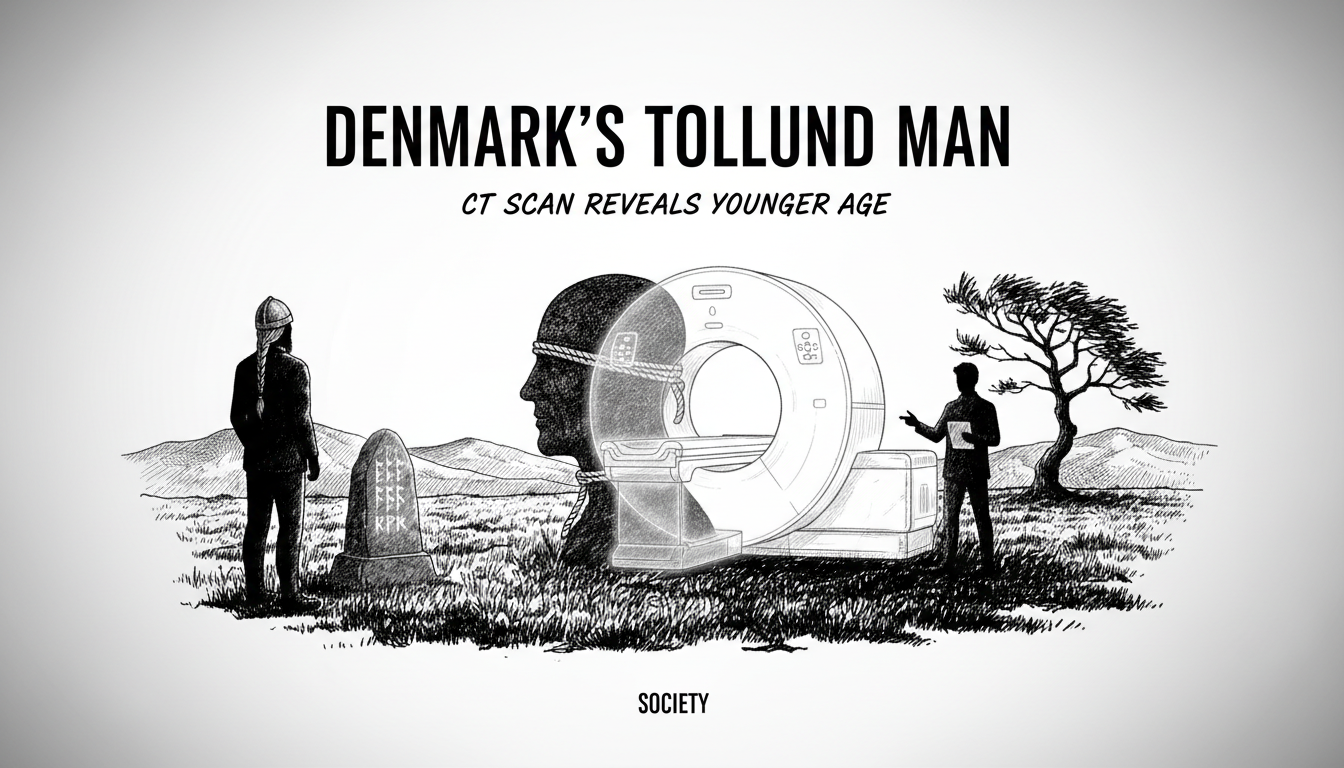
Denmark archaeology has yielded a significant new discovery about one of its most famous ancient residents. A recent CT scan of the Tollund Man, the world's best-preserved bog body, reveals he was likely a decade younger than previously believed. The man, whose remarkably intact face has gazed from museum displays for decades, was not around 40 years old when he died. New analysis suggests he was in his late twenties or early thirties, fundamentally reshaping our understanding of his life and death.
For over seventy years, the serene, sleeping face of the Tollund Man has been a window into Iron Age Denmark. Discovered in 1950 by peat cutters in a bog near Silkeborg, his preservation was so complete that the finders initially thought they had encountered a recent murder victim. The noose around his neck told a clear story of his end, but the details of his beginning have remained less certain. This latest scientific examination, using non-invasive CT scanning technology, rewrites a key chapter of his biography.
A Face from the Past, Re-examined
The initial assessment of the Tollund Man's age, made in the mid-20th century, relied on the physical examination of his remains and comparative anatomy. Scientists estimated he was approximately 40 years old at the time of his death around 400-300 BC. This age placed him as a mature adult within his prehistoric community. The new CT scan data provides a far more detailed internal view, allowing experts to analyze bone density, tooth wear, and skeletal development with modern precision. This digital autopsy points consistently to a younger man.
"This finding is more than just a correction of a number," said a senior archaeologist involved with the study. "It changes the social and narrative context. We are no longer looking at a man in middle age, but a young adult. This influences how we interpret his status, his role, and the potential reasons for his sacrifice or execution." The shift from 40 to perhaps 30 years of age invites a complete reconsideration of his story within the harsh realities of Iron Age society.
The Science of Bog Preservation
The Tollund Man's survival is a gift from the unique environment of Northern European peat bogs. These waterlogged, acidic, and oxygen-poor landscapes act as natural tanning vats. They inhibit the bacteria that cause decay, allowing for the miraculous preservation of soft tissues, skin, hair, and even internal organs for millennia. Denmark's wetlands have surrendered several such bog bodies, each providing fragmented clues about a distant past.
This natural mummification process is why we can still see the stubble on the Tollund Man's chin and the leather cap on his head. It preserved the very rope that hanged him. This exceptional preservation is what now allows modern technologies like CT scanning to be applied. Scientists can conduct detailed examinations without causing damage to the fragile remains, unlocking secrets that previous generations of researchers could only guess at.
Implications for Understanding Iron Age Life
The revised age of the Tollund Man sends ripples through archaeological interpretation. A man in his late twenties or early thirties in the Iron Age would have been in his physical prime, likely a full participant in the labor and defense of his community. His well-preserved stomach contents, previously analyzed, revealed a last meal of porridge made from barley, flax, and seeds, some of which were not in season. This suggests a ritualistic element to his death.
Was he a criminal punished for a transgression? A slave sacrificed as an offering? Or perhaps a person of status chosen for a ritual to appease the gods? His youth makes theories of criminal punishment for a lifelong offender less likely. It strengthens hypotheses around ritual sacrifice, where a vital, healthy individual might be considered a more valuable offering to the deities. His gentle, composed facial expression, often noted by observers, continues to contrast hauntingly with the violence of his hanging.
The Evolving Story of Danish Bog Bodies
The Tollund Man is not an isolated relic but part of a broader tapestry of Danish bog body finds. Each discovery, from the Elling Woman found nearby to the Grauballe Man, adds pieces to a complex puzzle. These individuals did not die of natural causes; their deaths were deliberate, often violent, and connected to the spiritual beliefs of their time. The ongoing re-analysis of these remains with new technologies shows that their stories are not static.
Every scan, every new chemical analysis, writes a new line in a biography that is thousands of years old. The commitment to preserving and restudying these remains in Denmark underscores a national dedication to understanding its deep history. Museums like the Silkeborg Museum, where the Tollund Man resides, become not just display spaces but active research centers where history is continuously updated.
A Young Man's Enduring Legacy
The updated image of the Tollund Man as a younger adult brings him closer to us in a poignant way. He is no longer a distant figure from the deep past but could be seen as a contemporary of many students and young professionals who visit his display. This connection across time is the power of archaeology. It transforms abstract history into a tangible, human story.
The CT scan has done more than adjust a timeline. It has refreshed our gaze upon one of history's most famous faces. As research continues on Danish bog bodies, each technological advance promises further revelations. The Tollund Man's peaceful expression now belies a shorter, perhaps even more tragic life than we once thought. His silent testimony, forever changed by a modern scan, continues to ask us what we are willing to give, and to lose, for the beliefs of our community.