
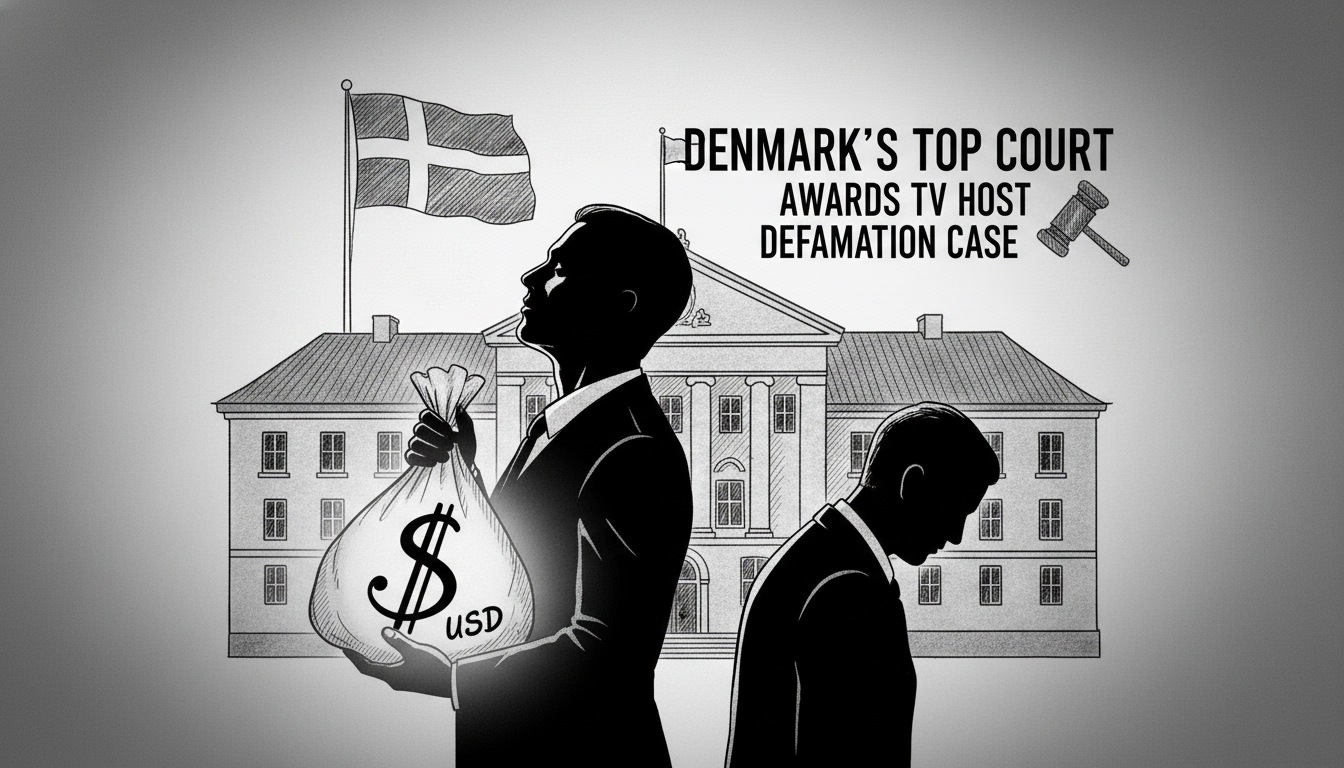
Denmark's Supreme Court has ordered lawyer Yvonne Frederiksen to pay former TV host Jes Dorph-Petersen 1.99 million kroner ($290,000) in damages. This landmark ruling concludes a bitter, multi-year legal battle rooted in Denmark's #MeToo movement, delivering a dramatic reversal for the dismissed television personality. It signals a stringent new judicial scrutiny of how sexual misconduct allegations are pursued legally in the Danish system.
A Personal and Professional Reckoning
For Jes Dorph-Petersen, the court's decision represents vindication after a precipitous fall from public grace. Once a familiar face in Danish living rooms, he was dismissed from TV 2 in 2021 following allegations of sexual misconduct. The accusations, which he has consistently denied, originated from a woman represented by lawyer Yvonne Frederiksen. His career halted abruptly, and his name became a focal point in the nation's complex conversation about power, behavior, and accountability. The financial compensation, while significant, cannot reclaim lost years or fully restore a public reputation. 'This has been an incredibly difficult period,' Dorph-Petersen stated simply after the verdict, a sentiment echoing the personal toll these cases exact beyond the courtroom.
The Legal Fault Lines of a #MeToo Allegation
The case pivoted not on the truth of the underlying misconduct claim, but on the conduct of the legal process itself. The Eastern High Court, whose ruling the Supreme Court upheld, found that Yvonne Frederiksen acted with wrongful intent or gross negligence in her handling of the case. Specifically, the courts criticized her for presenting the allegations publicly and to TV 2 in a manner that was deemed unjustifiably damaging before a full legal assessment could be made. This procedural misstep formed the core of the defamation claim. It underscores a critical tension in post-#MeToo litigation: the balance between a victim's right to pursue justice and an accused person's right to a fair process before public condemnation. The Supreme Court's decision firmly prioritizes the latter in this instance, setting a clear precedent.
Expert Analysis: A Chilling Effect or a Necessary Correction?
Legal experts are divided on the broader implications of this verdict. Professor Jens Elo Rytter, a legal scholar at the University of Copenhagen, suggests the ruling imposes a high standard on legal representatives. 'The Supreme Court is sending a clear message about the professional duties of lawyers in emotionally charged cases,' he explains. 'They must exercise extreme caution, even when advocating passionately for a client, to avoid crossing into defamation.' Some advocates for survivors of sexual harassment express concern. A spokesperson for a major Danish crisis center, who asked not to be named due to the sensitivity of the topic, worries about a potential chilling effect. 'There is a risk that lawyers will now become overly cautious, potentially making it harder for victims to come forward and seek robust legal counsel,' the spokesperson said. This tension between protection against false accusations and protection for victims defines the ongoing debate.
Denmark's #MeToo Landscape in the Aftermath
This ruling does not erase Denmark's #MeToo movement but adds a complex new chapter. The movement here has unfolded with distinct Scandinavian characteristics, often more muted than in the United States but with profound impacts in media, politics, and cultural institutions. Several high-profile figures have faced consequences following allegations. The Dorph-Petersen case, however, is the most prominent where the legal system has subsequently sanctioned the pursuit of an allegation. It forces a societal reevaluation of process. Danish defamation law has proven to be a powerful tool for those who feel wrongly accused. The verdict illustrates that the court of public opinion, while powerful, operates under different rules than the court of law. Public sentiment may have condemned Dorph-Petersen years ago, but the Supreme Court's meticulous review of legal procedure has now condemned the approach taken against him.
The Ripple Effects for Media and Public Discourse
The case also highlights the media's pivotal and often problematic role. TV 2's decision to dismiss Dorph-Petersen based on the allegations presented by Frederiksen became a key fact in the defamation claim. It raises difficult questions for employers navigating unproven allegations against employees in the public eye. Should they wait for a legal verdict, which can take years, or act on the perceived risk to their reputation? Furthermore, the public's consumption of such stories as they unfold creates narratives that are difficult to undo. The Supreme Court's ruling may encourage more cautious reporting and a longer view before institutional actions are taken. It reinforces the principle that allegation is not synonymous with guilt, a cornerstone of law that can blur in rapid-fire public discourse.
A Lasting Precedent for Justice and Reputation
The Supreme Court's decision is final, leaving Yvonne Frederiksen with a substantial financial liability and a marked professional outcome. For Jes Dorph-Petersen, the path forward remains challenging. Monetary compensation is one thing; rebuilding a career and a public persona is another. This case will be cited for years to come in Danish defamation law, particularly in cases involving sexual misconduct claims. It establishes that the method of pursuing an allegation can carry as much legal weight as the allegation itself. As Denmark continues to grapple with issues of power, gender, and accountability, this ruling serves as a stark reminder that the pursuit of justice must itself be just. It asks a difficult, enduring question: How does a society correctly balance the imperative to believe victims with the fundamental right to a presumption of innocence? Denmark's highest court has now given its firm, and costly, answer.