
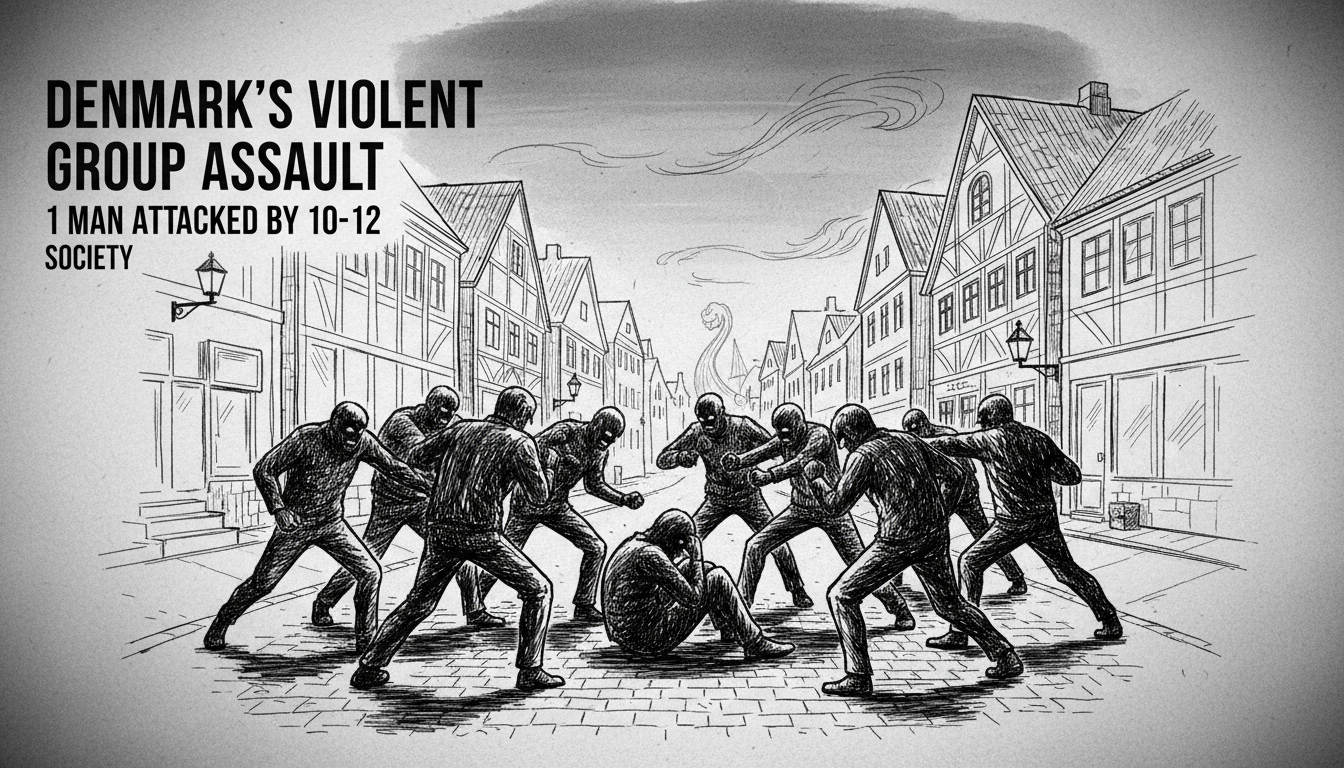
Denmark crime rates are among Europe's lowest, yet a single violent incident can fracture a community's sense of security. A 32-year-old man lies battered in a hospital after being held down and beaten by a group of 10 to 12 assailants on Vestergade in Herning. The Thursday night assault, occurring around 11:30 PM, has left police scrambling for answers and residents questioning safety in a familiar commercial street. This single act of brutality, far from the common petty crime, exposes the complex realities beneath Denmark's generally peaceful statistics.
A Night of Violence on Vestergade
The call to police in Herning reported a disturbance, but officers arrived to find a scene of significant violence. The victim, a man in his early thirties, had been set upon by a large group. According to Midt- and Vestjyllands Police duty officer Thomas Hald, the attack was severe and one-sided. "He was held fast and received a lot of blows. Among other things, he was hit with a bottle," Hald stated in his initial report. The assailants dispersed before police arrival, leaving the victim severely beaten but in stable condition, not life-threatening. Vestergade, a street lined with shops and nightlife venues, was transformed in an instant from a bustling corridor to a crime scene cordoned off with tape.
Police have launched a major investigation but have made no arrests. The motive remains unclear, and detectives face the challenge of piecing together the events that led to such a disproportionate attack. "It is a case at the severe end, where a single man has been assaulted by a larger group," Hald confirmed, highlighting the troubling dynamic of mob violence against an individual. Investigators are now canvassing for witnesses, reviewing surveillance footage from local businesses, and collecting forensic evidence. The success of this work hinges on community cooperation in a case that has shaken Herning.
The Paradox of Safety in Danish Society
This assault presents a stark contrast to Denmark's reputation for safety and social order. Nationally, rates of violent crime are low, a point of pride for the Danish welfare model which emphasizes social cohesion. Yet incidents like this reveal vulnerabilities, particularly in nightlife districts where alcohol, crowds, and transient populations mix. Criminologists often note that group dynamics can lower inhibitions and escalate aggression, a factor likely at play here. While statistically rare, such severe group assaults have an outsized impact on public perception, making people feel less secure in spaces they once considered harmless.
Herning, a major city in central Jutland, is not known for endemic gang violence or extreme crime. This makes the brutality and scale of the Vestergade attack more shocking to its citizens. Local social policy experts suggest that while the Danish welfare system provides a strong safety net, it cannot entirely prevent spontaneous acts of violence fueled by social friction or personal conflict. The incident forces a conversation about policing resources, street lighting, and late-night security in urban centers beyond Copenhagen, where national crime debates often focus.
The Human Cost and Investigative Hurdles
Beyond the statistics and policy discussions lies a recovering victim and a traumatized community. Violent assaults have long-lasting effects, both physical and psychological, for those directly involved and for bystanders. The police investigation faces significant hurdles. Identifying 10 to 12 individuals in a nighttime setting requires clear video evidence or witnesses willing to come forward. The lack of an immediate motive complicates the picture; it could stem from a personal dispute, a random act of aggression, or a case of mistaken identity.
Police procedure in Denmark in such cases is methodical. Forensics teams would have scoured the scene for the weapon—the bottle used as a bludgeon—and other physical evidence. Digital evidence from mobile phones and city cameras is crucial. The challenge, according to security analysts, is the collective nature of the crime. Witnesses may be reluctant to speak out against a large group, and perpetrators may shield each other with silent collusion. The response from Herning Municipality and local social centers will also be watched, as they often provide victim support and community mediation in the aftermath of violence.
A Community Seeks Answers
The attack has undoubtedly sent ripples through Herning. Business owners on Vestergade may reconsider security measures, and residents may think twice about nighttime walks. This is the profound social cost of a single violent act: it erodes the unspoken trust that allows a society to function smoothly. Danish integration policies often speak of 'samfundssind' – community spirit – which is tested when fear enters the public space. The police's ability to solve this case quickly and transparently is key to restoring that trust.
Local leaders will be pressed to comment on public safety without causing undue alarm. The balance is delicate. Acknowledging the severity of the incident is necessary, but so is maintaining perspective about the overall low crime rates in the region. This is where granular, local Danish society news matters more than national trends. What happens on Vestergade in Herning resonates deeply with those who live and work there, shaping their daily reality far more than abstract crime statistics.
Looking Ahead: Safety in Public Spaces
As the investigation continues, broader questions emerge. How can Danish cities preserve the openness and freedom of their public spaces while ensuring safety for all? Are current policing models in regional cities equipped to handle sporadic, high-intensity violence? The Danish welfare system is built on a foundation of security, and attacks that seem random or excessively brutal strike at its core promise. The coming days will reveal if police can identify the large group responsible.
For now, a man recovers from his injuries, and a street known for commerce and social life is marked by an act of cruelty. The incident serves as a sobering reminder that social harmony requires constant vigilance. It challenges the assumption that safety is a permanent condition, even in a country as orderly as Denmark. The true test for Herning will be how the community responds—whether it retreats in fear or comes together to reaffirm the safety of its streets. The answer will define the city long after this investigation closes.