
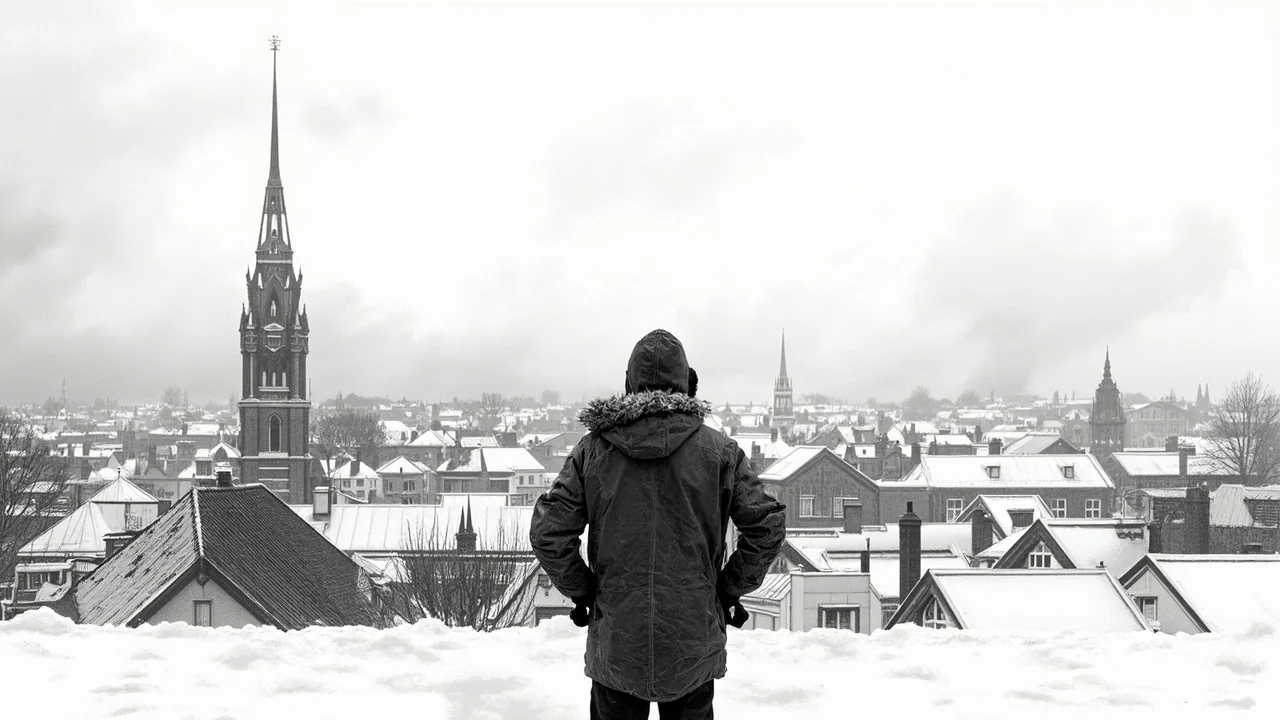
Denmark's construction sector faces a deep freeze as severe winter weather halts outdoor work, forcing companies to send skilled workers home with full pay. At Ryslinge Tagdækning on Funen, 40 of 65 employees are idled, a stark illustration of how Scandinavian winters can paralyze key industries and strain small business finances.
"It's practically impossible to work when there's up to ten centimeters of snow or ice at the bottom of a roof," says managing director Johnny Poulsen. The core problem is technical: roofing felt is an oil-based product that cannot be properly welded or sealed when it comes into contact with moisture. "We really only have two options: clear the snow and dry it off. Or send the employees home," he explains. For many clients, the extra cost of snow removal is prohibitive, leaving Poulsen with an involuntary workforce reduction of nearly two-thirds.
This scenario is not unique. Across Denmark, tradespeople specializing in roofing, paving, and foundation work are hitting a seasonal wall. Nicolaj Roesholm, owner of the sole proprietorship Roesholm Entreprise in West Funen, has been forced to reshuffle his schedule, relying on a backup plan of indoor tasks to keep busy. "I always have a contingency plan in the drawer, so I'm not super worried. But that plan doesn't last forever," Roesholm notes, adding that an extended freeze would certainly impact his bottom line.
The Economic Chill for Small Businesses
The financial impact of these weather-induced stoppages falls heavily on small and medium-sized enterprises (SMEs), which form the backbone of the Danish trades sector. While employees continue to receive their wages, company revenues stall. This creates a cash flow crunch, where fixed costs like vehicles, equipment leases, and insurance continue unabated while income evaporates. For a company like Ryslinge Tagdækning, paying 40 full salaries without corresponding billable work represents a significant financial burden that must be absorbed.
Morten Frihagen, chairman of the industry organization Dansk Håndværk (Danish Crafts), acknowledges the pressure. "Of course, especially smaller companies can feel it when they have more expenses than income," he states. He points out, however, that this is a known cyclical challenge in a region with distinct seasons. "Therefore, one also tries to build a buffer into one's schedule," Frihagen adds, referring to the common practice of planning for higher productivity in the warmer months to compensate for winter slowdowns.
This "buffer" strategy is a fundamental part of business planning for outdoor trades in Denmark. The financial year is often viewed in halves, with the first and sometimes second quarters expected to run at a loss or reduced profit. The pressure is then on to complete a higher volume of work during the late spring, summer, and early autumn to achieve annual targets. This cyclical model requires careful financial management and sufficient capital reserves to bridge the winter gap—a test of resilience for every business owner.
A Built-In Seasonal Vulnerability
The situation underscores a structural vulnerability in certain segments of the Danish economy. Unlike manufacturing or tech sectors that operate largely indoors, businesses in construction, landscaping, and exterior maintenance are directly exposed to the elements. Their productivity is intrinsically linked to the weather, making them less agile in the face of climate variability. While a mild winter might allow work to continue, an extended period of frost and snow, like the one currently affecting the country, brings operations to a standstill.
Johnny Poulsen frames it as an occupational reality. "These are the conditions when you work outdoors, that the first and sometimes also the second quarter show a deficit. Then we try to recover the loss for the rest of the year," he says. This acceptance, however, does little to ease the immediate stress of managing payroll and client expectations. It also highlights a potential competitive disadvantage against larger construction firms with more diversified service portfolios that can move idled workers to indoor renovation projects.
From an economic perspective, these micro-level disruptions aggregate into a macro-level dip in economic activity. Reduced output in the construction sector affects related industries, from building material suppliers to equipment retailers. While the effect may be temporary and localized, it contributes to quarterly economic volatility. For a trade-driven economy like Denmark's, understanding and mitigating these seasonal shocks is crucial for stable growth.
Workforce Management in a Deep Freeze
The decision to send workers home with full pay, rather than resorting to temporary layoffs or short-time work schemes, is a significant one. It reflects both a commitment to retaining skilled labor in a tight job market and adherence to collective bargaining agreements common in Denmark. Losing trained roofers or carpenters to other industries during a pause is a real risk, and re-hiring come spring is difficult and costly.
Therefore, paying wages during downtime is an investment in human capital and future productivity. It fosters employee loyalty and ensures the team is ready to mobilize immediately when conditions improve. However, this practice places the entire financial risk of bad weather on the employer, squeezing margins and testing the limits of their financial planning. It raises questions about whether existing business models and support structures are adequate for the level of climate-related disruption being experienced.
Could greater digitization or diversification offer a solution? Some forward-thinking trade firms are exploring complementary indoor services, such as energy consultancy, insulation checks, or smart home installations, which can be performed year-round. Others are investing in specialized equipment, like large tent structures or heaters, to create workable micro-climates on job sites, though at a substantial cost that must be passed on to the customer.
Looking Ahead: Climate and Planning
The current freeze prompts a broader discussion about climate adaptation for Danish business. While cold winters are expected, their intensity and duration can vary. Some analysts suggest that businesses may need to develop more robust contingency plans, moving beyond the traditional "buffer" to include financial products like weather insurance or deeper collaboration within networks to share resources and indoor work.
For now, the immediate outlook is one of waiting. Workers like those at Ryslinge Tagdækning are at home, their specialized skills temporarily redundant. Owners like Johnny Poulsen and Nicolaj Roesholm are watching the forecasts and managing their finances day by day. The Danish economy, in a small but tangible way, is holding its breath for a thaw.
This annual winter standoff reveals the delicate balance at the heart of many traditional Danish industries. It is a story of resilience baked into the business model, but also of vulnerability to the very environment that defines the Nordic region. As climate patterns continue to shift, the ability of Denmark's outdoor trades to adapt their centuries-old practices will be a critical test of their enduring strength. The question remains: how many weeks of paid idleness can a small business sustain before the seasonal buffer is completely exhausted?