
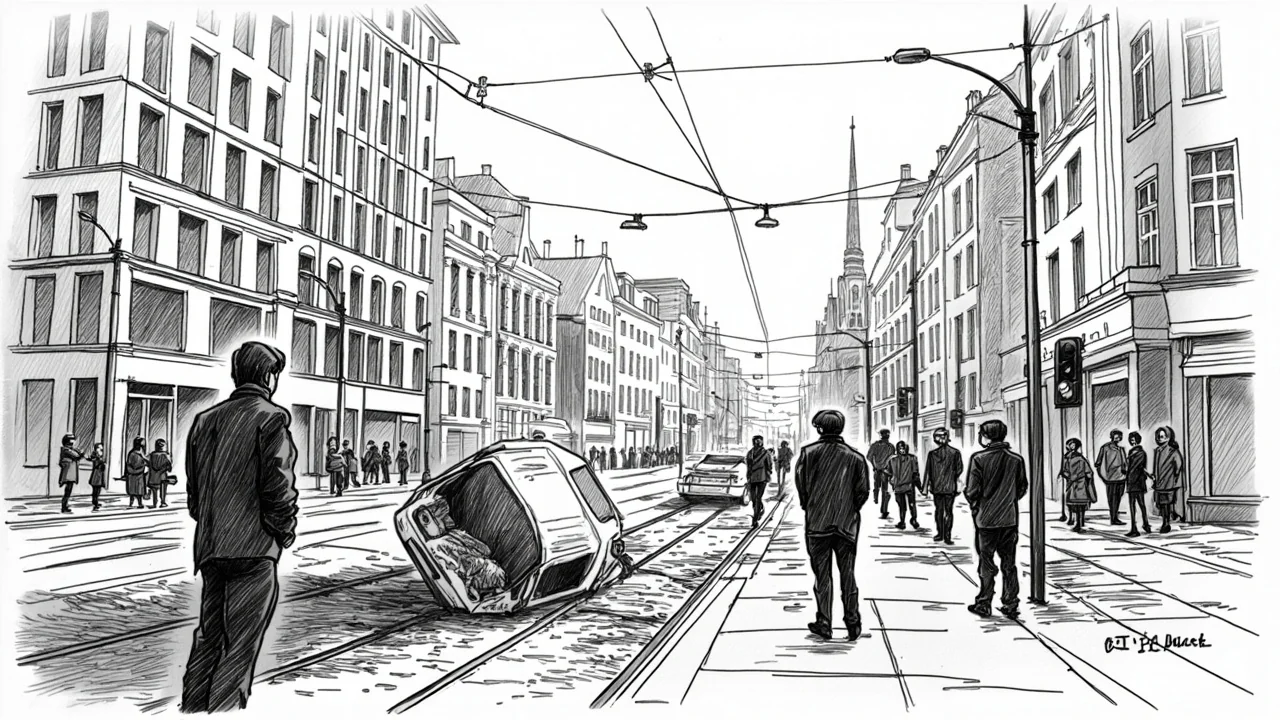
Copenhagen’s Tietgensbro bridge witnessed a 19-second emergency response after a serious collision Tuesday morning. A woman was injured and hospitalized when a vehicle struck her near the central station, an area used by 100,000 commuters daily. Police swiftly cordoned off the scene and detained the driver, launching an investigation that has temporarily disrupted the city's main transport artery. This incident immediately reignites a persistent debate about pedestrian safety and traffic design in Denmark's busiest urban corridor.
A Recurring Scene of Disruption
For the third time this year, blue police tape blocked access to Tietgensbro, the vital concrete link between Copenhagen Central Station and the rest of the inner city. The familiar sight of diverted buses and confused tourists highlights a vulnerability in the city's infrastructure. This bridge is more than a road; it is a primary funnel for foot traffic from the busiest transport hub in Scandinavia. Every incident here sends shockwaves through the city's mobility, exposing the delicate balance between vehicle access and pedestrian safety in dense urban spaces. As a reporter who has covered this intersection for years, the pattern is concerning. Each accident prompts temporary outcry and calls for change, yet the fundamental design challenges remain.
Local shop owner, Henrik Larsen, watched the aftermath unfold from his café window. “You hear the sirens, you see the tape, and business just stops,” he said. “But more than that, it’s the fear. People feel unsafe crossing here. It’s too wide, too open to speeding cars, and the signals seem to confuse everyone.” His sentiment echoes a common frustration. The area is a complex ecosystem of bicycles, taxis, delivery vans, buses, and thousands of pedestrians, many unfamiliar with the city layout. The Danish welfare system prides itself on safety and social protection, yet its most iconic public spaces can sometimes feel at odds with that promise.
The Integration of Safety into Urban Planning
This accident transcends a simple traffic report. It touches the core of Danish social policy, which aims to create secure, functional communities for all. Successful integration into Danish society, a key policy focus, includes safe access to public spaces and reliable infrastructure. When a key location fails repeatedly, it signals a policy gap. Copenhagen Municipality has invested heavily in cycling infrastructure, yet pedestrian zones like Tietgensbro remain contested territories. The city’s recent ‘Metropolis for People’ vision emphasizes livability, but its implementation faces tests at these critical junctures.
“Our investigations will determine the exact cause, but we cannot ignore the environment,” a senior Copenhagen police officer said in a background briefing. “When you have this volume of people, many distracted by phones or luggage, mixed with impatient drivers, the risk multiplies. Enforcement is one tool, but design is another.” This official perspective points to a necessary evolution in thinking. It moves the discussion from blaming individual drivers or pedestrians to examining systemic urban design. Danish immigration policy often stresses adaptation to societal norms, including traffic laws. However, the design of shared spaces must also adapt to the reality of a diverse, densely populated capital.
Data and the Human Cost
While national statistics show a general decline in serious traffic accidents, Copenhagen’s inner-city hotspots tell a different story. Data from the Road Directorate indicates that intersections near major transport hubs see a disproportionately high rate of collisions involving vulnerable road users. The human cost is measured in more than hospital visits. It creates a climate of anxiety and limits freedom of movement, particularly for families and elderly residents. For new arrivals navigating Copenhagen integration, a confusing or dangerous traffic environment can be a significant barrier to participation and a source of social isolation.
The injured woman’s condition was not disclosed, respecting strict Danish privacy laws. This legal protection is a hallmark of the Danish welfare system, but it can sometimes obscure the full human impact of such events. Community advocates argue that without public understanding of consequences, political will for expensive redesign projects can wane. “We need to talk about these incidents not as ‘accidents’ but as preventable outcomes of specific choices,” said Astrid Jørgensen, a urban planner with the nonprofit City & Citizens. “Do we prioritize the flow of a few hundred cars an hour over the safe passage of tens of thousands of people? Copenhagen’s answer should be clear.”
A Path Forward for Shared Spaces
The police investigation will conclude, the tape will come down, and traffic will resume its frantic pace. The critical question is whether this episode will fade or catalyze change. Copenhagen Municipality has pilot projects for pedestrianizing other areas, and the data collected from this incident will feed into those long-term plans. The challenge is aligning political timelines, budgetary constraints, and immediate public safety needs. The solution likely lies in a hybrid approach: immediate, low-cost interventions like better signage and extended crossing times, followed by a committed redesign.
This event serves as a stark reminder. The quality of Danish society is often judged in its shared spaces. A safe, efficient, and welcoming public realm is fundamental to social cohesion. As Copenhagen continues to grow and diversify, the pressure on its old infrastructure will only intensify. The response to this collision on Tietgensbro will reveal much about the city’s priorities. Will it continue to react, or will it finally redesign? The bridge’s concrete foundations are fixed, but the policies governing its use are not. The next chapter for this crucial corridor will be written by city planners, but it must be demanded by its citizens, for whom safety should never be a matter of chance.