
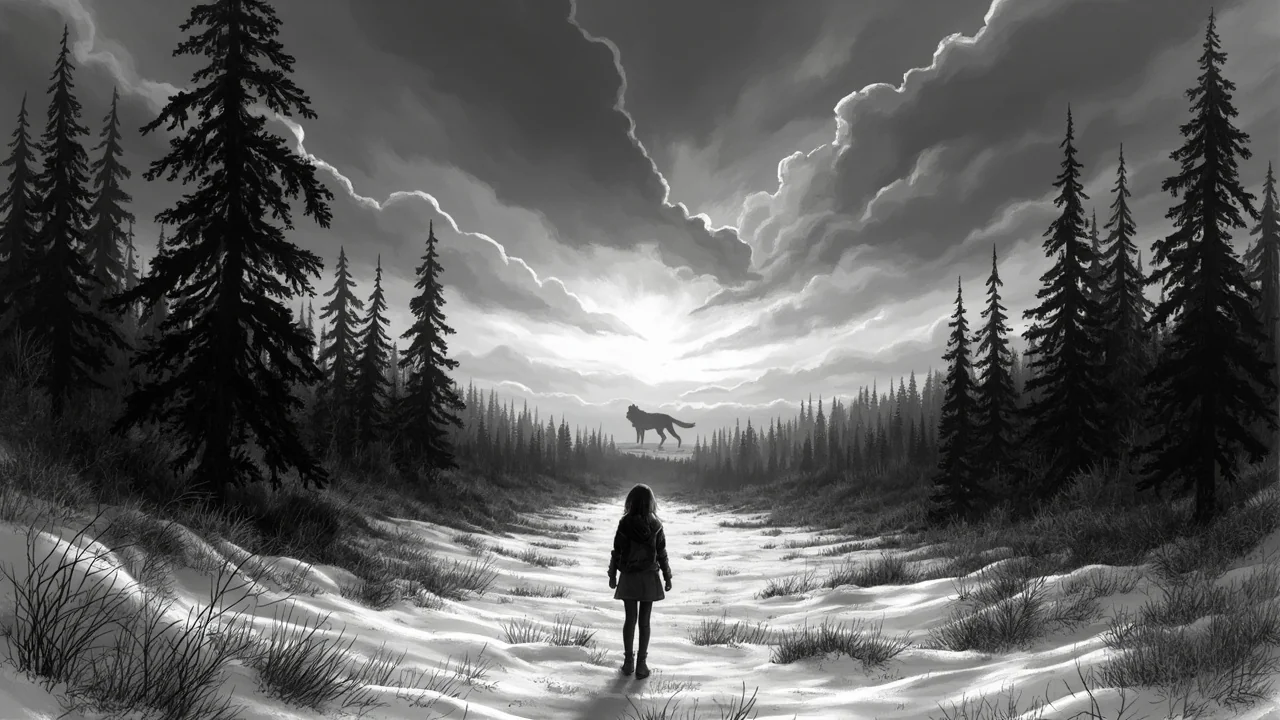
Denmark's environmental authorities have granted permission to shoot wolves that come within ten meters of people near the town of Oksbøl. The unprecedented order from the Agency for Green Transition and Water Management follows a Friday night incident where a wolf approached a 14-year-old girl in a forested area. The girl filmed the encounter, showing the animal pacing just meters away on a road before she was picked up by a passing couple. This event marks a significant escalation in Denmark's ongoing struggle to manage its small but growing wolf population, directly challenging the nation's conservation principles with immediate public safety concerns.
A Tense Encounter Captured on Video
The decision pivots on a single, chilling video recorded by a teenager. In the footage, the wolf moves back and forth on a quiet road near Oksbøl in Southwest Jutland, its proximity to the girl clear and unsettling. Authorities from the Agency for Green Transition stated that while they assessed the person was not in immediate danger, it was undoubtedly a frightening situation. This visual evidence provided the concrete justification for a dramatic shift in policy. Previously, the standard protocol involved scaring wolves away from human settlements. Now, if a wolf on the agency's lands near Oksbøl cannot be scared off and comes within that critical ten-meter distance, the Nature Agency has a green light to use lethal force.
This incident was not an isolated sighting. Oksbøl has recorded previous observations of wolves within its urban boundaries, prompting the establishment of a local wolf watch group last year. Comprised of volunteers, this group mobilizes when residents spot wolves in the town area. The repeated incursions suggest wolves are losing their natural wariness of humans in this specific region, a behavioral shift that alarms both residents and officials.
Balancing Protection and Public Safety
The authorization exposes the raw nerve at the center of Denmark's wolf debate: how to balance strict species protection with legitimate public security. Wolves are a protected species under both Danish and EU law. Their natural return to Denmark after a 200-year absence was initially celebrated as a conservation success. However, their presence has fueled persistent tension, particularly in rural Jutland where livestock owners have reported losses. The Oksbøl case, however, introduces a new dimension—direct, close-range encounters with people in semi-urban settings, moving the conflict beyond farmland and into community spaces.
In response to Friday's event, authorities and the local wolf watch have implemented several non-lethal measures. Thomas Sørup Mortensen, a spokesperson for the watch group, explained they have installed so-called 'fox lights' in multiple locations along the forest edge. These devices emit blinking lights designed to deter wolves from entering the town. Furthermore, the Nature Agency is setting up cameras in the woodland bordering Oksbøl to monitor wolf movements. These steps represent an attempt to re-establish a buffer zone between the wild animals and the community.
The Agency for Green Transition has been clear that these are the first steps. Their official news release on Tuesday stated that if wolves continue to enter the town despite these deterrents, authorities will consider additional measures for regulating the wolf population in Oksbøl. This language leaves the door open for further culling permits or other interventions, placing the local wolf pack under intense scrutiny.
A Community on Edge
For residents of Oksbøl and surrounding areas, the theoretical debate over wolves has become a tangible reality. The image of a wolf pacing near a child on a local road transforms policy discussions into urgent conversations about safety for families. The establishment of the volunteer wolf watch group itself indicates a level of community concern that pre-dates this latest incident. Residents are no longer just reading about wolves in distant forests; they are participating in citizen patrols and reporting sightings.
The psychological impact of such an encounter cannot be overstated. While statistically, the risk of a wolf attack in Europe remains exceedingly low, the feeling of vulnerability is profound. The agency's acknowledgment of the "frightening situation" validates these public fears, even as they clarify the objective risk was minimal. This distinction between statistical safety and perceived threat is crucial for understanding the political and social pressure that led to the shoot-to-kill order.
The decision also places local authorities and the volunteer group in a difficult position. Their primary role has been observation and non-lethal deterrence. The new mandate from the state introduces the possibility of a lethal outcome, for which they are not equipped or intended. The responsibility for any shooting falls to the national Nature Agency, creating a layered response where local volunteers monitor and national agents potentially execute.
A National Precedent in the Making
The Oksbøl authorization sets a significant national precedent. It establishes a specific, measurable threshold—ten meters—where a wolf's protected status can be legally voided in the name of public safety. Other Danish communities experiencing wolf proximity will likely look to this case. Could similar rules be applied in North Jutland or near other forest-adjacent towns? The decision creates a template that other municipalities may request, potentially normalizing lethal control in response to behavioral incursions, not just physical attacks.
This move will inevitably face scrutiny from conservation organizations. Denmark's wolf population is still tiny, estimated at only a few breeding packs. Conservationists argue that individual behavioral issues, often caused by habituation to humans sometimes through illegal feeding, should not result in policies that threaten the fragile population's recovery. They are likely to question whether all non-lethal avenues were truly exhausted and whether the response is proportionate.
The agency's statement emphasizes that shooting is a last resort, permissible only if the animal cannot be scared away. This attempts to position the order as a targeted safety measure, not a broad culling program. However, in the dense forests near Oksbøl, determining the moment when deterrence has failed and lethal force is justified will be a complex, high-stakes judgment call for the officials on the ground.
The Path Forward for Coexistence
The coming weeks in Oksbøl will be a critical test. The effectiveness of the new fox lights and surveillance cameras will be closely monitored. Every wolf sighting will now carry heightened tension, with residents wondering if it will end with warning lights or a gunshot. The local wolf watch volunteers will find their patrols carrying a new gravity, as their observations could directly trigger a state lethal response.
This situation forces a broader question about the future of large predators in modern Danish landscapes. Is true coexistence possible when wolves lose their fear of human infrastructure? Or does their protection inherently require maintaining a clear distance that has now been breached? The Danish model of welfare and regulated society is colliding with the unpredictable nature of rewilding.
The Agency for Green Transition has placed the responsibility for maintaining that distance back on the wolves themselves, with a fatal consequence for failure. The precedent is now set: in Denmark, the boundary of a wolf's territory is not just the edge of the forest, but a ten-meter radius around every person. As the cameras roll in the Oksbøl woods, the nation watches to see if the wolves will heed this new, starkly drawn line.