
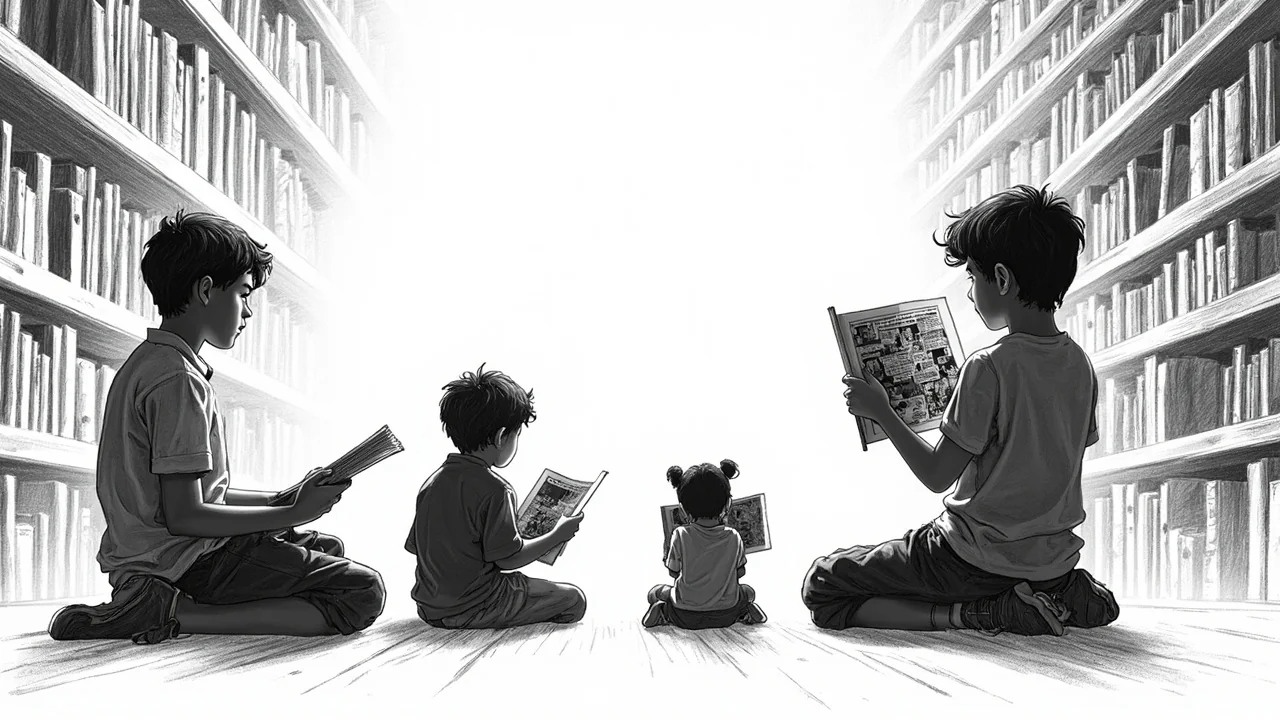
Denmark's reading crisis has pushed one in three 15-year-olds below the proficiency level needed to understand complex texts, a recent OECD PISA report found. To counter this, the government is launching a new national knowledge center dedicated entirely to comic books. The initiative aims to use the popular visual medium to reignite a passion for reading among children and young people who have increasingly swapped books for fleeting, screen-based media.
Culture Minister Jakob Engel-Schmidt outlined the grim reality that prompted the new national literature action plan. “We are experiencing a reading crisis where many children struggle to concentrate on reading a book,” Engel-Schmidt said. He emphasized that too few now experience the magical moment where imagination takes flight through literature. The plan's cornerstone is Tegneseriens Hus, or The House of Comics, a center funded with an initial 5 million kroner from the Danish Comic Council.
A National Strategy for Engagement
The center will not just celebrate comics as an art form but will actively develop and share knowledge on how illustrations and graphic novels can create more eager readers. Its primary role will be to advise schools and public libraries across Danish municipalities. It will also create teaching materials and methods designed to engage children and youth in voluntary reading. The ambition, according to the ministry, is for the center to eventually operate without state support, building a sustainable model for cultural education.
Matthias Wivel, chair of the Danish Comic Council, sees significant potential in the approach. “It is actually a very sophisticated form of expression, but it is accessible. That is why many will remember reading comics from their childhood,” Wivel said. He pointed to comics' unique blend of visual narrative and text as a bridge for reluctant readers. The strategy emerges directly from recommendations by a government-appointed Literature Working Group, which spent months analyzing how to get young people to open books again.
Why Comics Could Be the Key
Academic research and lending data from Danish libraries strongly support the focus. Marianne Eskebæk Larsen, a lecturer at Copenhagen University College and a member of the working group, confirmed the trend. “We can see from reading habit surveys, among other things, that children are really happy to read literature with pictures in it, including comics,” she said. Library lending figures nationwide show that illustrated literature is overwhelmingly popular with younger demographics, often flying off the shelves while traditional novels gather dust.
This pivot toward visual literacy acknowledges a fundamental shift in how young Danes consume stories. The action plan implicitly accepts that the battle is not to pull children away from screens and images entirely, but to meet them partway with a format that respects their visual vocabulary. By validating comics as legitimate literature, the government hopes to reduce the psychological barrier to reading. The center will compile and develop best practices, showing educators how to integrate graphic narratives into curricula in a way that builds confidence and skills.
Building on a Foundation of Success
The initiative is not creating demand from scratch but is instead institutionalizing a proven interest. Children's sections in libraries from Copenhagen to Aarhus already report that graphic novels and manga are among their most circulated items. The new center will systematize this organic popularity into a coordinated national effort. It will function as a hub, connecting comic artists with teachers and librarians, and ensuring successful local projects can be scaled and replicated in other communities.
Critics might question the investment in what some still see as a lesser art form. However, the government's literature plan frames it as a pragmatic and evidence-based response to a critical societal challenge. Literacy is a cornerstone of the Danish welfare model, essential for education, employment, and civic participation. Failing to adapt methods to the current generation risks deepening social divides, where reading ability becomes a key differentiator in future life chances.
The Road Ahead for Reading
The success of Tegneseriens Hus will be measured in its tangible impact on reading habits over the coming years. Can a dedicated focus on comics and visual storytelling move the needle on literacy rates and, more importantly, on the joy of reading? The project reflects a broader understanding in Danish social policy: effective integration into society, whether for immigrants or for youth disengaged from tradition, often requires meeting people where they are. For a generation raised on instant visual communication, the comic book is familiar territory.
The center's launch is a significant experiment in cultural policy. It bets that the gateway to a lifelong love of literature might not be a dense classic novel, but the next compelling graphic story. As one Copenhagen librarian noted informally, the goal is to create readers first, and the type of literature they eventually prefer can develop later. The five million kroner investment is a down payment on the idea that fostering any reading is better than fostering none, and in today's Denmark, that journey often starts with a speech bubble and a drawing.