
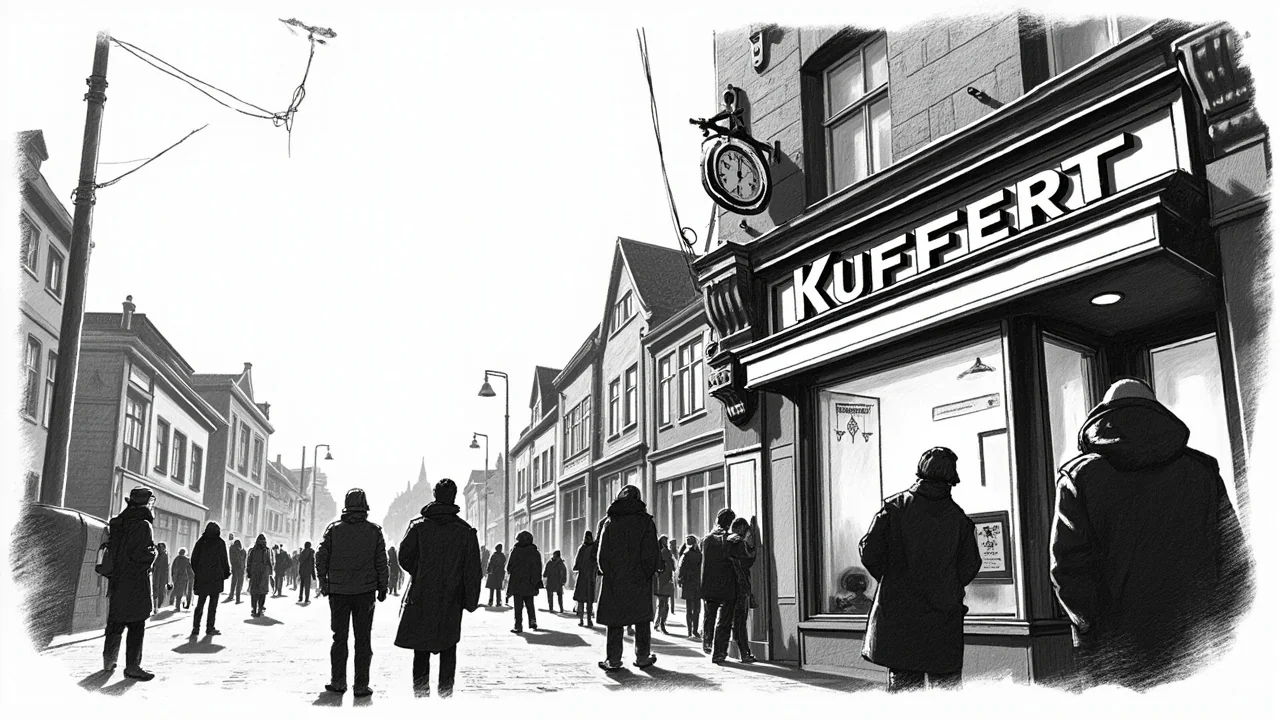
Denmark police and military bomb disposal units responded to a major security alert in central Odense Tuesday morning after a barber discovered a suspicious suitcase bearing his name. The incident, which triggered extensive street closures and a multi-agency response, was resolved without explosives found, but resulted in the arrest of a 50-year-old local man on threat charges.
Simon Jensen, owner of Jensen's Barbershop, found the suitcase at his shop's rear entrance around 9:24 AM. A note was attached. When he noticed a wire, he immediately contacted authorities, setting in motion a protocol that saw the bomb squad's robot, Rullemarie, fire a high-pressure water jet to neutralize the potential threat. "It was a frightening situation," Jensen later recounted, describing the moment he decided not to open the case himself.
A City Center on Hold
For several hours, a significant portion of downtown Odense became a security perimeter. Police cordoned off multiple streets, disrupting business and pedestrian traffic in the bustling area. The Danish Defence's EOD (Explosive Ordnance Disposal) team was deployed, a move reserved for credible threats. Their remote-controlled robot, Rullemarie, approached the suitcase deliberately. Its primary function is to disrupt potential explosive devices using targeted water jets, a method designed to render components inert without triggering a detonation.
This cautious, methodical response reflects standard Danish procedure for unattended and suspicious items. "The safety of the public is our absolute priority in these situations," a police spokesperson stated. "When there is any doubt, we treat the item as a real threat until proven otherwise." The operation concluded by early afternoon when investigators confirmed the suitcase contained no explosive material.
The Human Element of a Threat
While the physical threat proved false, the psychological impact and criminal intent behind the act remain very real. The personalization of the threat—a suitcase marked with the barber's name—transforms the incident from a generic scare to a targeted act. Simultaneous with the bomb squad's work, Funen Police investigators opened a separate case, leading to the swift arrest of a 50-year-old man from Odense Municipality.
He now faces formal charges for making threats. Police have not released a motive, stating further investigation is needed to understand the context. "The arrest shows our focus on following all leads, not just the physical object," the police spokesperson added. The scene near the barbershop remains cordoned off for forensic examination.
The Cost of Caution
Events like these, while ultimately false alarms, carry substantial social and economic costs. Local businesses within the cordon faced lost revenue during peak hours. Public transportation routes were altered. The deployment of specialized military and police resources represents a significant investment of public funds and manpower. Yet, experts argue this cost is non-negotiable in contemporary security landscapes.
"We cannot afford to be complacent," says Lars Bækgaard, a former police commissioner and current security analyst. "The protocols followed in Odense are the result of hard-learned lessons internationally. A swift, overwhelming response that errs on the side of caution is the only responsible approach, even if nine times out of ten it's a false alarm. The one time it isn't, it saves lives."
He notes that the integration of military EOD teams with local police is a well-practiced element of Denmark's national security preparedness. The use of robotics, like Rullemarie, also minimizes risk to human personnel.
Community Resilience and Aftermath
For Simon Jensen and his customers, the day's events will linger. Targeted threats against small business owners can create lasting anxiety and challenge the sense of security within a community. Odense, Denmark's third-largest city, is known for its tight-knit urban villages and vibrant street life. An incident that closes its core streets strikes at the heart of its civic identity.
Local community leaders often emphasize the importance of reporting suspicious activity, as Jensen did. His decision to call police rather than investigate the suitcase himself is precisely the behavior authorities encourage. "It is always better for us to check and find nothing, than for a citizen to take a risk," the police statement reiterated.
As the investigation continues, questions will focus on the arrested individual's motives and whether he acted alone. The charge of making threats can cover a broad spectrum, from personal disputes to more ideologically driven actions. The police have not suggested any link to organized crime or terrorism, but their ongoing forensic work aims to paint a complete picture.
A Reflection on Security Norms
This incident in Odense is a microcosm of a modern dilemma: balancing open, accessible societies with necessary security precautions. Denmark consistently ranks high in global safety indexes, a fact that makes such dramatic bomb squad deployments particularly jarring. They are reminders that safety is maintained through constant, often invisible, vigilance.
The successful resolution—no explosion, an arrest made—will be recorded as a textbook example of effective inter-agency cooperation. The system worked as designed to protect the public. Yet, the underlying mystery of why a man would allegedly plant a fake bomb at a barber's shop points to deeper, more complex issues of conflict and social friction that no robot can disarm.
For now, the streets of central Odense are reopening. The immediate fear has dissipated. But the memory of a tense morning, the image of a robot facing down a suitcase, and the unresolved questions about a neighbor's alleged threat will integrate into the city's story. It underscores that security is not just about responding to crises, but understanding what drives individuals to create them in the first place.