
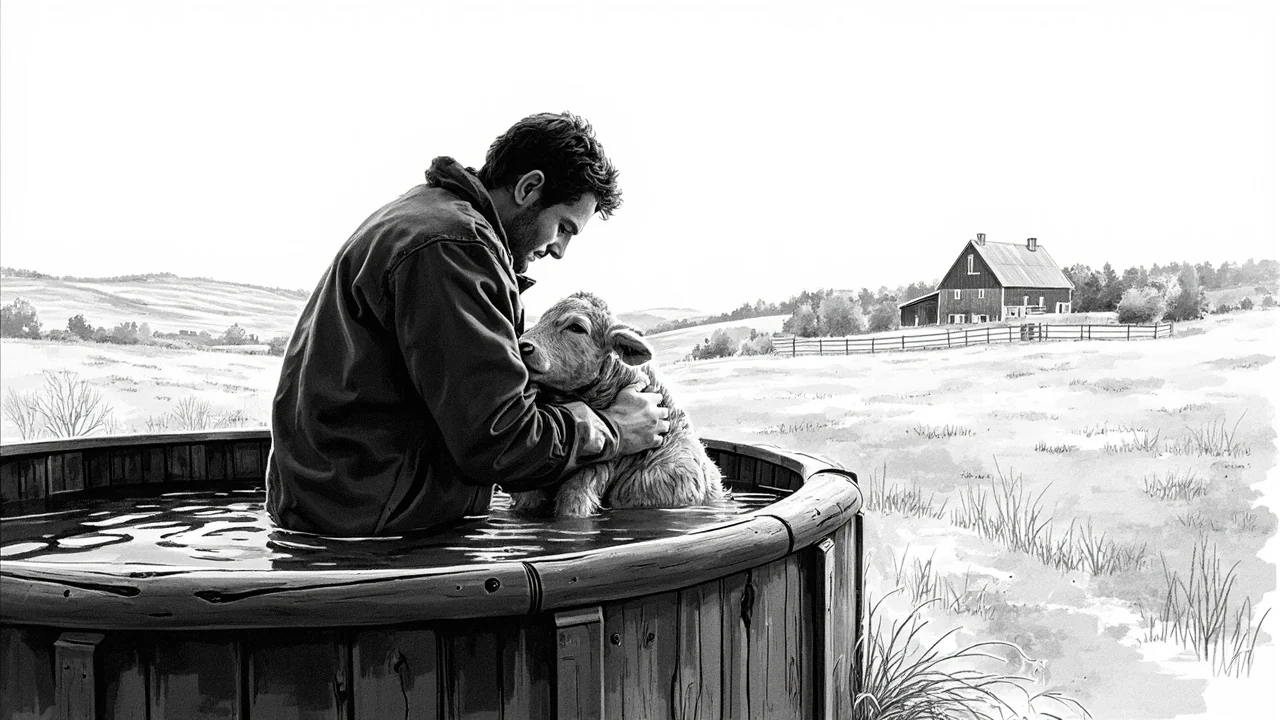
Denmark's Houen Thomsen family bathroom carries an unusual scent these days. It is not from soap or cleaning products but from a newborn Dexter bull calf named Moomi, who has found an unlikely sanctuary in the family's jacuzzi. Rejected by his mother at birth, the calf developed pneumonia and now recovers wrapped in blankets where humans usually relax. This small act of intensive care on a North Jutland farm highlights the daily realities and ethical considerations within Danish agriculture.
Jane Houen Thomsen explains the situation on their farm near Brønderslev. "Normally, the mother licks the calf clean and makes sure it gets some milk," she says. "But the cow just butted the calf, so we had to take care of it." Initial care with a heat lamp and milk replacer was not enough. When the calf grew weak over the weekend, a veterinarian diagnosed pneumonia. The subsequent failure of the heat lamp forced a creative solution. Their daughter, Sofie, carried the calf into the house, and it was settled on blankets inside the empty jacuzzi.
A Jacuzzi Becomes a Neonatal Unit
For the past day and a half, the jacuzzi has served as Moomi's intensive care unit. The enclosed space retains heat, providing a stable, draft-free environment crucial for a sick newborn. "He got his last shot of antibiotics today, so now we really hope it turns around," Jane Houen Thomsen says, acting as both farmer and foster mother. The calf's appetite is improving, a positive sign in its recovery. Beyond human care, the family dog, Ace, has taken an interest. "Ace has kind of taken over the mother's job and licks him clean when he has eaten," she notes. "It's lovely to see." This interspecies care adds a poignant layer to the story, illustrating the complex social bonds that can form on a working farm.
The Practical Realities of Small-Scale Farming
The story of Moomi is not just a charming anecdote but a window into the practical, often unromantic, decisions of running a livestock farm. The Houen Thomsens raise Dexter cattle, the smallest breed in Denmark. Originating from southwestern Ireland, these hardy animals weigh only 300-500 kilograms. They are primarily raised for beef and are also used for land maintenance, grazing on weeds like brambles on the family's land. The standard fate for a bull calf like Moomi in a beef herd is straightforward. "Normally we slaughter our bull calves and sell the meat in our farm shop," Jane Houen Thomsen states frankly.
However, Moomi's difficult start has altered his future. The family has decided he will not follow the usual path to the butcher. Instead, he is slated to take over from the farm's current breeding bull, Cornelius, when he retires. This decision reflects a personal investment that goes beyond economics. It is a choice born from the effort poured into saving his life and the attachment formed during his recovery in their home. "The family, especially our daughter Sofie, will miss the little calf when he moves back to the barn," Jane admits.
Animal Welfare at the Intersection of Care and Commerce
This incident touches on broader themes within Danish agriculture and animal welfare policy. Denmark has strict legislation governing livestock treatment, emphasizing freedom from discomfort, pain, and injury. Farmers are legally and morally obligated to provide necessary care for sick animals. The Houen Thomsens' actions—calling a vet, administering antibiotics, and improvising a warm recovery space—demonstrate this duty in practice. Their approach goes beyond the minimum, however, bringing the animal into their personal living space, which blurs the line between production animal and pet.
This blurring is a central tension in modern small-scale farming. Consumers increasingly seek transparency and ethical treatment, often envisioning idyllic scenes of animals in fields. They are less exposed to the more challenging realities: difficult births, rejections, illnesses, and the ultimate purpose of meat production. The jacuzzi calf story makes these realities visible. It shows the genuine care farmers can have for individual animals while operating within a system where most livestock are destined for consumption. It raises unspoken questions about the value assigned to life and the emotional labor involved in raising animals for food.
A Temporary Guest with a Permanent Impact
Life in the bathroom is temporary. "Even though it's cozy with a guest in the bathroom, the calf must soon be back on its feet," says Jane Houen Thomsen. Once recovered, Moomi will join the other cows in the barn, eventually assuming his role as the farm's new breeding sire. His story will become part of the family's lore, a tale of the calf that lived in the jacuzzi. His presence has already changed the dynamics of the household, engaging both the family dog and the daughter in his survival.
The episode also leaves a literal mark on the home. "Luckily, we'll get a slightly better smell in here in the bathroom when Moomi returns to his rightful element," Jane remarks with a smile. The unusual scent will fade, but the memory of this intensive care effort will remain. It serves as a reminder of the responsibility farmers hold and the unexpected measures sometimes required to uphold it. In a time when farming is often criticized or misunderstood, this story presents a raw, honest snapshot of its complexities—where care, commerce, life, and death intimately coexist.
Beyond the Heartwarming Headline
While the image of a calf in a jacuzzi is undeniably charming, it invites deeper reflection on our relationship with farm animals. Denmark's agricultural sector is a cornerstone of its economy and export market, built on high welfare standards and efficiency. Stories like this one humanize that sector, showing the individual attention possible, especially on smaller farms. They also highlight the emotional calculus farmers perform daily. The resources spent on vet bills, antibiotics, and time for a single calf represent an investment that may not be financially rational but is deeply human.
Ultimately, Moomi's second chance was granted by a combination of veterinary science, practical ingenuity, and compassionate intervention. His future as a breeding bull is a direct result of the bond formed during his recovery. Not every rejected calf on a Danish farm gets to recover in a jacuzzi or have its fate changed. This makes Moomi's story both special and illustrative. It shows what is possible when animals are treated as individuals, even within a system of production. As he moves from the warm tiles of the bathroom to the straw of the barn, he carries with him a small testament to the care embedded in the heart of Danish family farming, a care that sometimes requires thinking—and caring—outside the box.