
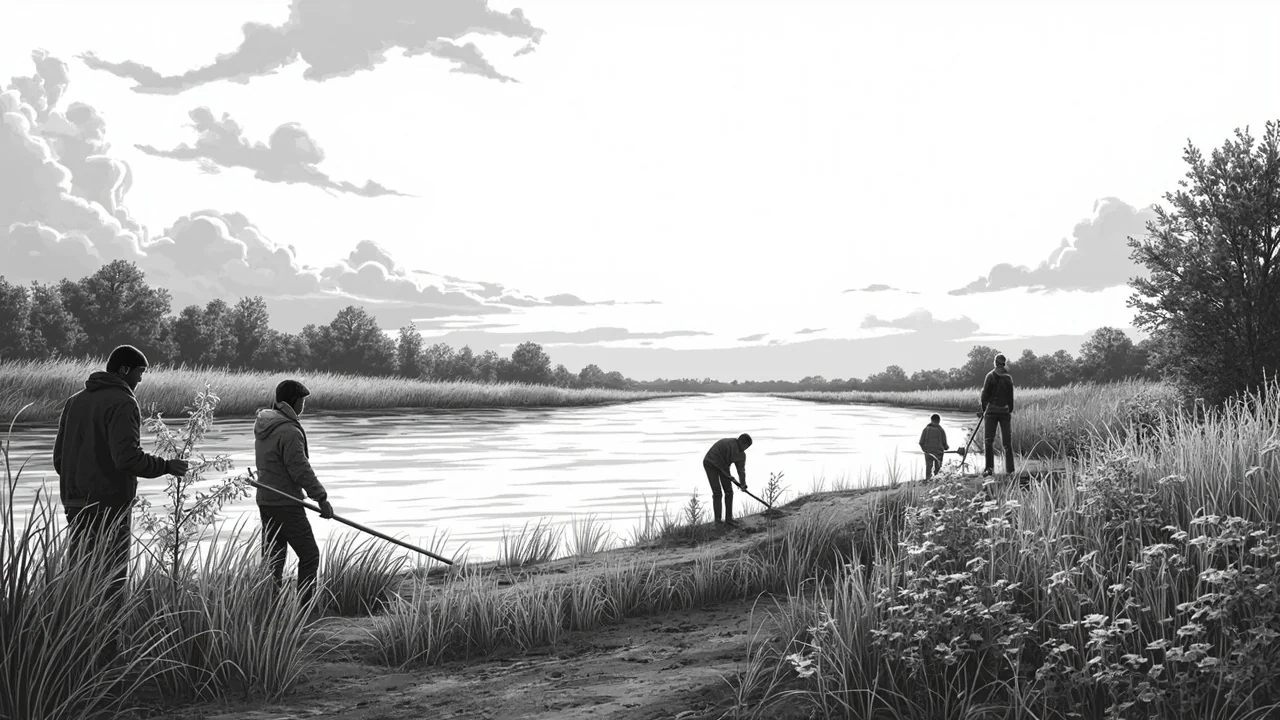
Denmark's largest EU-funded waterway project aims to repair a river that fails its environmental inspection 'with a bang'. The Gudenå River near Vestbirk has produced hydroelectric power for over 150 years. Now, Horsens Municipality and the Danish Nature Agency are starting excavation work to return a nine-kilometer stretch to its original, meandering course. The goal is to transform the river from a power source back into a healthy habitat for fish, insects, and plants.
A Failing Environmental Grade
Project leader Peter Eskildsen from Horsens Municipality explained the urgent need for intervention. 'Our streams, lakes, and fjords have biological quality standards they must meet,' Eskildsen said. 'For waterways, biologists examine insects, fish, and plants. It's like a car that goes for its inspection and fails because it can't brake. In the same way, the Gudenå fails with a bang.' The primary issue is poor water quality, stemming from over a century of human alteration. A dam built across the river created three artificial lakes, which have fundamentally changed a 3.6-kilometer upstream section.
Reclaiming a Century-Old Path
The project will focus on the area around Bredvad Lake, which will be split in two by a 1.7-kilometer-long dam. The dam is scheduled for completion in the spring of 2026. The eastern part of the lake will be preserved, while the restored river will wind through the decommissioned western basin. 'In the western side, the Gudenå's original course lies at the bottom,' Eskildsen noted. 'A ten to twelve-meter-wide watercourse will emerge, with what are, in Danish terms, relatively fast-flowing waters. No one has seen it in 100 years, and there are no pictures of it, so it will be quite exciting.'
The Human Impact on Hydrology
The historical modifications have had severe ecological consequences. The impounded lakes increased water depth and drastically reduced flow speed upstream. This change buried the original riverbed, which was once composed of stone and gravel, under sediment. The slower, warmer water created poor conditions for native species that thrive in cooler, oxygen-rich, fast-moving currents. The restoration directly addresses this by re-establishing natural flow dynamics, which will create spawning grounds and free passage for fish throughout the river system.
A Vision for a Wilder Future
Local officials have welcomed the ambitious project. Horsens Mayor Peter Sørensen highlighted the long-term vision. 'The Gudenå will lie as it did 100 years ago, with all the life that existed 100 years ago,' Sørensen said. 'The goal is to create more life and a better aquatic environment.' The €18 million initiative, supported by EU funds, represents a significant shift in priorities from industrial utility to ecological recovery. It acknowledges that past engineering for economic gain came at a steep cost to biodiversity.
The Mechanics of Rewilding
The technical work involves carefully dismantling a legacy of industrialization. Workers will excavate the old river channel from the western lake bed, following historical maps and geological surveys. This process will re-introduce the varied currents and depths essential for a diverse ecosystem. The new dam will permanently separate the managed eastern lake from the rewilded western section, allowing for different land uses in a single geographic area. The project is a complex balance of demolition and construction, aiming to erase one human footprint while carefully crafting another that heals the landscape.
A Broader Trend in Danish Environmental Policy
This project is not isolated. It fits within a wider Danish and European Union strategy to improve water quality and restore natural habitats under directives like the EU Water Framework Directive. Municipalities across Denmark are undertaking similar, though smaller, projects to reconnect rivers to their floodplains, remove obsolete dams, and re-meander straightened channels. The scale of the Gudenå project, however, sets a new precedent for what is possible when significant funding aligns with political and environmental will.
Listening to the River's Needs
The core philosophy is one of stepping back. For decades, management focused on controlling the river for energy and drainage. The new approach involves understanding and replicating the river's own intrinsic patterns. It requires humility, accepting that the natural design perfected over millennia is often superior to human engineering for fostering life. The project team, comprising hydrologists, biologists, and engineers, is essentially acting as midwives for a process the river would undertake itself if given the chance and the time.
What Success Will Look Like
Success metrics will be biological. Officials will monitor the return of specific fish species like trout and grayling that require clean, gravel-bottomed spawning grounds. They will track populations of stream insects, which are key indicators of water purity. The return of riparian vegetation along the new banks will also be a sign of health. The ultimate test is whether the river can once again pass its 'inspection'—not for brakes and lights, but for the vibrant, interconnected web of life it supports. When the excavators fall silent, the hope is that the sound of rushing water and the sight of thriving wildlife will tell the story of a river finally coming home.