
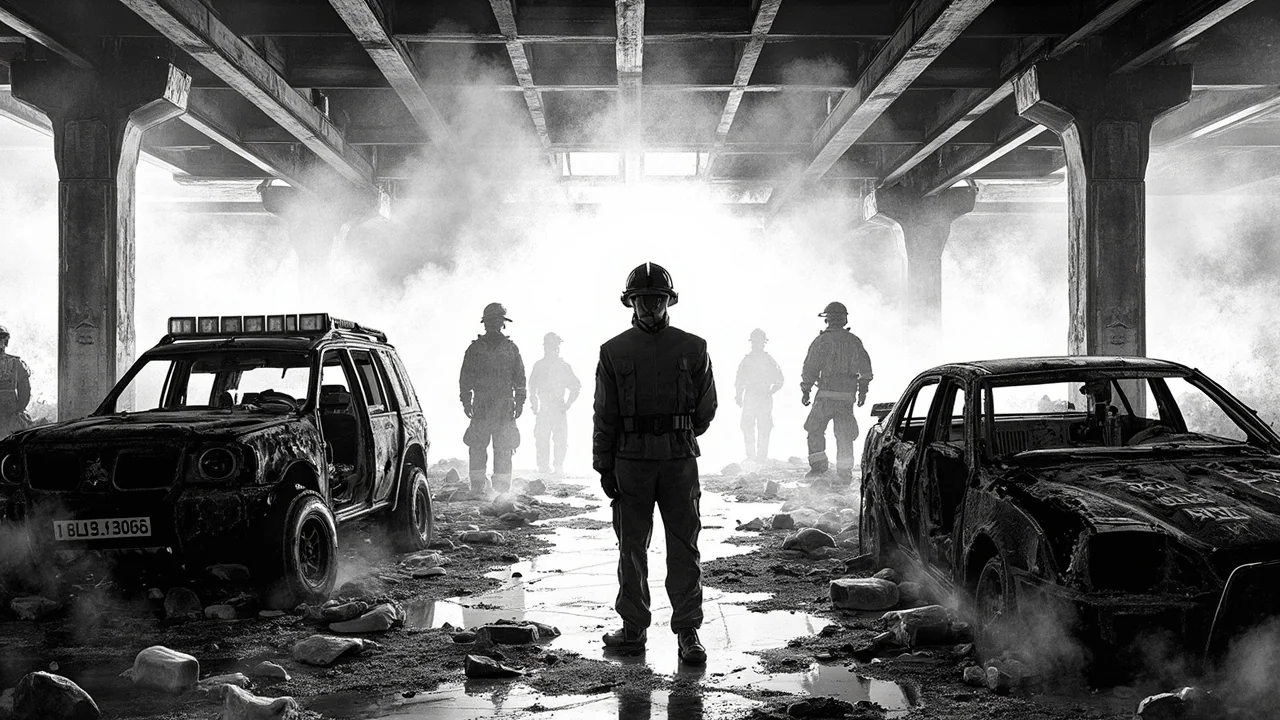
Denmark's latest urban safety crisis unfolded in Herning, where a Sunday evening fire has left a residential parking garage at risk of collapse. Police have cordoned off the entire structure on Thyrasvej, warning residents to stay clear. "People must not go inside," said Thomas Hald, the duty officer for Midt- and West Jutland Police. The blaze, which also engulfed one or more vehicles, produced toxic smoke that forced nearby residents to seal their homes. This incident exposes the fragile infrastructure beneath Denmark's modern housing developments and raises urgent questions about municipal safety protocols.
A Community on Edge
The fire broke out without warning in a garage built for approximately twelve cars. For residents of the quiet neighborhood, the event transformed a routine Sunday into a scene of emergency services and acrid smoke. Duty officer Simon Stage initially warned the community about the particularly harmful fumes, a common danger in modern vehicle fires involving plastics and synthetic materials. Now, the immediate threat of smoke has been replaced by the lingering danger of structural failure. The garage's compromised integrity means a section of the community's foundation is literally unstable, a disquieting reality for homeowners above. Such incidents, while localized, ripple through Danish society, testing the responsive capacity of local fire brigades and building inspectors.
The Hidden Cost of Suburban Living
This garage collapse risk in Herning is not an isolated engineering failure. It represents a broader, often overlooked vulnerability within Denmark's extensive suburban and urban housing stock. Many multi-unit dwellings constructed in the latter half of the 20th century feature underground parking facilities. These structures are subject to constant stress from vehicle weight, moisture, and temperature fluctuations. A intense fire can rapidly degrade reinforced concrete, weakening support columns and slabs in ways that are not immediately visible. The Herning municipality now faces a complex and costly assessment process. Engineers must determine if the structure can be salvaged or if a full demolition and rebuild is required, a process that could displace residents and create significant financial burdens for the housing association or private owners.
Municipal Response and Preventative Policy
The police warning underscores a critical phase in any Danish disaster response: the handover from emergency containment to long-term risk management. The Herning fire department extinguished the flames, but their work is only half done. They have likely provided initial assessments to the police and municipal building authorities. Now, specialized structural engineers must be brought in to conduct a detailed safety analysis. This process is governed by strict Danish building regulations (Bygningsreglementet), which set standards for fire resistance and structural integrity. A key question for local politicians will be whether current inspection regimes for such common infrastructure are sufficient. Are these garages, often out of sight, also out of mind during routine property maintenance checks?
A Personal Reflection on Danish Safety
Reporting on this story from Copenhagen, I am struck by the universal Danish expectation of safety in our built environment. We trust that our homes, schools, and parking garages are sound. This trust is a cornerstone of the social contract here, supported by a renowned welfare system that includes rigorous standards. When that trust is breached by a collapsing garage or a toxic fire, it feels like a personal violation of a national promise. The residents of Thyrasvej are not just dealing with inconvenience; they are grappling with a loss of security. Their experience forces a necessary conversation about proactive maintenance and the allocation of resources for inspecting aging infrastructure, not just in Herning, but in cities and towns across Denmark.
Looking Ahead: The Road to Recovery
The path forward for the Herning neighborhood is fraught with logistical and insurance complexities. The immediate police cordon will remain until engineers declare the area safe. Residents who parked in the garage have lost vital personal property—their cars—adding a layer of personal economic shock to the communal safety scare. Their insurance claims will become a case study in how Danish insurers handle combined property damage from fire and structural collapse. Furthermore, the investigation into the fire's cause will begin in earnest. Was it an electrical fault, a vehicle defect, or something else? The answer will determine liability and influence future safety recommendations. For now, the community waits, a stark reminder that safety is not a static condition but a continuous effort.
This event, though small in scale, holds a large mirror up to Danish societal priorities. We invest heavily in social welfare and healthcare, but how diligently do we invest in the silent, unseen skeletons of our cities? The collapse risk in Herning is a physical manifestation of a potential systemic blind spot. It challenges the comforting notion that Danish engineering and regulation are infallible. The true test will be in the response: whether this incident prompts a nationwide review of similar structures or fades away once the rubble is cleared. For the sake of every Dane who parks their car underground, we must hope it's the former.