
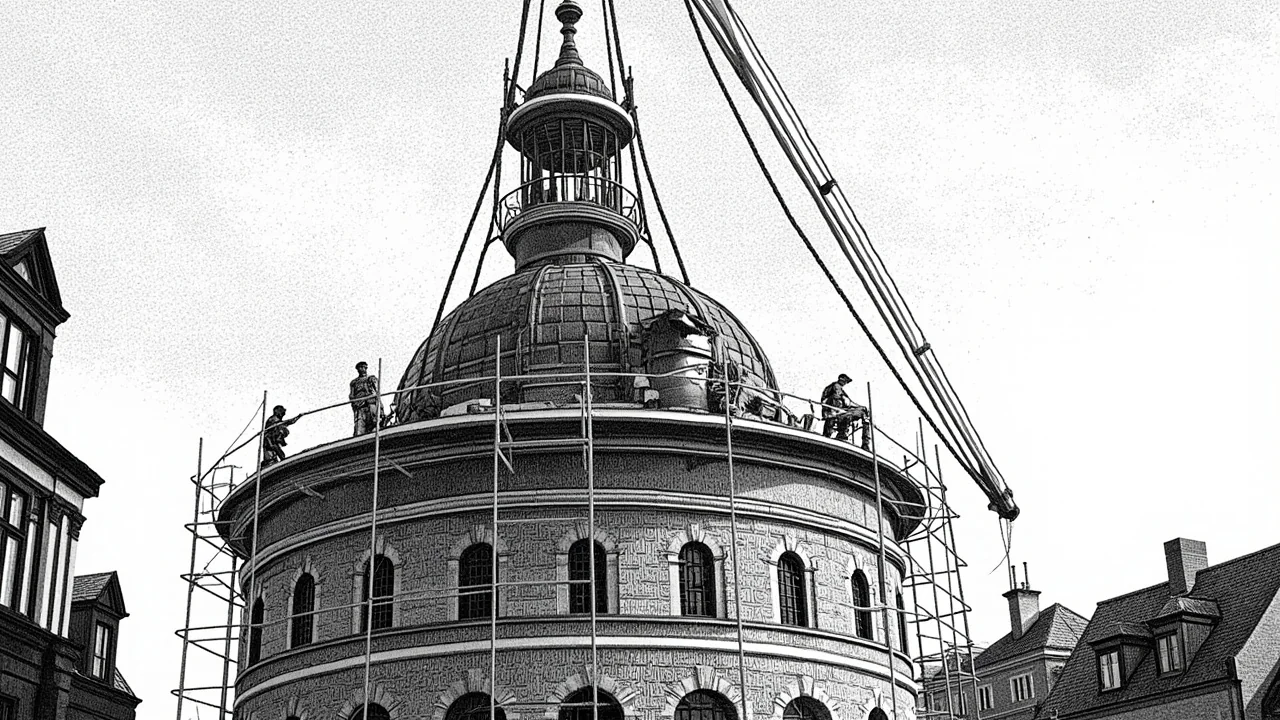
Denmark's historic Round Tower in Copenhagen is undergoing a major restoration, requiring its iconic copper dome to be carefully removed by crane. This complex engineering operation marks the first time the dome has been taken down since its last major renovation over a century ago. The project highlights the constant, often unseen, work required to maintain Denmark's cultural heritage within its celebrated welfare system. It also prompts a deeper conversation about how a society allocates resources to preserve its physical history while funding contemporary social needs.
A Delicate Operation in the Heart of Copenhagen
Crews began the meticulous process of detaching the green copper dome from its 17th-century brick base in the early hours. A large mobile crane, positioned on the narrow streets of the city center, was tasked with lifting the 4-ton structure and gently lowering it to street level. The operation required precise coordination between structural engineers, crane operators, and heritage conservationists. Traffic in the surrounding area was rerouted, and pedestrian access was restricted to ensure public safety during the lift. The dome will be transported to a specialist workshop where artisans will carry out a comprehensive restoration.
This involves replacing damaged copper plates, repairing the internal wooden framework, and applying new protective layers. The distinctive green patina, a result of copper oxidizing over centuries, will be preserved where possible. For Copenhagen residents and regular visitors, the sight of the tower without its crowning dome will be jarring. The structure, built by King Christian IV between 1637 and 1642, is a defining feature of the city's skyline and one of its most visited landmarks. Its spiral ramp, leading to a panoramic viewing platform, has attracted everyone from astronomers to tourists for nearly 400 years.
Balancing Heritage and Modern Priorities
The restoration project, funded by the state through the Palaces and Culture Agency, is estimated to cost several million kroner. In a country with a strong focus on social welfare and egalitarian principles, such significant expenditure on historical monuments can spark debate. "Every kroner spent on our shared cultural heritage is an investment in our national identity and a gift to future generations," argues a senior curator with the agency. "The Round Tower is not just a building; it is a symbol of Danish history, science, and resilience."
However, this perspective is sometimes challenged in discussions about municipal budgets. Community center leaders in neighborhoods like Nørrebro or Vestegnen might note the tension between funding for grand national projects and the need for local social infrastructure. "When we discuss integration and social cohesion, we talk about investing in people and communities today," says a social worker from a Copenhagen integration hub. "These historical projects are important, but so is ensuring our libraries, community centers, and youth programs are well-funded." This is not an either-or proposition in a wealthy nation like Denmark, but it reflects a constant prioritization process within the welfare state.
The Silent Work of Preservation
The dome's removal is a rare visible moment in the otherwise silent, ongoing work of preservation. Denmark's social model is often discussed in terms of healthcare, education, and unemployment benefits. Less frequently highlighted is the systemic, tax-funded commitment to maintaining the nation's physical history—from Viking ring fortresses to Renaissance castles and functionalist housing blocks. This preservation is itself a form of social policy. It fosters a sense of shared history and continuity, which sociologists argue contributes to social trust, a key component of Danish society.
Maintaining these structures also provides skilled employment in traditional crafts, from masonry to copper-smithing. The apprenticeship required for such work aligns with Denmark's strong vocational training system. The project manager on site emphasized the specialized knowledge being applied. "We are using modern engineering techniques to solve age-old problems," he said, watching the crane's progress. "But the actual restoration of the copper will rely on craftsmanship that hasn't changed much in hundreds of years. It's a blend of the old and the new."
A Temporary Change to the Cityscape
For the next several months, the Round Tower will stand with its top covered by a temporary protective cap. The observatory platform, normally accessed after a walk up the wide spiral ramp, will be closed. The library hall and other interior spaces remain open to the public. The disruption, while significant, is planned to be relatively short-term. The entire restoration is scheduled for completion within a year, allowing the dome to be lifted back into place, gleaming with renewed copper that will slowly return to its familiar verdigris hue over the coming decades.
This cycle of care—observe, maintain, restore—is a slow-motion echo of the Danish welfare system's approach to its people. Both require long-term planning, professional expertise, and a collective agreement to invest in the future. The sight of the crane in the old city center is more than a construction update; it is a physical manifestation of a societal choice. It represents a decision to actively maintain a link to the past while firmly operating in the present. As one passerby, a local teacher, remarked, "It looks strange now, bare. But it's good to know we're looking after it. It means my students' children will be able to see it too, just as we have."
What does a society choose to keep, and what does it allow to fade? The careful lowering of the Round Tower's dome is Denmark's answer, played out not in political rhetoric, but in copper, brick, and the steady hum of a crane.