
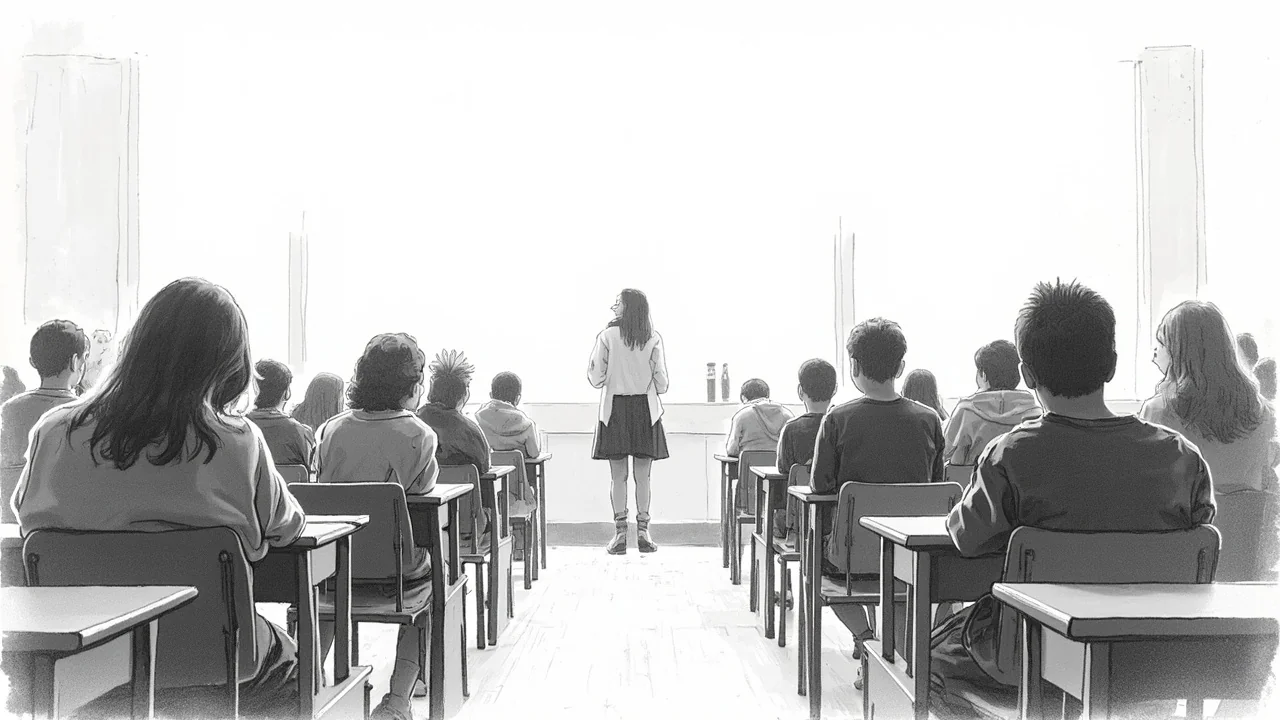
Denmark’s Social Democrats, led by Prime Minister Mette Frederiksen, have launched a major education policy proposal to cap class sizes at just 14 students for the youngest school children. The plan, which the party will take to the next general election due by October 31, promises to transform the early school day but comes with a 5-billion-kroner annual price tag and no detailed funding plan.
Frederiksen announced the policy in an interview, framing it as creating a “small school within the public school.” The proposal targets the kindergarten class (0th grade) and grades 1 through 3. “We propose to create a small school within the public school, so that future pupils in kindergarten class, 1st, 2nd, and 3rd grade get a school day that, for many children, will be very different from the one they have today,” she stated. The key mechanism is a strict class size limit. “Namely, by ensuring that in the future there will only be 14 children in the class,” Frederiksen said.
A Response to Parental Concerns and Wellbeing
The Prime Minister positioned the idea as a direct response to parents. She said the concept of a lower class size ceiling was “primarily proposed by parents.” While asserting that “we have a good school” in Denmark today, she argued “it can be made even better.” The policy’s stated goals are to reduce school refusal and improve student wellbeing by allowing for more focused teaching and individual attention in the crucial early learning years.
Currently, Danish law sets a maximum of 26 students per class for the early grades (0-3) and 28 for grades 4 through 9. The proposed reduction to 14 represents a dramatic shift. Frederiksen promised the proposal would be “at the very top of our agenda” for the upcoming election and that the Social Democrats would place “particular emphasis” on it in any subsequent government negotiations.
Teacher Support Meets Political Skepticism
The immediate reaction from Denmark’s largest teachers’ union was overwhelmingly positive. Gordon Ørskov Madsen, chairman of the Danish Union of Teachers, said he found it “hard to contain my enthusiasm.” He underscored the daily challenges in today’s classrooms. “A class ceiling of 14 students will really be noticeable. Today, the teacher is all too often alone with 26 students, and that means there is too much firefighting and too little time for good teaching,” he said in a statement. This endorsement highlights the potential the policy holds for improving working conditions for educators and the learning environment for children.
However, the proposal’s reception among opposition parties was cool, centering squarely on its cost and financial vagueness. The Social Democrats estimate the annual cost at 5 billion kroner but have not presented a financing model. Frederiksen stated the details would come “at a later date” and confirmed the money would not come from the existing economic fiscal space—meaning it would require new taxes, reallocations, or cuts elsewhere.
This lack of a funding plan drew sharp criticism. Jan E. Jørgensen, political spokesperson for the Liberal Party (Venstre), expressed skepticism. He is “doubtful that” the proposal will not cost more than the Social Democrats’ estimate. Similarly, Mohammad Rona, political spokesperson for the Moderates, stated a clear precondition for further discussion: “I would like to see the financing.” This political pushback sets the stage for education funding to be a key battleground in the election campaign.
The Central Question of Billions
The unresolved 5-billion-kroner question dominates the practical and political analysis of the proposal. A policy of this scale, affecting the foundational years of education, requires significant and sustained investment in physical infrastructure and, crucially, in hiring many more teachers. Denmark, like many nations, already faces challenges in teacher recruitment. Implementing such a low cap would exponentially increase demand for qualified early-grade teachers, a logistical hurdle alongside the financial one.
Critics argue that announcing a major spending commitment without a funding plan risks irresponsibility. Supporters counter that the investment in early childhood education pays long-term dividends in improved educational outcomes, better mental health, and a more skilled future workforce. The debate will force voters and other parties to consider whether this specific intervention—extreme class size reduction—is the most effective use of such a vast sum compared to other educational needs like teacher salaries, special needs support, or facility upgrades.
A Defining Election Pledge
By placing this “small school” model at the heart of their election platform, the Social Democrats are making a clear play for families with young children and positioning education as a top-tier issue. The proposal taps into widespread parental concerns about child wellbeing and academic pressure in the school system. The powerful imagery of a near-halved class size is easy for voters to grasp and presents a compelling vision of more tranquil, attentive early learning.
The policy’s fate is entirely tied to the election result. If the Social Democrats lead the next government, they have pledged to make it a negotiation priority. Its implementation would then depend on their ability to secure support from other parties, which will inevitably demand answers on the financial mechanics. The proposal, therefore, is not just an education policy but a political marker that will influence coalition mathematics and define the Social Democrats’ campaign promises.
Ultimately, the proposal for a 14-student class limit sets up a fundamental choice. It asks whether Denmark should make a historically large investment to fundamentally restructure the beginning of its public education system. While the goals of reducing distress and improving teaching quality are universally shared, the path to achieving them—and the price tag—will be hotly contested in the months leading to the ballot box.