
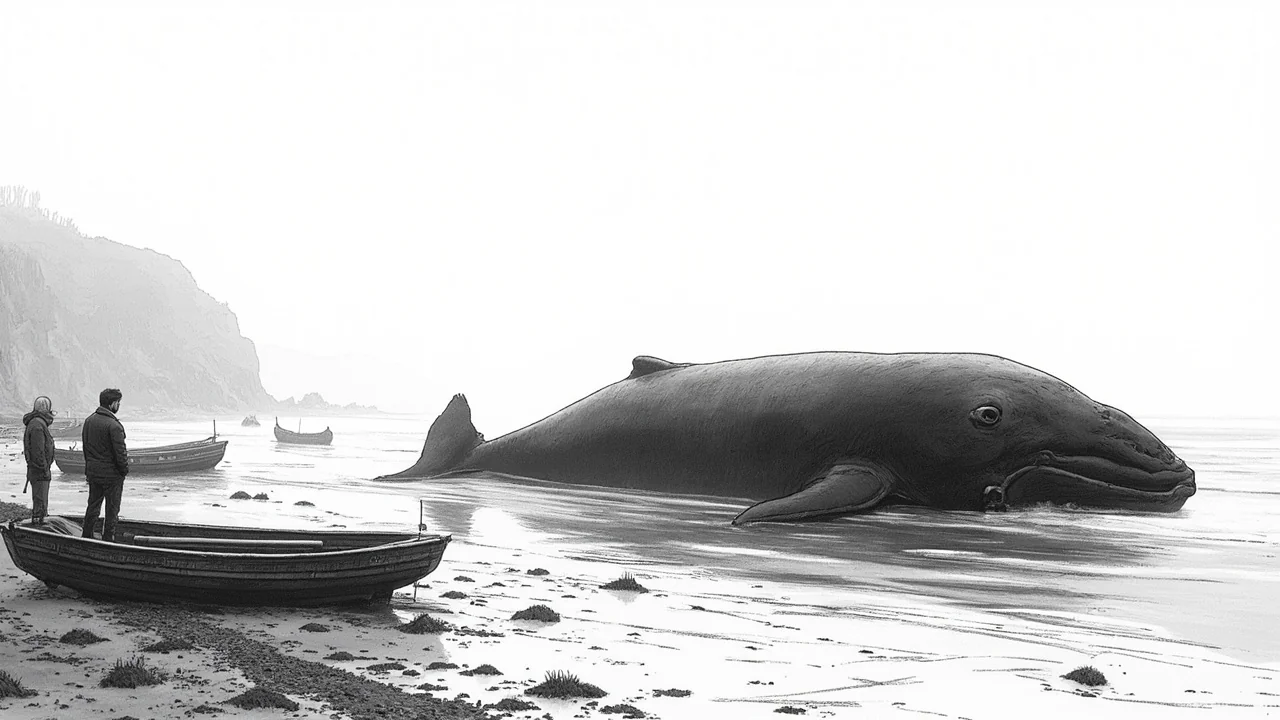
Denmark's northern coast has become the final resting place for a rare sperm whale, found dead in Ålbæk Bugt near Skagen this past Saturday afternoon. The 13.7-meter-long whale, a species not seen stranded on Danish shores since 2016, has prompted a coordinated response from national authorities. The Nature Agency confirmed the death after an inspection, though the cause remains unknown. This event marks a significant and infrequent occurrence in Danish maritime history, drawing attention to the delicate balance of marine life in regional waters.
A Solemn Discovery in Skagen
Local observers first spotted the massive sperm whale in the shallow waters of Ålbæk Bugt, a bay area known for its rugged beauty near Denmark's northern tip. The Nature Agency swiftly arrived to assess the situation, measuring the whale at 13.7 meters in length. Officials noted that the whale was already deceased upon discovery, eliminating any possibility of rescue efforts. The scene presented a stark contrast to the usual coastal activities, with the carcass drawing curious onlookers and concerned citizens. Authorities quickly cordoned off the area to begin planning for the next steps, emphasizing the need for careful handling due to the whale's size and condition.
Historical Rarity in Danish Waters
This stranding is notably rare, as the last recorded sperm whale on Danish coasts was in 2016, when a dead whale washed ashore on Fanø. Sperm whales, typically deep-sea creatures, are uncommon visitors to the Baltic Sea and surrounding Danish waters. Their appearances often signal unusual oceanic patterns or individual distress. The 2016 incident similarly involved a dead whale, and scientific examination then provided limited insights into migration anomalies. The recurrence after eight years highlights the sporadic nature of such events in Denmark, where marine mammal strandings are monitored closely but occur infrequently compared to other regions.
Coordinated Recovery Efforts Underway
The Nature Agency is now collaborating with the Maritime and Fisheries Museum to develop a plan for recovering the whale's body. This process involves logistical challenges, given the remote location and the whale's substantial weight, estimated to be several tons. Recovery operations aim to transport the carcass to a facility where a thorough autopsy can be performed. Danish authorities have experience in such endeavors, leveraging municipal resources and expert teams to ensure minimal environmental impact. The collaboration underscores Denmark's structured approach to natural events, where agencies work in tandem to address both scientific and practical concerns.
Scientific Quest for Answers
A primary goal of the recovery is to enable a detailed autopsy, which researchers hope will reveal the whale's cause of death. Scientists from the Maritime and Fisheries Museum will lead the examination, looking for clues such as disease, injury, or evidence of human interaction like ship strikes or pollution. The autopsy may also provide data on the whale's age, diet, and overall health, contributing to broader studies on sperm whale populations in the North Atlantic. While results are pending, the investigation aligns with Denmark's commitment to marine research, often supported by national funding for environmental science. Previous strandings have yielded valuable information, though conclusions can be elusive without clear indicators.
Understanding Whale Strandings in Denmark
Whale strandings in Denmark are documented events that occasionally capture public interest, though they remain rare due to the country's geographical position. Most strandings involve smaller species, with sperm whales being exceptional cases. The Danish Nature Agency maintains records of such incidents, using them to inform conservation policies and marine management strategies. In this instance, the stranding occurs in a region with active fishing and shipping lanes, prompting questions about potential anthropogenic factors. However, without evidence, authorities refrain from speculation, focusing instead on factual analysis through the upcoming autopsy. This cautious approach reflects Denmark's evidence-based policy-making in environmental matters.
Broader Implications for Marine Conservation
While this event is isolated, it resonates within Denmark's ongoing discussions about ocean health and biodiversity. The country's welfare system extends to environmental protection, with agencies like the Nature Agency playing a key role in monitoring ecosystems. Findings from the whale's autopsy could inform future policies on marine protected areas or shipping regulations, though any such links would require further study. For now, the focus remains on understanding this individual case. As Denmark balances economic activities like fishing with conservation, rare events like this serve as reminders of the ocean's mysteries and vulnerabilities.
Awaiting Findings and Future Steps
The recovery operation is expected to proceed in the coming days, with the autopsy scheduled shortly thereafter. Scientists anticipate preliminary results within weeks, which will be shared with the public and international research communities. The whale's body may be used for educational purposes or disposed of in an environmentally safe manner, following Danish protocols. This process highlights the interplay between local authorities and scientific institutions in Denmark, where social policies often integrate environmental stewardship. As the investigation unfolds, it offers a moment for reflection on humanity's relationship with marine giants, underscoring the need for continued vigilance and research in Danish waters.