
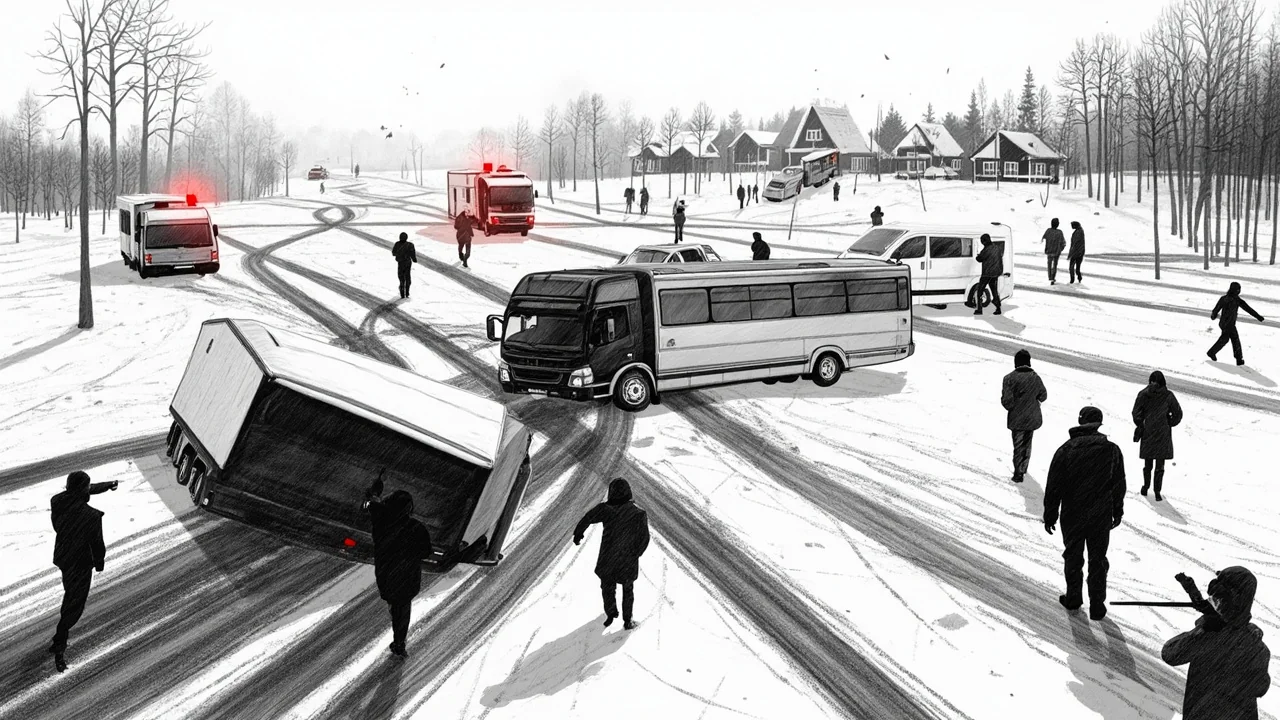
Denmark's Monday morning commute descended into chaos as three separate traffic accidents, linked to sudden snowfall and icy conditions, brought key roads to a standstill. The most significant incident occurred on Route 269 Haslevvej between Ringsted and Haslev on Zealand, where authorities halted all traffic in both directions. Details on potential injuries remain unclear, compounding the morning's disruption.
A second accident was reported on the Alssund Bridge towards Kliplev, with the status of those involved also unknown. Meanwhile, on the northbound Køge Bugt Motorway, a collision involving two vehicles in the second lane from the left created growing traffic queues, prompting emergency services to scramble to the scene. This series of incidents underscores the immediate and severe impact of Denmark's volatile winter weather on its transportation infrastructure and public safety.
A Morning of Cascading Disruption
The accidents created a ripple effect across the region's road network. With Route 269 completely closed, drivers were forced to seek lengthy alternative routes, increasing congestion on secondary roads. The blockage on the Køge Bugt Motorway, a critical artery into the Copenhagen area, threatened to disrupt commercial logistics and delay thousands of commuters. These incidents occurred despite police warnings issued earlier in the morning urging caution due to sleet and black ice. The speed with which conditions deteriorated highlights a perennial challenge for Danish municipalities and road authorities.
Each winter, Denmark allocates significant resources to its winter maintenance program, known as 'vintervedligehold'. This involves a fleet of gritting trucks and coordinated response plans. However, sudden meteorological events like the one this morning—where sleet turns to ice rapidly—can outpace even the best-prepared services. The concentration of multiple serious incidents in a short timeframe suggests conditions were particularly treacherous, catching many drivers off guard during the peak travel period.
The Human and Economic Toll of Winter Roads
While the immediate concern is for the well-being of those involved in the crashes, the broader impact is substantial. Traffic standstills have a direct economic cost in lost productivity, delayed goods, and increased fuel consumption. For individuals, it means missed appointments, late arrivals at work or school, and significant stress. As a reporter who has covered Danish social policy for years, I see these events as more than traffic reports; they are sudden stressors on the welfare system's ideal of smooth, efficient daily life.
Danish society is built on predictability and trust in system functionality, from public transport to road safety. When that predictability shatters on an icy road, it creates a domino effect. Emergency services are diverted, workplace schedules collapse, and family logistics are thrown into disarray. The social contract in Denmark's high-functioning welfare state implicitly includes safe, reliable infrastructure. Days like today test that contract, revealing how vulnerable mobility is to the whims of Nordic weather.
Expert Perspectives on Preparedness and Response
To understand the response, I spoke with a former traffic planner for a large Danish municipality, who wished to remain anonymous as they are no longer an official spokesperson. "The protocol is clear," they explained. "Priority one is securing the accident site and caring for the injured. Priority two is managing traffic flow to prevent secondary accidents, which often occur in these conditions. A full closure, like on Route 269, is never a first resort but a necessary one when scene safety or recovery operations demand it."
The expert pointed out that communication is a critical, yet often critiqued, component. "Drivers need real-time, accurate information to make alternative plans. The challenge is that situations evolve minute by minute—what starts as a two-car collision can require a crane, turning a one-hour closure into a three-hour one." They emphasized that Danish road authorities are among the world's best prepared, but nature introduces variables that are impossible to fully control. Public adaptation, through adjusted driving behavior and heeding warnings, is the other half of the equation.
A Recurring Seasonal Challenge for Danish Society
This morning's events are not an anomaly but a feature of Danish winters. Statistics from the Danish Road Directorate show that adverse weather contributes to a marked increase in accidents annually between November and March. The societal response is ingrained: news bulletins feature weather warnings, employers often show flexibility, and a collective awareness of 'winter driving' takes hold. Yet, as today proves, routine warnings can lead to complacency, and the first major weather event of a season always catches a portion of the public unprepared.
The infrastructure itself is designed for this climate. Roads use specific asphalt mixes for frost resistance, and bridges like the Alssund are equipped with automated de-icing systems. However, the transition periods—when temperatures hover around freezing and precipitation changes form—are the most dangerous. This is when the sophisticated systems and driver vigilance are both pushed to their limits. It represents a fascinating, if dangerous, annual interaction between Danish engineering, social planning, and the natural environment.
Looking Ahead: Safety in the Season of Darkness
As the clean-up continues and traffic slowly normalizes, the questions turn to prevention. Danish traffic safety campaigns consistently focus on winter preparedness: checking tire tread depth, increasing following distance, and adjusting speed to conditions. The police statement from earlier this morning, which preceded the accidents, contained this exact advice. The gap between receiving that advice and implementing it in the moment, however, can be vast for a driver rushing to work on a dark, cold Monday.
The ultimate takeaway from today's chaotic morning is a reminder of shared vulnerability. In a country famed for its cycling culture and efficient public transport, the private car remains essential for many, especially in rural areas outside major cities. Its dependence on clear roads binds Danes to the weather in a fundamental way. The winter test will repeat itself many times before spring. The success of Denmark's response is measured not in avoiding all incidents—an impossible task—but in minimizing harm through preparation, clear communication, and a collective cultural emphasis on safety over speed. For the drivers caught in today's queues and the emergency workers responding, that lesson is now etched in the icy pavement.