
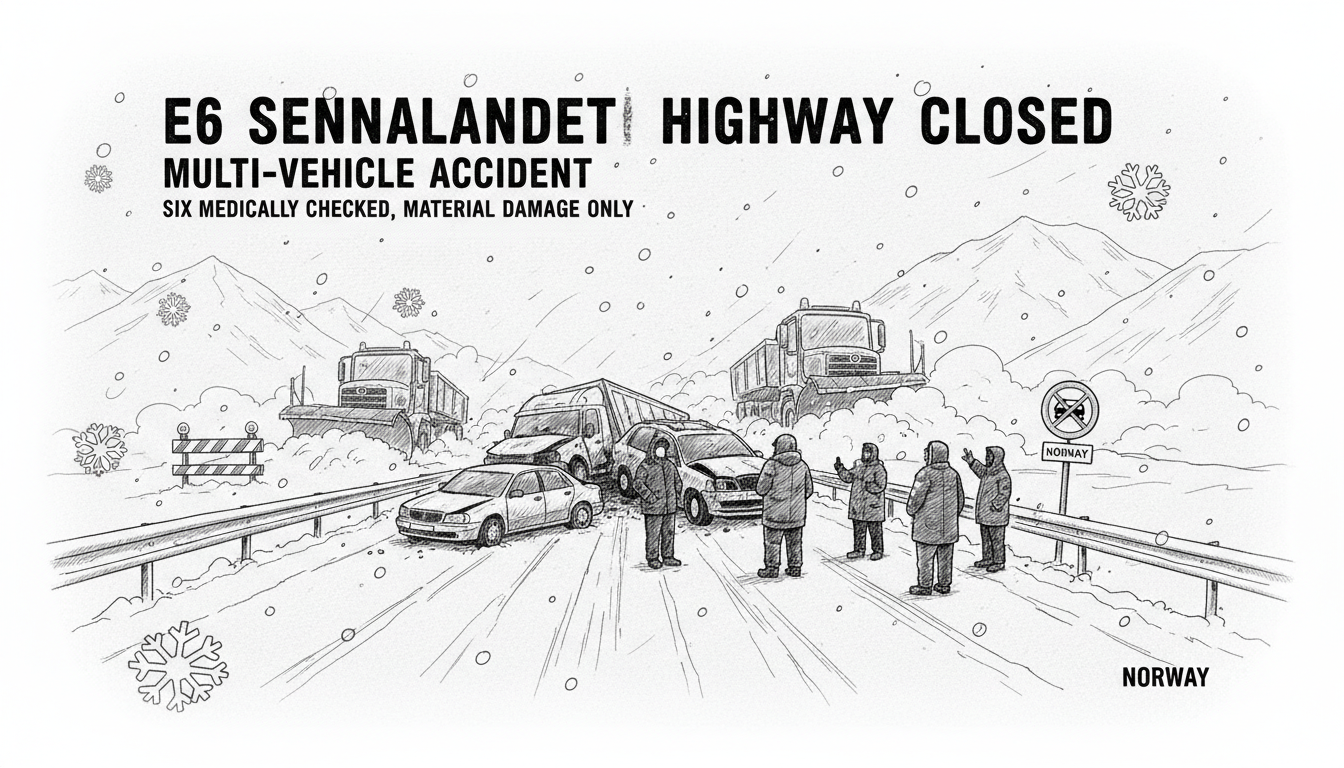
Norwegian authorities closed the E6 highway at Sennalandet following a multi-vehicle accident during challenging winter conditions. Police initially reported two separate incidents involving five vehicles but later clarified the situation involved three vehicles with distance between them.
Operations manager Jan Arne Pettersen confirmed six people were involved in the collision. All received medical checks at the scene. Officials reported only material damage to the vehicles involved.
The accident occurred during heavy snow showers across Sennalandet on Monday evening. Traffic operator Fredrik Nyland described conditions as demanding with poor visibility in some areas. He noted the three vehicles involved in the main incident ended up off the roadway.
Police suspect the accident began when two oncoming vehicles slightly brushed against each other. Authorities have ruled out impairment as a contributing factor. Recovery vehicles were dispatched to clear the scene as snowplow crews maintained continuous operations in the area.
This incident represents another in a series of road accidents in Finnmark county today. Earlier, emergency services recovered a vehicle in Nordkapp municipality amid similar winter conditions.
Norwegian winter driving presents unique challenges that international readers should understand. The country's extensive mountain passes like Sennalandet experience rapidly changing conditions. Heavy snow showers can reduce visibility to near-zero within minutes. Ice formation on road surfaces creates particularly hazardous driving environments.
Norway maintains extensive winter road maintenance operations. Crews work around the clock to keep major arteries like the E6 open. The E6 highway serves as a critical transportation corridor connecting northern and southern Norway. Its closure disrupts both local travel and commercial transport routes.
Drivers in Norway must adapt to these conditions by using winter tires, reducing speed, and maintaining greater following distances. The country's strict driving regulations and comprehensive emergency response systems help manage these seasonal risks. Still, accidents remain common during the transition periods between seasons when drivers may not yet have adjusted to changing road conditions.
Road authorities could not provide an exact reopening time for the Sennalandet section but indicated it would likely reopen shortly. The continuous snow removal operations help minimize closure durations even during active snowfall periods.