
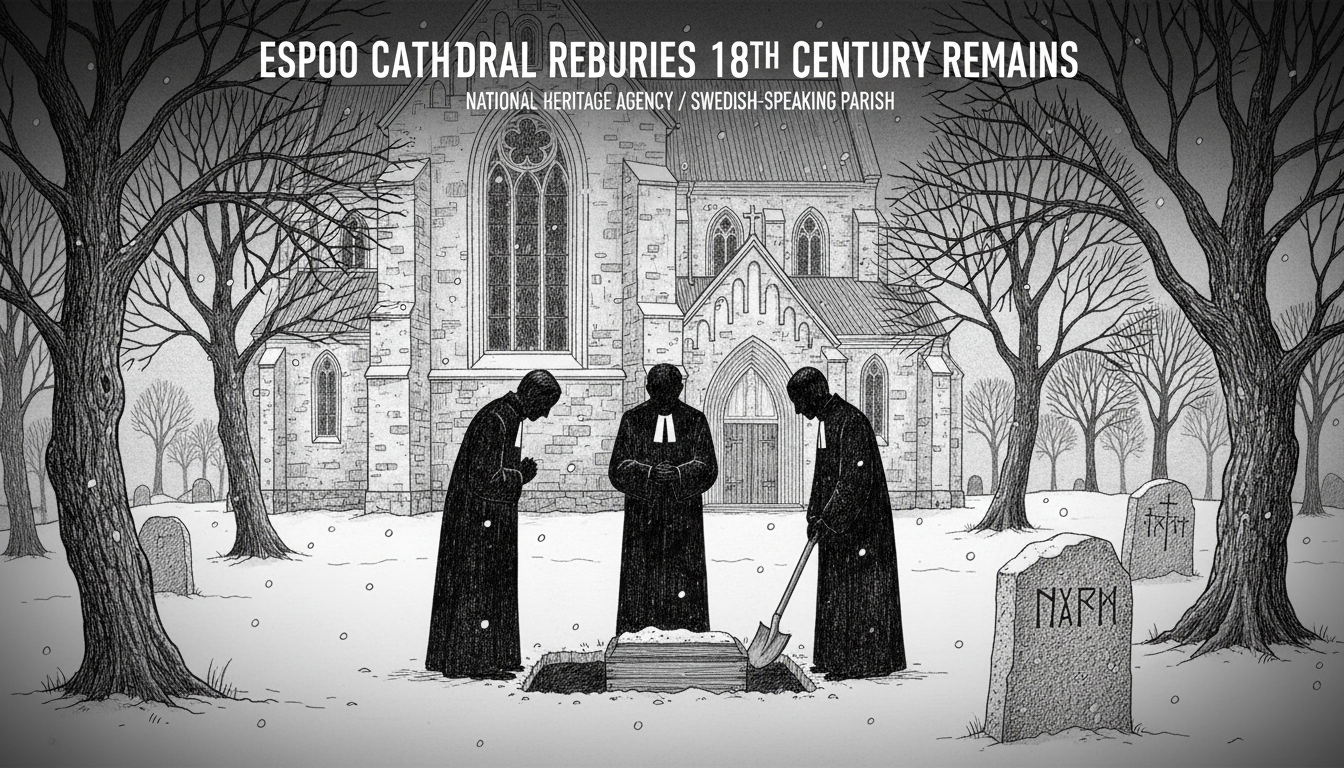
Three sets of human remains, estimated to be from the 18th century, received a formal burial in the cemetery surrounding Espoo Cathedral on Wednesday. The discovery occurred during excavation work for the medieval cathedral's ongoing renovations. An archaeologist supervising the dig immediately reported the find to the National Heritage Agency, as required by Finnish law.
The National Heritage Agency conducted an examination of the remains. The analysis confirmed the individuals were adults who lived approximately three centuries ago. Due to the heavily decomposed state of the bones, officials determined further scientific study or DNA sampling was not feasible. The agency then released the remains for reburial.
Juha Ollila, head of burial services for the Espoo Parish Union, explained the decision. He said the agency saw no possibility to continue research or obtain DNA samples because the remains were in such an advanced state of decay. This is a common outcome with very old, poorly preserved skeletal finds, where organic material has largely disappeared.
The burial was conducted by Esbo svenska församling, the Swedish-speaking parish of Espoo. This choice reflects the area's historical linguistic demographics, as Espoo was predominantly Swedish-speaking in the 1700s. A tree will be planted at the gravesite later, and a memorial plaque will be installed to mark the location.
Kira Ertman, the vicar of Esbo svenska församling, emphasized the ceremony's core purpose. She stated it is always important to respect human dignity, a principle guiding all such reinterments. The parish handled the service with the same solemnity accorded to contemporary burials.
According to the Espoo Parish Union, excavation work in the cathedral area is now complete. No further discoveries of this nature are anticipated, allowing restoration projects to proceed without further archaeological delays. This process highlights the standard Finnish protocol for managing unexpected historical finds during construction, balancing development with cultural heritage preservation.
This event is not an isolated case in Finland. Urban development and renovation of old church sites, particularly in the growing Helsinki capital region, frequently encounter historical graves. Finnish law mandates archaeological oversight for ground disturbances in areas of known historical significance. The discovery of centuries-old remains in Espoo, a now-bustling suburban city, underscores the layers of history beneath modern Finnish infrastructure.
The reburial also touches on contemporary discussions about memory, respect, and urban identity. As Finnish cities densify, decisions about how to treat unearthed history become more common. The Espoo case shows a straightforward administrative and ethical path: scientific assessment when possible, followed by dignified recommitment to the earth. It is a quiet but consistent practice that avoids the controversies seen in some other nations regarding ancient remains.
For international observers, this story illustrates Finland's methodical and legally structured approach to cultural heritage. There is no dramatic conflict or political debate, simply a procedure followed to its logical, respectful conclusion. The system works as intended, protecting both the past and the needs of the present.