
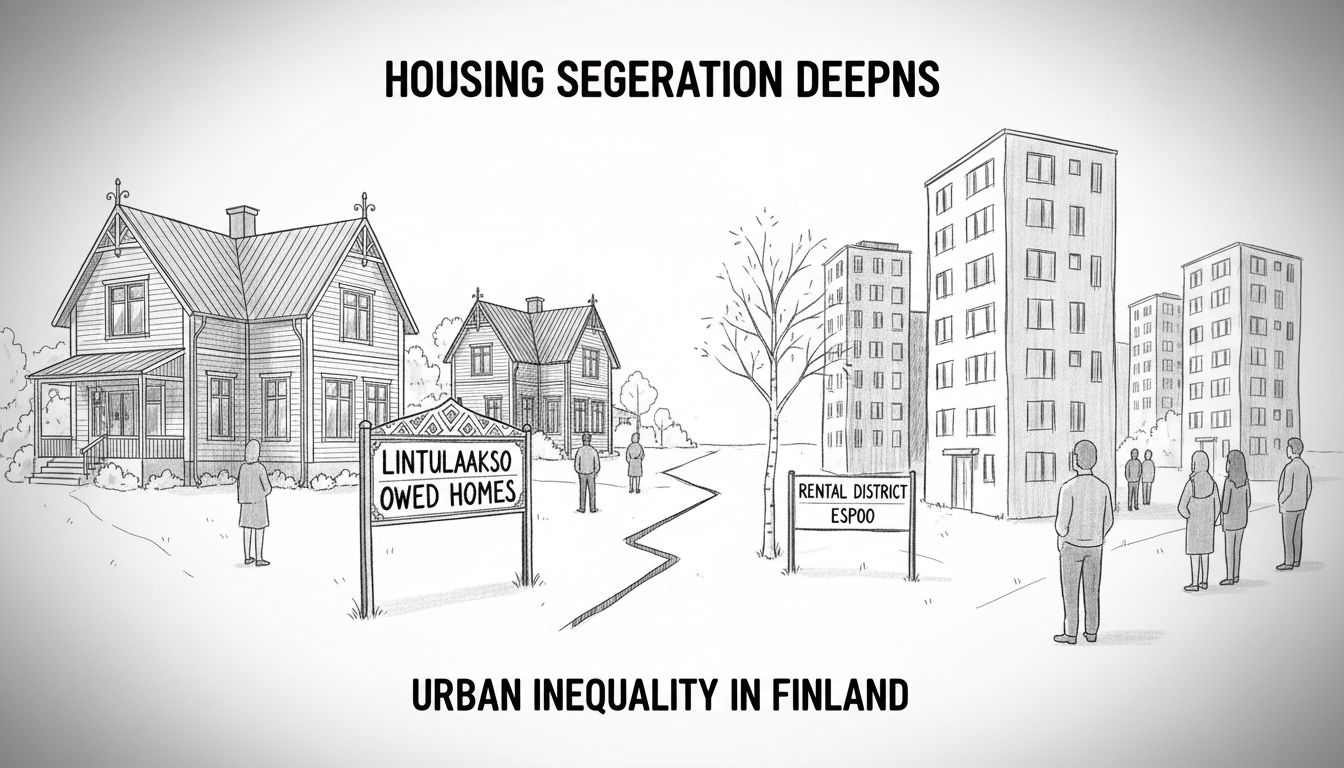
The cherished Lintulaakso neighborhood in Espoo represents Finland's growing housing segregation challenge where rental apartments remain scarce. Researchers confirm Espoo's residential areas are becoming increasingly divided by socioeconomic status. This development raises important questions about urban planning and social equality in Finnish cities.
Lintulaakso resident Timo Saarnio enjoys the neighborhood's peaceful atmosphere while pushing his sons Eero and Olli in Leppävaara resident park. The park sits exactly on the border between Northern Leppävaara and Lintulaakso residential areas. Saarnio does not perceive the area's overwhelming homeownership rate as problematic for community dynamics.
The scenery could belong to any small Finnish town with its distinctive character. Massive pine trees and thuja hedges line the sandy roads flanked by row houses on spacious lots. Small birds create constant background music from garden bushes throughout the neighborhood.
Urban researchers identify this pattern as part of Espoo's gradual transformation toward Swedish-style housing segregation. The city's development strategy has consciously created distinct residential zones with different ownership structures. This approach contrasts with Helsinki's more mixed housing policies that combine rental and owned apartments within neighborhoods.
Finland's second largest city now faces crucial decisions about its urban future. The current trajectory shows clear separation between ownership-dominant areas like Lintulaakso and rental-concentrated districts elsewhere. Municipal planners must balance neighborhood character preservation with social diversity goals.
Espoo's city council recently debated new housing regulations that would require mixed ownership models in future developments. The proposal received support from center-left parties but faced opposition from conservative representatives. They argued for maintaining local character and property values in established neighborhoods.
The European Union's urban development guidelines emphasize inclusive cities with reduced spatial segregation. Finland's implementation of these principles varies significantly between municipalities. Espoo's current approach places it among European cities with moderate to high residential segregation levels.
International residents and newcomers to Finland should understand these housing patterns when choosing where to live. The distinction between rental-heavy and ownership-concentrated areas affects community dynamics, services, and daily life. Espoo's western neighborhoods typically feature higher ownership rates while eastern sectors offer more rental options.
Future urban development in the Helsinki metropolitan area will likely address these segregation concerns through revised zoning policies. The current government's housing program emphasizes creating more diverse neighborhoods across Finnish cities. Municipal elections next term may significantly influence Espoo's approach to residential planning.
What does this mean for Finland's social fabric? Housing segregation often leads to educational segregation and unequal access to public services. The Nordic welfare model traditionally emphasized mixed neighborhoods as foundation for social cohesion. Espoo's development challenges this principle through its current urban structure.
Urban researchers continue monitoring these trends across Finnish cities. Their findings inform national housing policy and municipal planning decisions. The ongoing transformation of Espoo's residential areas provides important case studies for understanding urban development in Nordic welfare states.