
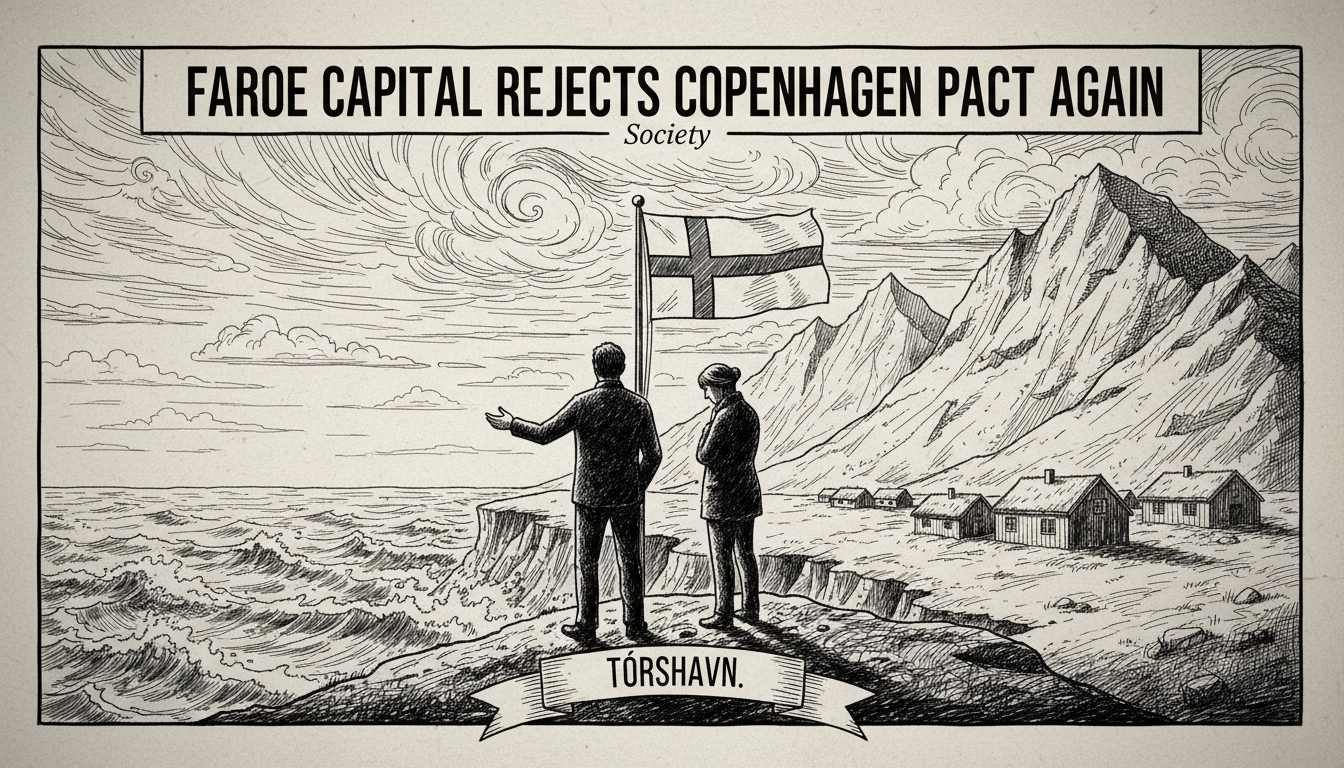
Denmark Faroe Islands relations face a subtle but telling strain as Tórshavn declines a sister city agreement with Copenhagen for the second time. This polite refusal from within the Kingdom of Denmark highlights ongoing negotiations over identity and autonomy. It comes despite Copenhagen's push to strengthen bonds across the rigsfællesskabet with Greenland's Nuuk. For observers of Danish society and integration policy, the move signals deeper currents about self-determination and resource allocation.
A Polite But Firm Refusal
Carina Heinesen á Rógvu, the municipal coordinator in Tórshavn, cited prioritization as the core reason. 'It is a matter of where we focus our efforts and resources,' she explained in a written statement. The invitation from Copenhagen's City Hall sought to establish a formal cultural and educational exchange. This would have involved school trips between the three capitals of the Danish realm. Tórshavn's administration delivered its negative answer just days before Christmas, offering no further elaboration to Copenhagen politicians.
The rejection repeats a decision made two years prior. It leaves a planned triangular friendship pact between Copenhagen, Nuuk, and Tórshavn incomplete. Such agreements are common tools to foster people-to-people connections and mutual understanding. Their absence here is conspicuous, occurring within a political family that often emphasizes unity.
Autonomy and Identity in Focus
The Faroe Islands have governed their own internal affairs since 1948. They are a self-governing community within the Kingdom of Denmark. This arrangement grants control over areas like education, culture, and tax policy. Defense, foreign affairs, and currency remain under Danish purview. This dynamic creates a constant, low-level dialogue about the boundaries of autonomy.
With a population of just 54,000, the Faroese are deeply protective of their distinct Norse-Gaelic culture and language. Tórshavn, as the capital, houses roughly 14,000 residents. Local analysts suggest the sister city rejection is a quiet assertion of this separateness. It is a signal that not all initiatives from Copenhagen align with Faroese priorities or self-image.
'This isn't about hostility,' says a Copenhagen-based diplomat familiar with the relations, who spoke on background. 'It's about agency. The Faroese are meticulous about choosing their partnerships. They want engagements that feel reciprocal, not paternalistic.' This sentiment echoes in other areas, such as fisheries management and economic subsidies, where negotiations can be delicate.
Resources and Political Messaging
The concept of prioritization mentioned by Heinesen á Rógvu is practical. A small municipality like Tórshavn must weigh every commitment. Organizing student exchanges requires administrative capacity and funding. These are finite resources in a tight-knit community. Choosing to forgo this pact may simply reflect a full plate of local projects.
Yet, the symbolic weight is unavoidable. Sister city agreements are rarely just about school trips. They are soft diplomacy tools that build long-term networks. By saying no, Tórshavn controls its external narrative. It avoids being framed as one point in a Danish-led triangle. Instead, it asserts its role as a capital in its own right, with global connections beyond the kingdom.
Some experts see a political dimension. 'There is always an undercurrent of independence politics in the Faroes,' notes a researcher from the University of the Faroe Islands. 'While full independence isn't the immediate goal of the current government, every act of self-assertion matters. Declining a well-meaning offer from Copenhagen is a low-cost way to demonstrate self-sufficiency.' This doesn't rupture relations but adds a layer of complexity to Danish social policy aimed at cohesion.
Implications for Danish Integration Models
From my perspective covering Danish society, this event offers a mirror to mainland Denmark's own approaches. Denmark's integration policies often emphasize adaptation and shared civic culture. The welfare system is built on a model of relatively homogeneous social trust. Initiatives like cross-kingdom exchanges aim to extend that model, fostering a common identity.
Tórshavn's decision challenges the assumption that such overtures are always welcome. It underscores that integration, even within a kingdom, cannot be a one-size-fits-all prescription. Successful partnerships require acknowledging differing priorities and levels of autonomy. For Copenhagen's policymakers, the rejection is a case study in the limits of top-down cultural bridge-building.
The situation contrasts with Greenland's Nuuk, which reportedly remains interested in the trilateral pact. Greenland also has self-rule but faces different economic and social challenges. Its engagement might reflect alternative strategic calculations. This divergence between the two autonomous territories itself is instructive for understanding the nuances of the Danish state.
A Look to the Future
Will Copenhagen extend the invitation a third time? City Hall officials have not publicly commented on future plans. The ball is now in their court to interpret the silence from Tórshavn. They might seek a different, less formal approach to cooperation. Alternatively, they could accept that some bonds are stronger without official designation.
The broader relationship between Denmark and the Faroe Islands remains solidly functional. Trade, travel, and citizenship ties are deeply entrenched. This small diplomatic episode is unlikely to alter that. However, it serves as a reminder that within the Danish kingdom, harmony does not always mean unanimity. Respect for different paces and choices is paramount.
For international observers, the story is a nuanced lesson in subnational diplomacy. It shows how small nations navigate their relationships with larger counterparts. In an era where identity politics are potent, even a declined sister city offer can speak volumes. The question now is how Denmark's capital will listen and adapt its outreach to honor the autonomy it has promised to uphold.