
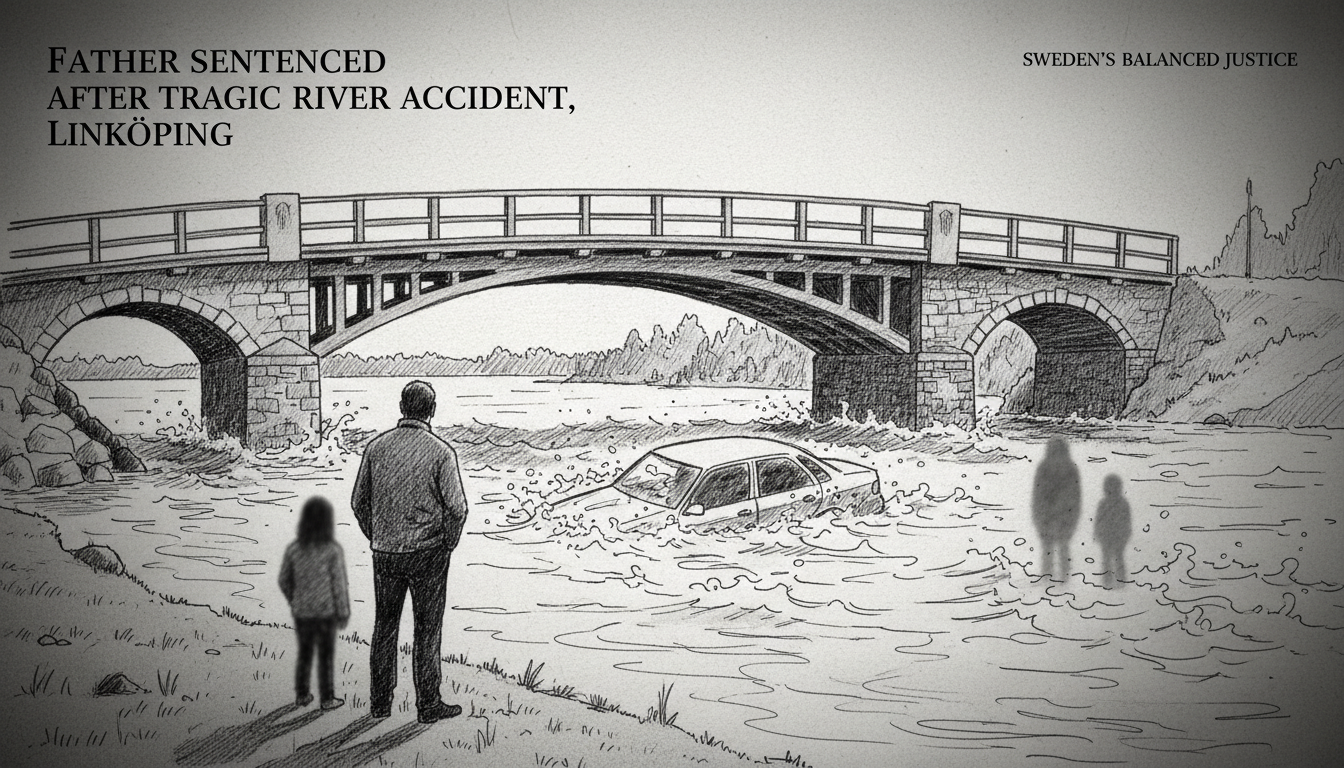
A Swedish court has delivered its verdict in a heartbreaking case that shook the community of Linköping. A father faced judgment after his car plunged into the Stångån river at Kallerstad Road last August. The vehicle carried four family members - two parents and their young children.
The accident claimed two lives. The mother died shortly after the incident. Her daughter passed away two months later from injuries sustained in the crash.
After a year-long legal process, the court found the man guilty of causing two deaths through negligence. The sentence carried a prison term of several months. But the court decided on a conditional punishment instead. The man had no prior criminal record. Officials saw no reason to believe he would commit further crimes.
The court also ordered the father to pay 1,000 kronor to Sweden's crime victim fund. This requirement applies when convictions involve offenses with penalties exceeding fines.
Judges acquitted the man on charges of creating danger for others. They acknowledged his special responsibility for his son's safety. Yet they determined his carelessness didn't reach the level of gross negligence.
Court documents stated this was not a case of conscious risk-taking. The father maintained his innocence throughout the proceedings.
This tragedy highlights Sweden's balanced approach to justice. The legal system considers both accountability and rehabilitation. Swedish courts often show leniency toward first-time offenders who pose no ongoing threat to society.
The Stångån river flows through central Linköping, a university city known for its peaceful atmosphere. Such accidents are rare in Swedish communities where road safety standards rank among the world's highest.
Local residents remember the incident as a community tragedy. The case has sparked conversations about road safety near waterways. It also raises questions about how societies handle family tragedies within the legal system.
Sweden's conditional sentencing system aims to prevent unnecessary incarceration when appropriate. The approach reflects the country's focus on rehabilitation over pure punishment. Yet victims' families sometimes question whether justice is fully served.
The court's decision shows how Swedish law distinguishes between different levels of negligence. Not all careless actions qualify as gross negligence, even when consequences prove tragic. This legal distinction matters greatly in determining appropriate consequences.
As Linköping continues to heal, the community reflects on road safety and family responsibility. The case serves as a sobering reminder of how quickly ordinary journeys can turn tragic.