
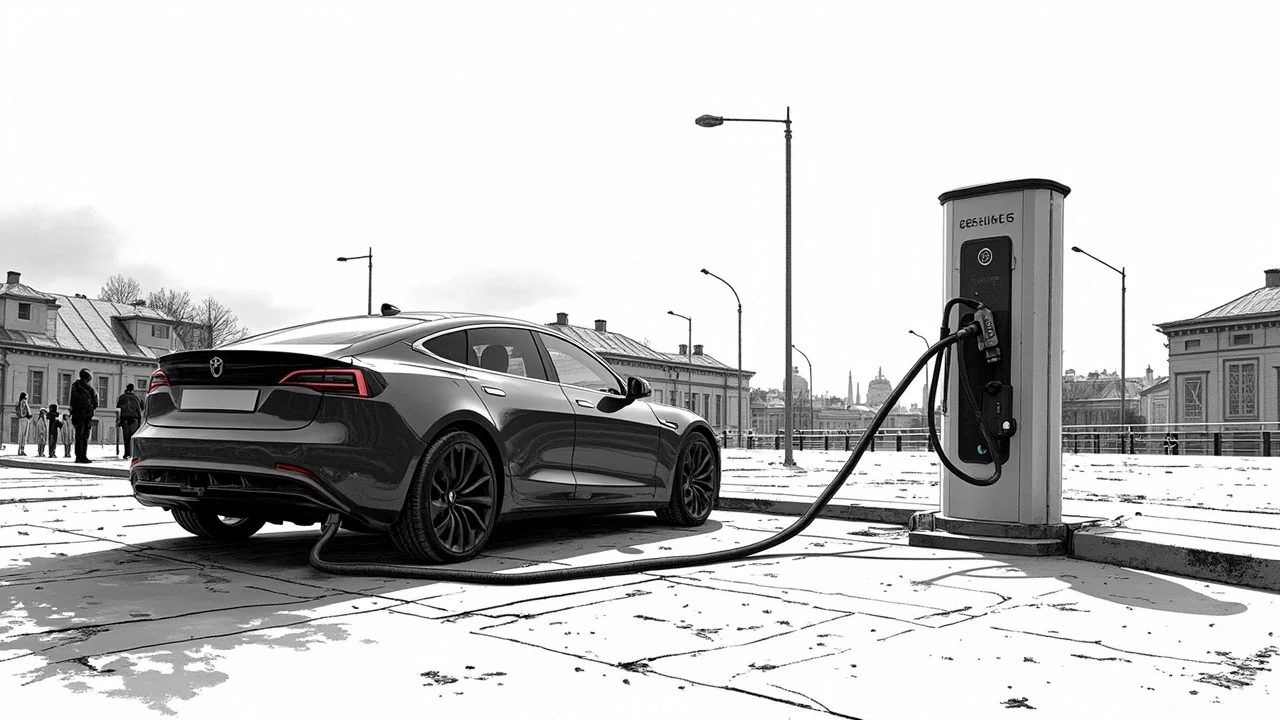
Finland's electric vehicle fast-charging prices have surged to 0.72 euros per kilowatt-hour, temporarily erasing the cost advantage over gasoline and diesel cars. Major network operators like ABC Lataus, Neste Lataus, and Tesla have dynamically raised prices during a period of exceptionally high electricity costs in the wholesale market, with some station prices doubling overnight.
This price shock hits drivers reliant on public fast-chargers, particularly those without access to cheaper home charging. The surge coincides with a historic spike in the Finnish electricity exchange price, which reached a peak of 77.05 cents per kWh on Tuesday, February 3rd, driven by severe cold weather and low wind power production.
Dynamic Pricing Creates Wild Variations
The increases are not uniform across all stations, creating a confusing landscape for drivers. An ABC charging station in Riihimäki listed a price of 0.72 €/kWh on Tuesday, while an ABC station on Helsinki's Mannerheimintie maintained its typical rate of 0.36 €/kWh. Similarly, Neste raised the price at its MY Renewable Charging station in Linnatuuli to 0.67 €/kWh, up from its normal level of around 0.35 €/kWh.
Olli Tervonen, Head of eMobility at SOK Liikennekauppa, which runs ABC Lataus, addressed the high prices. “Currently, the price is exceptional at a small portion of our stations,” Tervonen said in a statement. The ABC charging network includes nearly 400 stations, and he noted prices have not changed at most locations. He advised drivers to check real-time prices via the ABC mobile app.
The Wholesale Electricity Trigger
The fundamental driver is the record-high cost of electricity on the Nord Pool exchange. For consumers, the average price on February 3rd was 48.47 c/kWh. Operators using dynamic pricing models directly link their retail charging rates to this wholesale cost. Tervonen cited “exceptional price spikes” in the electricity market as a key factor in their pricing decisions.
“The development of the electricity exchange price for the coming days fortunately shows signs of calming down,” he added, suggesting relief may be coming. He declined to detail specific pricing factors further, citing competition law considerations. This transparency issue leaves consumers guessing why two stations in relatively close proximity can have vastly different prices during the same market conditions.
Calculating the Cost Comparison
Prior analysis established a break-even point for EV charging economics. When home electricity using the spot price reaches 27 c/kWh, the cost to charge is roughly equal to using a fast-charger at the typical rate of 0.35 €/kWh. If home electricity is more expensive than that threshold, using a fast-charger was previously the cheaper option.
The current scenario inverts that logic. With fast-charging prices now between 0.67 and 0.72 €/kWh, and the average spot price at 48.47 c/kWh, home charging—even with expensive electricity—is now significantly cheaper for those who can do it. This calculation shifts the economic burden overwhelmingly onto drivers who depend entirely on the public fast-charging network, such as apartment dwellers and long-distance travelers.
Impact on Finland's Green Transition
The price spike presents a real-world test for Finland's ambitious electric vehicle adoption goals. The government promotes EVs as a key part of its climate strategy, but volatile energy costs reveal a vulnerability in the transition. If consumers perceive public charging as unpredictably expensive, it could dampen enthusiasm for switching from internal combustion engines, especially among those without a private parking spot and charger.
The situation also highlights the evolving nature of energy markets. As transportation electrifies, it becomes more directly coupled to the electricity grid's fluctuations. Events like a cold, still winter week can now directly translate into soaring costs for drivers, not just homeowners heating their houses. This interdependence necessitates new consumer strategies and potentially new policy considerations regarding price transparency and market regulation for vehicle charging.
A Temporary Shock or New Reality?
Industry comments point toward this being a temporary phenomenon linked to an acute energy market crisis. The expectation is that prices will normalize as the weather warms and wind power production increases. However, the event sets a precedent, showing how high electricity prices can filter directly into transport costs with little warning.
For the Finnish EV driver, the episode underscores the importance of having multiple charging options. The economic case for installing a home charger, where possible, is strengthened dramatically. It also makes apps that show real-time pricing essential tools, rather than conveniences. The question now is how often such extreme volatility will occur, and whether the public charging network's pricing models will adapt to maintain driver confidence in the electric future.
The final impact may be measured in consumer sentiment. If trust in the affordability and predictability of public charging erodes, Finland's journey toward a fully electric transport system could face unexpected speed bumps, proving that the road from fossil fuels is not just about technology, but also about stable and fair market structures.