
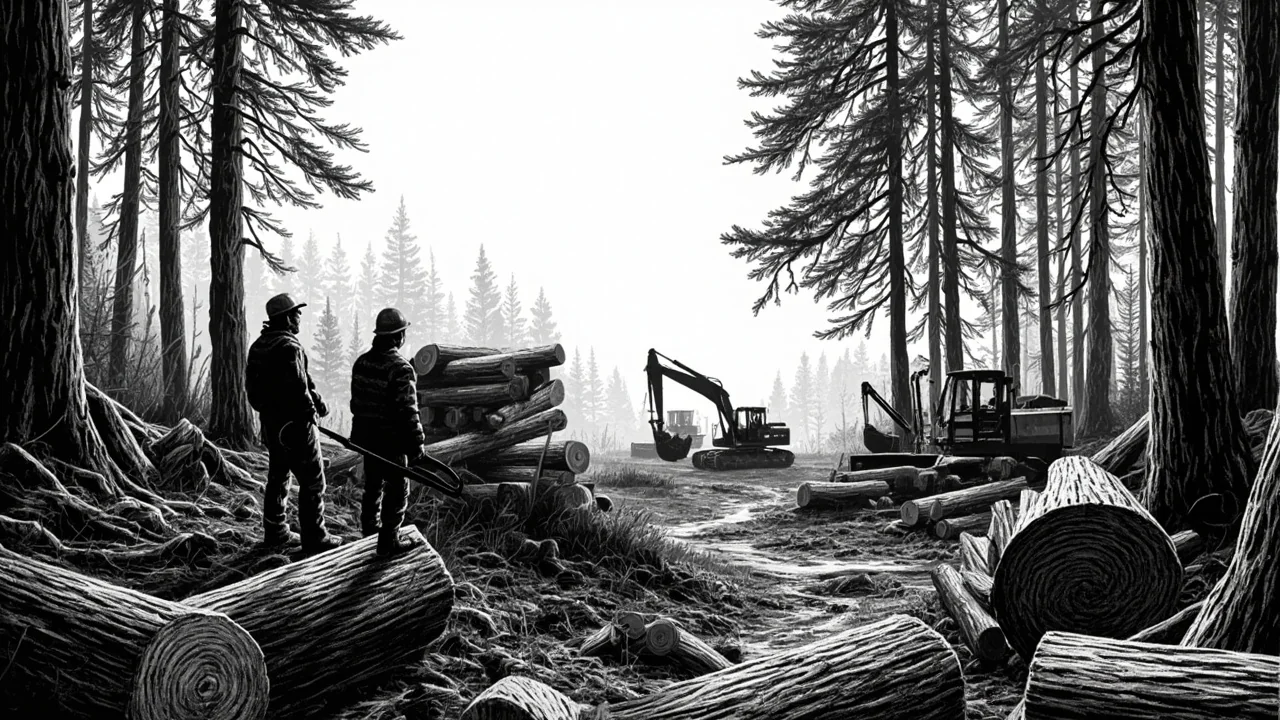
Finland's Central Finland region received approximately 544 million euros in forestry revenue from timber sales last year. The figure comes from calculations by the Central Union of Agricultural Producers and Forest Owners (MTK). While the sum marks a decrease from the record 600 million euros seen the previous year, it still ranks among the highest annual totals in history.
According to Pauli Rintala, Field Manager for MTK Forest Owners, last year was the fifth consecutive good year for timber trade in the region. He described the year as distinctly two-sided in a statement. The first half of 2023 saw high timber trade volumes and strong prices, but the latter half experienced a clear drop in wood prices, which consequently reduced sales volumes in the autumn.
'After the summer holidays, sales volumes fell to half of the previous year's levels,' Rintala stated. 'Central Finland's total sales volumes decreased by 13 percent from the previous year according to forest use notifications, and stumpage earnings fell by 10 percent. The year's average prices were thus slightly higher than the year before, even though wood prices fell sharply during the autumn season.'
A Historical Perspective on Forestry Income
The consistent high revenue over five years underscores the critical role of forestry in Central Finland's economy. This income flows directly to tens of thousands of private forest owners across the region, forming a foundational part of rural livelihoods and regional wealth. The sector's performance is a key indicator for local investment, employment in forestry and transport, and the health of related industries like sawmilling and bioenergy.
The decline from 2022's peak reflects broader market fluctuations. The dip in the latter half of the year is attributed to reduced demand in key export markets and adjustments in global timber and pulp prices. Despite this downturn, the fact that the annual total remains historically high points to a sustained period of economic strength for forest owners following weaker cycles in earlier decades.
The Two-Sided Economic Reality
Rintala's analysis of a 'two-sided' year reveals the volatility within what is still considered a strong period. The high prices and activity in spring and early summer provided a significant cash flow for owners who sold during that window. This early surge helped buoy the annual average price, even as those who marketed timber in the autumn faced a cooler market with lower returns per cubic metre.
This shift had direct consequences for regional logging activity and the cash flow of forestry service companies. The 13 percent drop in sales volume indicates a deliberate pullback by many forest owners, likely waiting for price improvements rather than selling at a perceived low. This behavior is a common market response, demonstrating how forest owners actively manage their assets in response to price signals.
Broader Impacts and Sector Resilience
The injection of over half a billion euros into Central Finland's economy has wide-ranging effects. This capital supports not only individual households but also local businesses, municipalities through tax revenues, and investments in sustainable forest management. The revenue funds everything from property maintenance and new machinery to long-term savings and community projects, embedding forestry income deeply into the social fabric.
The sector's resilience is being tested by the price drop. However, the five-year run of strong returns has provided a financial buffer for many forest-owning families. This buffer can help them weather periods of lower prices without being forced to liquidate timber assets prematurely. The long-term management cycle of forests, often spanning decades, allows owners to time their sales with greater flexibility compared to annual agricultural crops.
| Year | Approximate Forestry Revenue to Central Finland | Change from Previous Year |
|---|---|---|
| 2022 | 600 million euros | Record High |
| 2023 | 544 million euros | -10% (approx.) |
| 5-Year Period | Consistently High Totals | Historically Strong Cycle |