
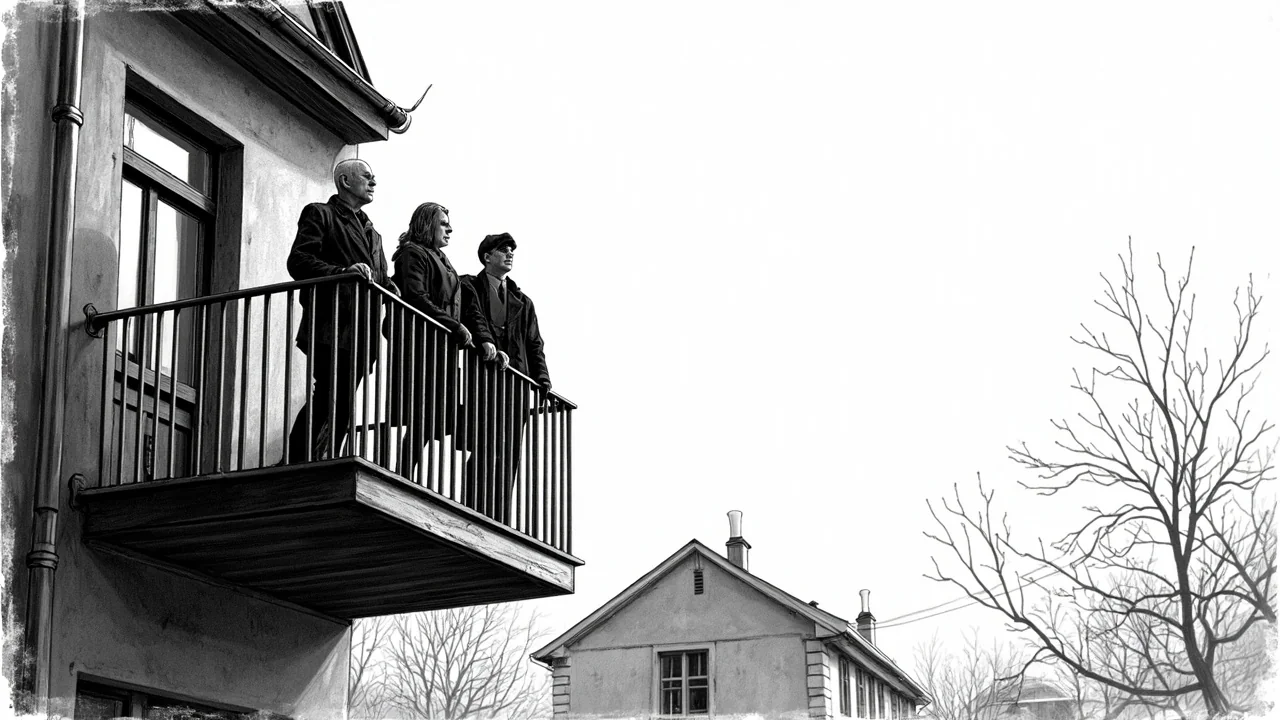
Finland's Helsinki police have closed the investigation into the Hietalahti balcony death, citing insufficient evidence to determine if the woman's fatal fall last September was an accident or a crime. The decision, made public Monday, ends an inquiry that initially focused on a man found in the apartment who repeatedly asked responding officers what had happened to the woman.
The Night of the Incident
Police patrols responded to Hietalahti last September after reports of a fallen person. Officers found the deceased woman in an interior courtyard. The fall had occurred through a balcony railing panel, and pieces resembling plaster were scattered at the scene. The officers then went to the apartment's door, attempting for minutes to get someone inside to open it by shouting through the mail slot. No sounds came from within the apartment. Police eventually entered using a maintenance worker's key. They moved through the home announcing their presence loudly. In the final bedroom, they found a man lying on a bed with a television on.
The man was confused about why police were there. He asked multiple times if something had happened to the woman. He obeyed police commands and was taken to a patrol car via the stairs. He was not told what had happened at that moment and was not allowed to look toward the courtyard where the body was, even though he tried to look out a window while on the stairs, which would have given him a direct view. Inside the patrol car, police spoke with the man. He asked what had happened to the woman and said she could not have jumped from the balcony and killed herself. Already inside the apartment, he had told officers he had spoken with the woman half an hour earlier.
The Investigation Hits a Wall
Helsinki police concluded the investigation for several reasons, a position supported by the prosecutor's office. In the newly public document, police state that sufficient evidence to bring charges could not be obtained. The man initially suspected of involvement in the woman's fall denied being on the balcony at the time of the incident and denied any guilt in a crime. The police decision notes, 'The police have carried out an extremely wide range of pre-trial investigation measures, including interviews of those involved and scene investigations. No eyewitnesses to the event have been found, and there are no surveillance cameras on the property premises from which the course of events could be determined with certainty.' Critically, the document concludes, 'The possibility of an accident or a crime has not been able to be ruled out, one or the other.' No compelling public or private interest required the pre-trial investigation to continue.
The Unanswered Questions
This case underscores the definitive limits of police work when physical evidence and witness testimony are absent. Without camera footage or anyone else present, the investigation relied heavily on the accounts of the individuals involved and forensic analysis of the scene. The presence of plaster-like fragments suggested structural failure, but this alone could not determine causation. The man's actions and statements upon police arrival—his confusion, his questions, and his assertion that the woman would not have jumped—were documented but provided no conclusive proof of criminal activity or innocence. The fundamental question of how the woman came to fall through the railing remains unanswered by the available evidence, leaving the manner of her death officially undetermined.
The Legal Standard and Case Closure
Finnish law requires a high standard of proof for criminal charges. The police and prosecutor's assessment that evidence was insufficient to meet this threshold is the central reason for terminating the inquiry. The decision reflects a legal system that cannot proceed on suspicion alone. The document explicitly states that neither the possibility of an accident nor a crime could be ruled out, placing the case in a permanent evidentiary limbo. For the case to proceed, either new, credible evidence would have to emerge or the existing evidence would need to point more conclusively toward one scenario. With no witnesses, no camera footage, and conflicting possibilities from the physical scene, the investigatory path was exhausted.
A Lingering Mystery in Helsinki
The closure of the Hietalahti case leaves a family and community without official answers about a sudden death. It also highlights a rare but challenging scenario for law enforcement where the available facts paint an incomplete and ambiguous picture. The police report methodically lists the steps taken: interviews, scene examinations, and technical reviews. Yet, each step failed to provide the crucial link needed to classify the incident. The man’s persistent questioning of officers—'What happened to the woman?'—echoes the central, unresolved question of the investigation itself. With the formal file now shut, the truth of what occurred on that balcony last September may remain known only to the woman who died and, perhaps, the man who was asleep inside.