
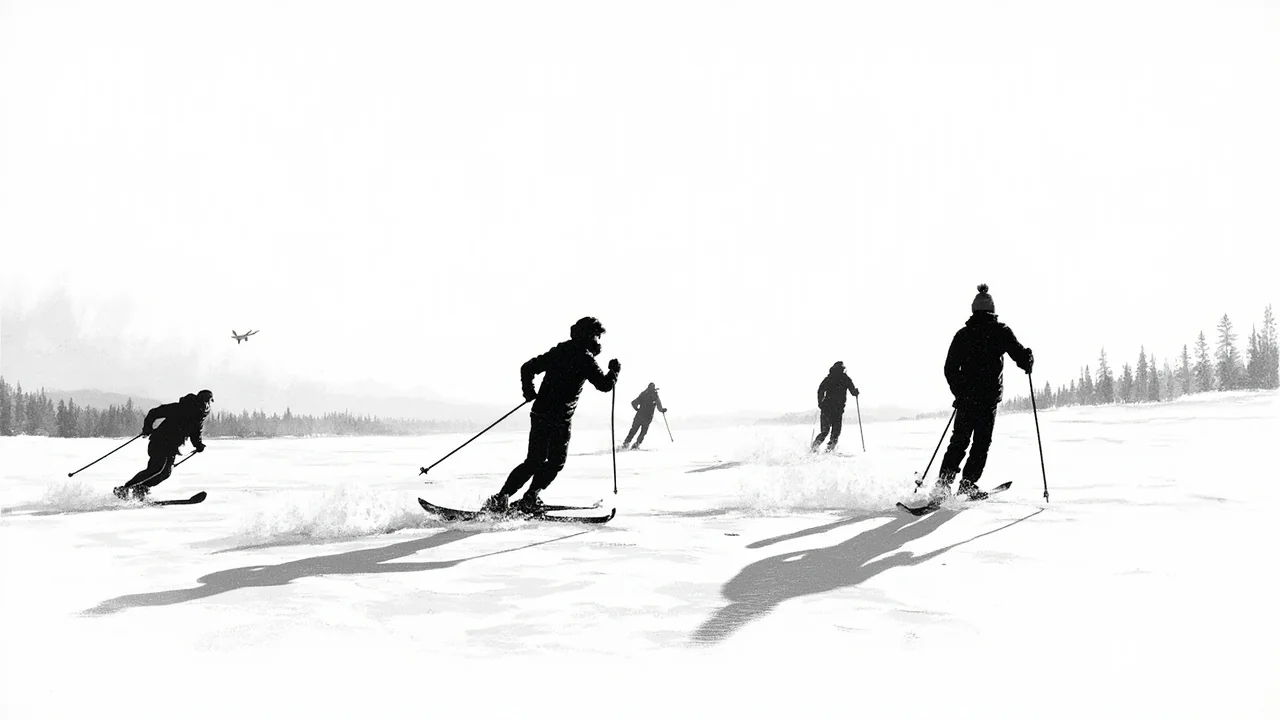
Finland's recurring winter ice danger has emerged again at Jyväskylä's Äijälänsalmi strait, where fresh tracks show skiers using both classic and skate techniques on ice weakened by a powerful undercurrent. Keski-Suomen rescue department's on-duty chief, Mika Kuivalainen, confirms the peril, stating that despite the hard frost, a strong flow beneath the surface is eroding the ice from below. This incident marks the latest in a pattern of similar dangerous behavior observed at this location over recent winters, highlighting a persistent public safety challenge during the country's long winter season.
A Recurring Hazard in a Winter Landscape
The discovery of ski tracks and footprints across the Äijälänsalmi strait signals a clear disregard for official safety warnings. The rescue services note that individuals have traversed the strait on foot, in addition to the skiers. The conditions are particularly deceptive, the ice may appear solid and thick from above, especially after a period of severe cold, but the hidden current creates unpredictable and potentially fatal weak spots. This specific geographical feature, a narrow strait, is notoriously susceptible to such hidden dangers due to water movement, a fact well-known to local authorities and seasoned residents. The visual evidence of two distinct skiing techniques indicates that multiple individuals, likely with varying experience levels, judged the ice to be safe enough for recreational activity.
Rescue Authority's Stark Warning
Mika Kuivalainen's statement cuts through any ambiguity about the risk. "Even though the strait has frozen over during the hard frosts, there is a strong current under the ice that is eating away at it from underneath," he said. This formulation is critical. It explains that the danger is not from thin ice in general, but from a specific, localized phenomenon where the ice's thickness is not uniform. The erosion happens out of sight, making the ice's actual load-bearing capacity impossible to assess from the surface. Rescue services across Finland consistently broadcast the message that no ice, especially on flowing water, is ever 100% safe. This incident serves as a tangible case study of that fundamental principle, occurring not on a remote lake but in a populated area near Jyväskylä.
The Context of Finnish Winter Risk
This event fits into a broader national context of ice-related accidents that occur every year in Finland. While the Finnish public is generally highly knowledgeable about winter conditions, lapses in judgment or local knowledge can lead to tragedies. The period around mid-winter, when ice has had time to form but spring melts are still distant, can create a false sense of security. Authorities differentiate between ice on stagnant lakes, which is generally more stable, and ice on rivers, sea areas, or straits with currents, which is far more hazardous. The Äijälänsalmi case is a textbook example of the latter. Public education campaigns run by the Finnish Rescue Services and organizations like the Finnish Lifeboat Institution repeatedly emphasize checking official ice thickness reports, avoiding ice near currents, and never going out alone.
Preventive Measures and Legal Framework
Finnish law places the primary responsibility for personal safety in nature on the individual. Rescue operations launched due to negligence can, in some cases, lead to the individual being billed for the cost of the operation, a policy designed as a deterrent. However, the primary tool remains prevention through information. Local rescue services are likely to reiterate warnings through their communication channels following this incident. Furthermore, municipalities sometimes install warning signs at known dangerous spots, increase patrols, or use barricades to physically prevent access. The ultimate solution, however, relies on cultivating a safety culture where understanding the invisible forces beneath the ice becomes as instinctive as dressing for the cold.
A Look Ahead: From Incident to Prevention
The discovery of tracks on Äijälänsalmi is not an active rescue mission but a warning sign—a precursor to a potential disaster. The response is now in the realm of proactive risk mitigation. It will test the community's ability to learn from a near-miss. Will this event lead to renewed local discussions, shared reminders on community social media groups, or even citizen-led initiatives to warn others? Or will the tracks simply fade with the next snowfall, only to be replaced by new ones when conditions again seem deceptively calm? The coming weeks will show whether this serves as a wake-up call or just another footnote in the annual statistics of risky winter behavior. The ice will remain, and so will the current beneath it, waiting for the next gamble with nature's hidden mechanics.