
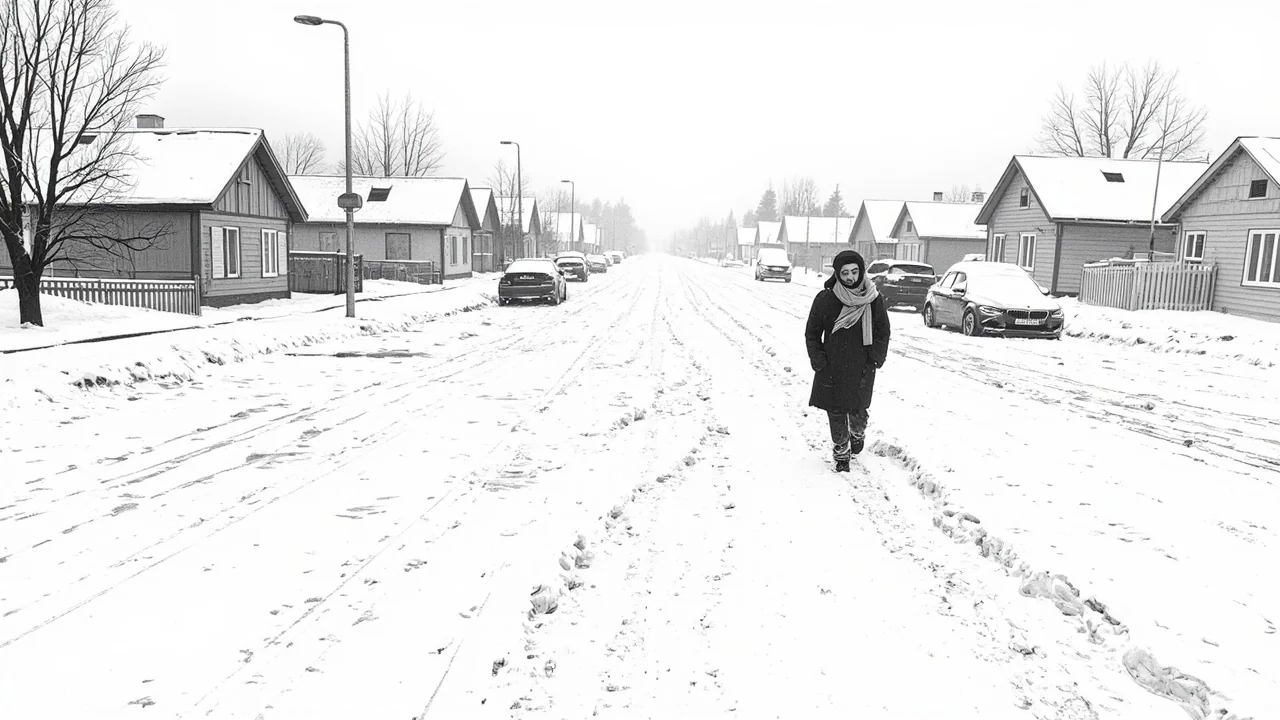
Finland’s winter maintenance system failed a Vantaa family when their residential street went without snow clearing for two full weeks. Resident Balabek Tonoyan said he was astonished by the city's inaction on Ongenkouku Street in the Nikinmäki district, describing a situation that created a clear safety risk for the neighborhood's many school-aged children.
A Father's Frustration Mounts
Balabek Tonoyan, who lives on the street with his family, reported that the road had not been plowed for a fortnight. He measured at least seven centimeters of snow accumulation on Tuesday. 'The street is dangerous when you cannot distinguish the children from the middle of the snow,' Tonoyan said, highlighting the safety hazard for the numerous children living along the 700-meter road, which serves 25 detached houses and two larger apartment buildings. He described everyday life as a struggle, noting it was an impossible task to navigate with prams and that cars were slipping on the unplowed surface. Tonoyan and several neighbors contacted the City of Vantaa about the issue, with records showing Tonoyan made contact twice, suspecting the street had been either deliberately ignored or forgotten.
City Management Responds with Surprise
After being contacted, Vantaa's head of maintenance, Jyrki Vättö, confirmed the street was finally plowed on Wednesday. He stated that prior to this, the last clearing occurred on January 8th, exactly two weeks earlier. Vättö expressed surprise, saying he had not been aware of the problem. 'Residential streets are plowed at a maximum interval of three days. That street was left unplowed for some reason now,' Vättö said. He explained that Vantaa classifies its streets into three different maintenance categories, with the need for snow clearing on residential streets defined as lower than on main bus routes. According to city guidelines, plowing begins when snow reaches approximately 3 to 5 centimeters.
The Contractual Framework Behind Winter Maintenance
Vättö provided background on the city's operational model, revealing that Vantaa is divided into three contract areas, with about half of the total surface area subcontracted to private operators. 'The contracts have been put out to tender in different years and there is some variation in them. But the thresholds for action are talked about in centimeters,' he clarified. He emphasized that no other major challenges in winter maintenance have been observed this season, attributing potential delays to consecutive days of snowfall. 'We haven't had a monstrous amount of snow this year. Sometimes response times can be delayed if it snows daily,' Vättö added.
Systemic Pressures and Resident Reliance
The incident on Ongenkouku Street exposes the tight tolerances and logistical pressures inherent in Finland’s highly regimented winter maintenance system. Municipalities operate under strict, publicly defined service level agreements that prioritize main traffic arteries and public transport routes. Residential areas, while guaranteed regular service, exist lower on the operational hierarchy. This model, designed for efficiency across vast urban areas, relies on precise scheduling and contractor performance. A single missed cycle, as admitted by the maintenance head, can therefore leave a neighborhood stranded for an extended period. Residents like Tonoyan depend entirely on this system functioning flawlessly for safe access to schools, work, and daily services during the long winter months.
Legal Obligations and Municipal Accountability
Finnish law and municipal regulations place a clear duty of care on cities to maintain safe streets. The Local Government Act mandates that municipalities ensure public areas are safe for use. Vantaa’s own published guidelines, which promise plowing within three days for residential streets, form a public commitment to residents. The two-week gap on Ongenkouku represents a significant deviation from this published standard. While the city acknowledged the error, the episode raises questions about monitoring and oversight mechanisms, particularly for subcontracted services. It highlights how a breakdown in communication or a logistical error in one of the three contract areas can directly compromise safety and mobility before the issue is escalated to senior management.
The Human Cost of a Missed Schedule
Beyond the contractual failure, the situation illustrates the tangible human impact of missed maintenance. Tonoyan’s concern centered on children’s safety, a paramount issue for any community. The inability to use prams safely isolates families with young children, while the slipping hazard for vehicles creates risks for all road users. For a period of 14 days, the normal functioning of the street was suspended, turning a routine part of the neighborhood into an obstacle. This case serves as a reminder that behind service level agreements and contractor maps are residents whose daily lives are directly shaped by the reliability—or unreliability—of basic municipal services.