
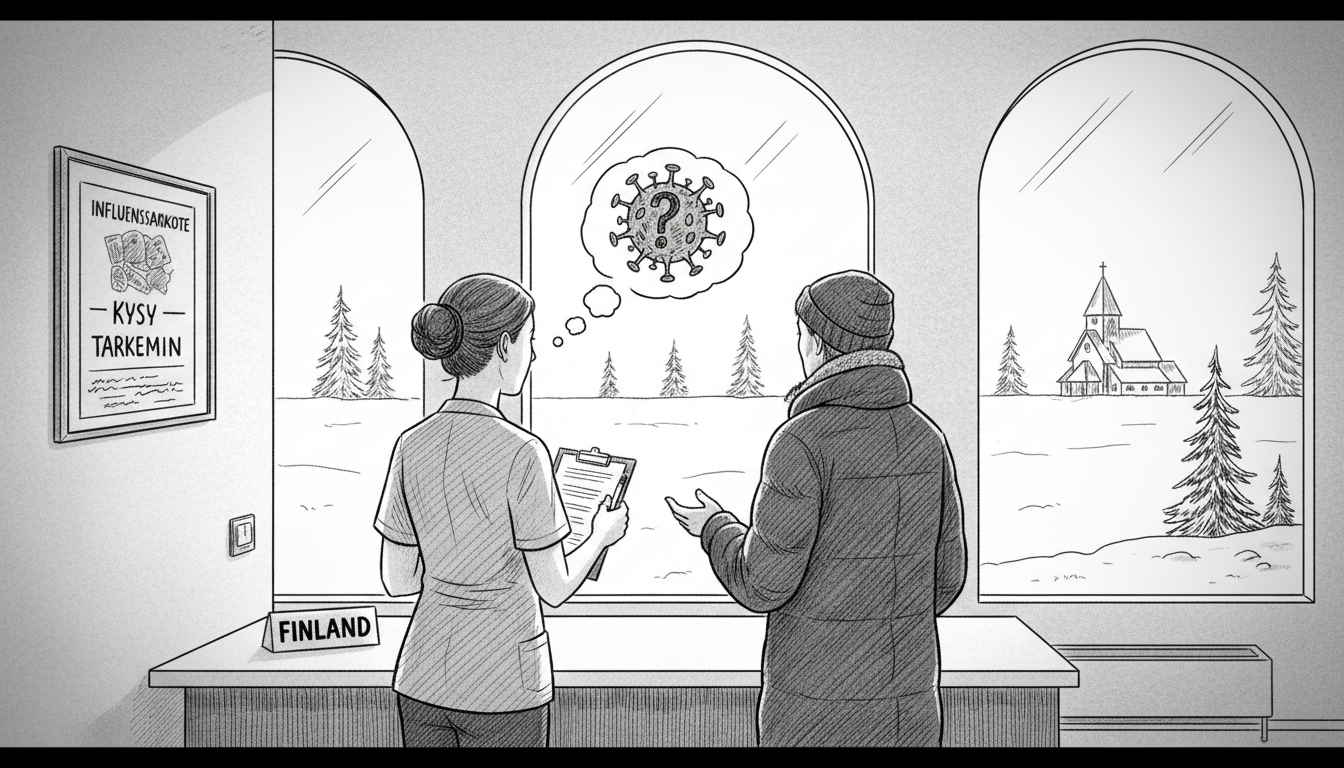
Finnish health authorities are implementing strict verification protocols for free influenza vaccinations, leading some citizens to describe clinic visits as feeling like interrogations. The Finnish Institute for Health and Welfare (THL) guidelines require public healthcare nurses to question applicants about their eligibility, specifically whether they are in close, regular contact with a person in a high-risk group. This policy aims to prevent misuse of publicly funded vaccines but has created awkward and frustrating encounters at local health stations across the country.
A senior THL expert, Mia Kontio, stated the principle should be trusting the word of the applicant, and written proof should not be demanded. However, the need to define 'close contact' has placed nurses in a difficult position. The guidelines specify that contact means living in the same household or having weekly face-to-face meetings with the at-risk person. In practice, this leads to questions like, 'Your grandmother doesn't happen to live in Kuopio, does she?' as reported from a clinic in Oulu, a city hundreds of kilometers away.
Pirjo Koistinen, a head nurse responsible for vaccination arrangements in the North Ostrobothnia wellbeing services county, explained the dilemma. Nurses are instructed to ask on what grounds a person believes they are eligible. The goal is to clarify if the at-risk relative truly lives nearby. Koistinen acknowledged that not all clients appreciate this line of questioning and finds it unfortunate if situations are perceived as cross-examinations. She emphasized that nurses are not supposed to demand addresses or exact meeting counts, but must rely on verbal accounts, even with inherent uncertainty.
The policy stems from a 2021 change to national vaccination recommendations, which expanded free shots to the close circles of high-risk individuals. Kontio recalled that the initial inclusion of close contacts was partly to ensure vaccines did not go to waste. While self-purchasing a flu shot from a pharmacy costs around 20 euros, and many receive it through employer-funded occupational health, the public system must ration its resources. Kontio stated the national assessment is about determining for whom vaccines should be publicly funded, as giving all vaccines to everyone is not feasible.
This meticulous gatekeeping highlights a recurring tension in Finland's universal welfare model: balancing broad accessibility with necessary fiscal control. The Nordic principle of high trust in citizens is being tested against the practical reality of limited budgets. The situation is further complicated by the introduction of new, more expensive enhanced flu vaccines for those over 85 and specific risk groups, which has increased overall program costs. For international observers, this is a granular example of how Nordic societies manage their famed social contracts in an era of rising healthcare expenses and complex demographic challenges. The policy's on-the-ground execution, reliant on frontline healthcare workers making sensitive judgments, reveals the human friction sometimes generated by otherwise rational public health directives.