
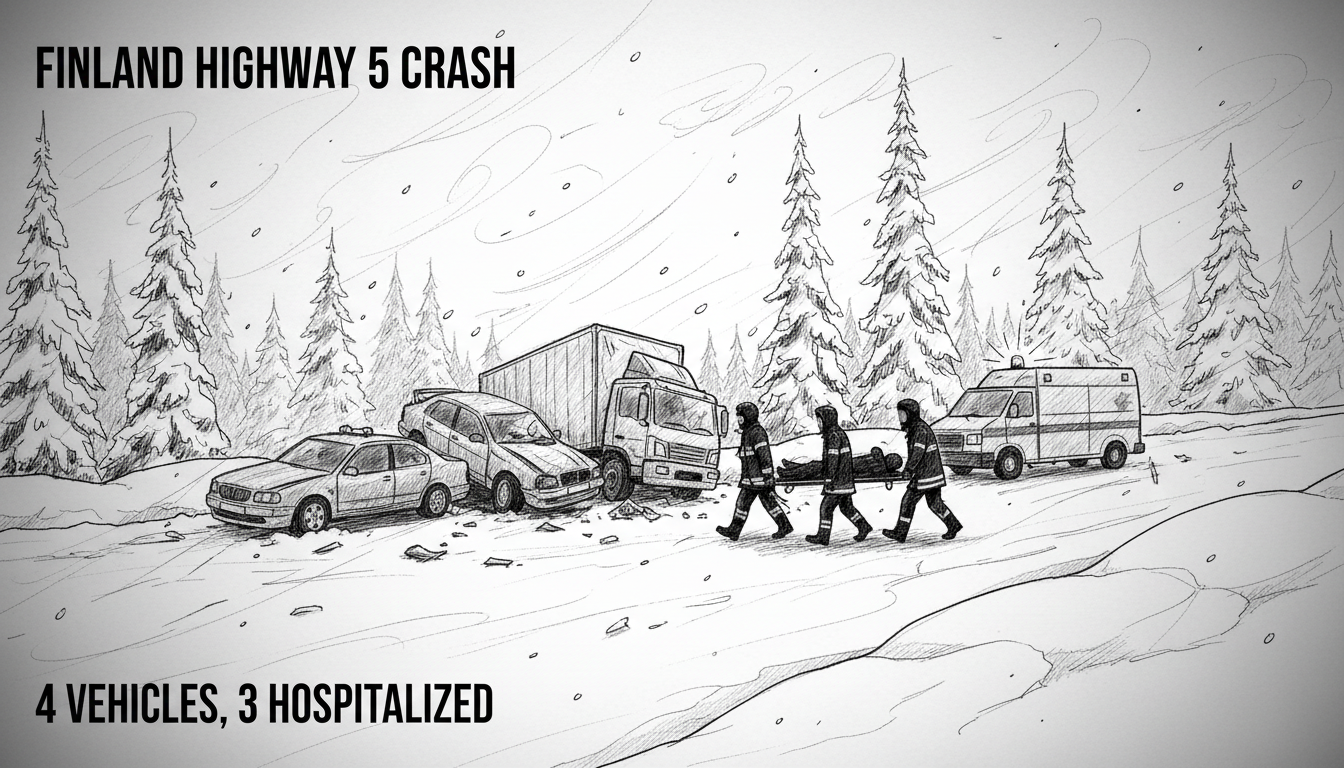
Finland traffic accident investigators are piecing together the events of a major multi-vehicle collision on a key national artery. A serious crash involving four vehicles shut down southbound traffic on Highway 5 near Kuopio on Sunday afternoon, sending three people to the hospital. Emergency services received the first alert at 1:03 PM local time, prompting a rapid response from police, rescue services, and paramedics to the scene between the Bella and Kolmisoppi interchanges.
The scene was one of controlled chaos as responders worked to secure the area, treat the injured, and clear the wreckage. Police confirmed by 1:57 PM that the involved vehicles had been removed and the southbound lanes reopened, but the disruption caused significant traffic delays. Authorities diverted southbound traffic onto alternative routes for nearly an hour while they managed the incident. The condition of the three individuals transported to Kuopio University Hospital remains unknown, with officials stating no further details on their injuries are currently available.
A Critical Artery Temporarily Severed
Valtatie 5, designated as European route E63, is far more than just a local road. It serves as a vital north-south lifeline, connecting the southern regions near Heinola all the way to the vast expanses of Lapland at Sodankylä. This highway is crucial for commercial transport, tourism, and daily commutes, particularly in the Savonia region where Kuopio acts as a major hub. Any closure, even a temporary one, creates a cascade of logistical problems and economic friction. The accident site, nestled between two key access points to Kuopio's urban network, underscores how a single incident can paralyze a significant segment of regional infrastructure.
The swift reopening of the lanes highlights the efficiency of Finnish emergency protocols, but the incident raises persistent questions about safety on high-speed, high-volume routes. Traffic on Highway 5 varies from long-haul trucks and tourist coaches to local passenger vehicles, creating a complex mix of speeds and driver intentions. Sunday's clear afternoon conditions rule out weather as an immediate factor, shifting the preliminary focus toward driver behavior, vehicle spacing, and attentiveness.
Expert Analysis on Highway Safety Challenges
Traffic safety researchers in Finland consistently point to a combination of factors on roads like Highway 5. Professor of Traffic Safety, who has studied Nordic road networks for two decades, explains the common risk profile. "On straight, high-quality highways, driver fatigue and inattention become heightened risks," the professor said in a recent seminar. "The monotony can reduce vigilance. The primary defenses are strict adherence to safe following distances—a two-second rule that should be extended in heavier traffic—and constant situational awareness, especially near interchanges where lane changes are frequent."
While Finland boasts one of the world's safest road systems, its long, dark winters and concentrated summer traffic periods present unique challenges. Investigations into crashes like this one will meticulously examine telematics data if available, physical evidence from the vehicles, and witness statements. They will seek to determine if speed was excessive for the conditions, if distracted driving played a role, or if a technical failure initiated the chain-reaction collision. The involvement of four vehicles suggests a sequential impact, where one initial collision led to others being unable to stop in time.
The Human and Systemic Cost of Road Incidents
Beyond the immediate shock and injury, an accident of this scale has a wider impact. It strains public resources, from the dispatch of multiple emergency units to the potential need for specialized trauma care at the hospital. It causes economic delays for freight companies and disrupts the plans of countless individuals. For the families of those hospitalized, it begins a period of anxious waiting and potential long-term recovery.
The incident also serves as a stark reminder for transport policymakers. It occurs amidst ongoing national debates about road maintenance budgets, the expansion of median barriers on dual carriageways, and the role of advanced driver-assistance systems in preventing multi-vehicle pile-ups. Each serious accident provides data points that inform future safety campaigns, potential speed limit adjustments, and infrastructure investment decisions. The location between two ramps may prompt a review of signage or road markings in that specific section.
Looking Forward: Investigation and Prevention
The local police district will lead the formal investigation. Their findings, which could take weeks or months to finalize, will be critical. A precise understanding of the causation chain is essential not only for any potential legal proceedings but, more importantly, for preventing similar tragedies. The results contribute to a national database used by the Finnish Transport and Communications Agency (Traficom) to identify risk patterns across the network.
For now, the southbound lanes of Highway 5 near Kuopio are clear, with traffic flowing normally. The physical evidence has been cleared, but the questions remain. The event is a sobering punctuation mark in an ordinary Sunday, highlighting the ever-present risks of modern mobility. It reinforces the non-negotiable importance of defensive driving, even on familiar roads under clear skies. As the injured receive care and investigators begin their work, the broader conversation about how to further fortify the safety of Finland's essential corridors continues, one data point at a time. Will this incident lead to localized safety measures, or is it a tragic statistical outlier on a generally safe road? The coming months will provide answers.