
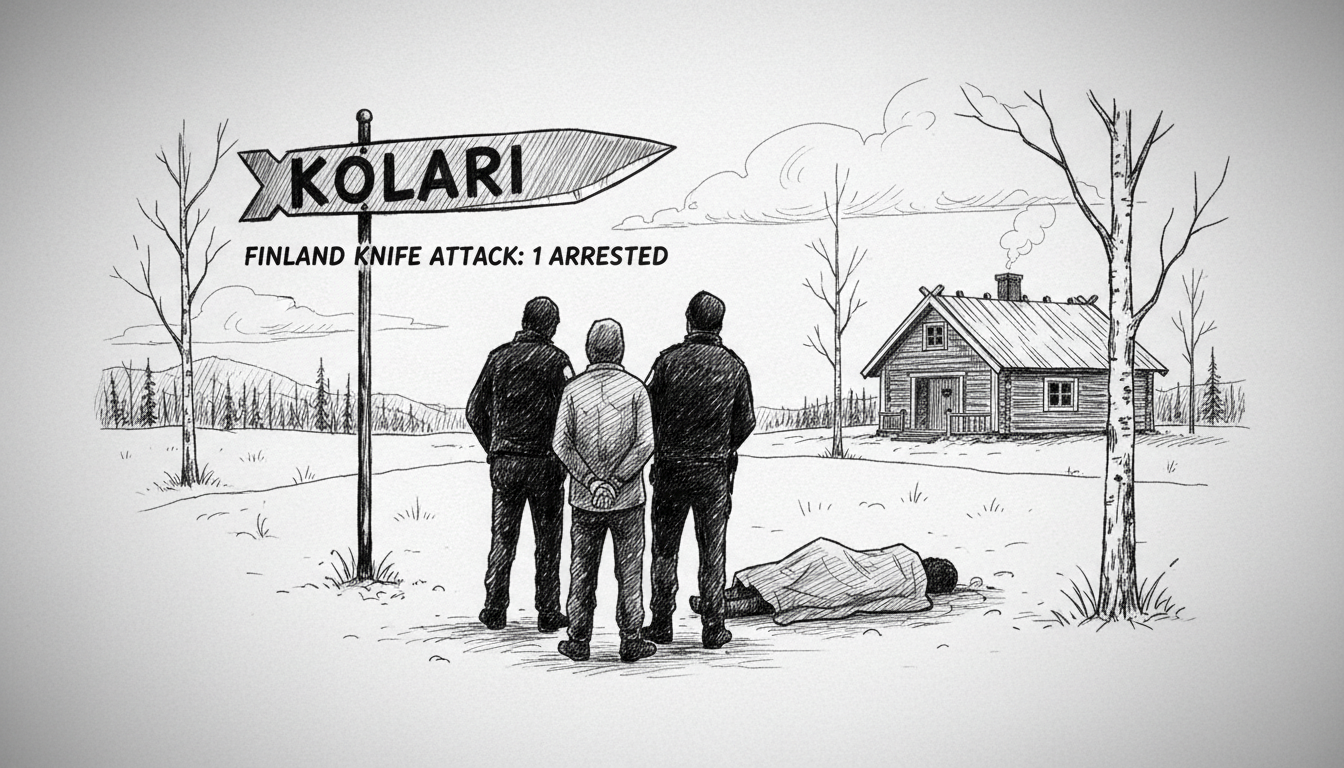
Finland records fewer than 150 homicides annually, yet a Monday night stabbing in Kolari has spotlighted persistent violent crime risks. Police in Lapland responded to a puukotus, or knife attack, at a private residence on Muoniontie road. The suspect was apprehended at the scene, while the victim was rushed to Lapland Central Hospital with serious injuries. Authorities confirm the victim is no longer in life-threatening condition, investigating the case as attempted murder.
Initial reports indicate the suspect and victim were strangers before the incident. This random nature heightens community concern in the small municipality of Kolari, which has around 4,000 residents. Local police have cordoned off the area for forensic analysis, with detectives interviewing witnesses and examining evidence.
A Rare Violent Crime in Lapland
Lapland, Finland's northernmost region, is known for its low crime rates and tight-knit communities. Violent incidents like this stabbing are statistically uncommon here. Finland's overall homicide rate stands at approximately 1.6 per 100,000 people, one of the lowest in the European Union. However, isolated attacks involving knives do occur, often linked to factors such as alcohol use or personal disputes.
The Kolari stabbing disrupts the peace in a region where police typically handle minor offenses. Lapland's vast geography and sparse population can present challenges for emergency response, but authorities emphasize that systems worked effectively in this case. The suspect was detained quickly, and the victim received prompt medical attention.
Police Investigation and Legal Framework
Finnish police are treating this case with utmost seriousness under criminal code provisions for tapon yritys, or attempted homicide. If convicted, the suspect faces a potential prison sentence of several years. Finland's legal system imposes stringent penalties for violent crimes, reflecting a societal commitment to safety and justice.
Investigators are piecing together the sequence of events that led to the altercation. They are reviewing security camera footage from nearby properties and conducting forensic tests on the weapon recovered. The lack of prior acquaintance between the parties complicates the motive analysis, pushing police to explore all angles.
Senior Detective Chief Inspector involved stated that all resources are dedicated to uncovering the truth. The National Bureau of Investigation may assist if needed, though local authorities currently lead the probe. This incident triggers standard protocols for violent crime, including psychological support for affected residents.
Expert Insights on Violent Crime in Finland
Criminologists point to underlying factors that can contribute to such incidents in Finland. Alcohol consumption is frequently cited in assault cases, alongside mental health struggles or social exclusion. However, experts caution against generalizing, as each event has unique circumstances.
Dr. Lena Kortelainen, a criminology researcher at the University of Helsinki, explains that Finland's low crime rate does not eliminate individual acts of violence. She notes that random attacks, while rare, can stem from sudden conflicts or untreated behavioral issues. Preventive measures include community outreach and accessible mental health services.
Finland's comprehensive social welfare system aims to address root causes, but gaps remain. In Lapland, long winters and isolation can exacerbate personal crises. Local organizations work to support vulnerable individuals, yet funding constraints sometimes limit reach.
Political and Policy Responses
As Finnish Political Correspondent, I see this incident resonating in Helsinki's government district. The Ministry of the Interior monitors such cases for trends that might influence national crime prevention strategies. Finland's EU membership involves cooperation on security matters, including data sharing on violent offenders across borders.
Parliamentary committees periodically review legislation on weapon control and assault penalties. The current government coalition has emphasized public safety in its platform, with initiatives to bolster police presence in rural areas. This stabbing may fuel debates on resource allocation for Lapland's law enforcement.
EU directives on victim rights and crime prevention inform Finnish policy, ensuring alignment with broader European standards. However, domestic priorities often shape responses, focusing on local community needs. Kolari's municipal leaders are already discussing enhanced neighborhood watch programs.
Community Impact and Moving Forward
The stabbing has shaken Kolari's residents, who pride themselves on a peaceful lifestyle. Local schools and community centers are offering counseling sessions. Public discussions about safety measures are emerging, though many stress that this appears to be an isolated event.
Finland's reputation for safety remains intact globally, but incidents like this serve as reminders. They highlight the importance of vigilant social services and proactive policing. The victim's recovery is a positive sign, and the swift arrest demonstrates police effectiveness.
Looking ahead, the judicial process will unfold over coming months. Finnish courts are known for thorough proceedings, and the outcome will be closely watched. This case may also inspire broader reflections on how Nordic societies manage the rare but impactful instances of violence.
In a nation celebrated for its tranquility, the Kolari stabbing underscores that no society is entirely free from conflict. It challenges policymakers and citizens alike to maintain the balance between security and social cohesion that defines modern Finland.