
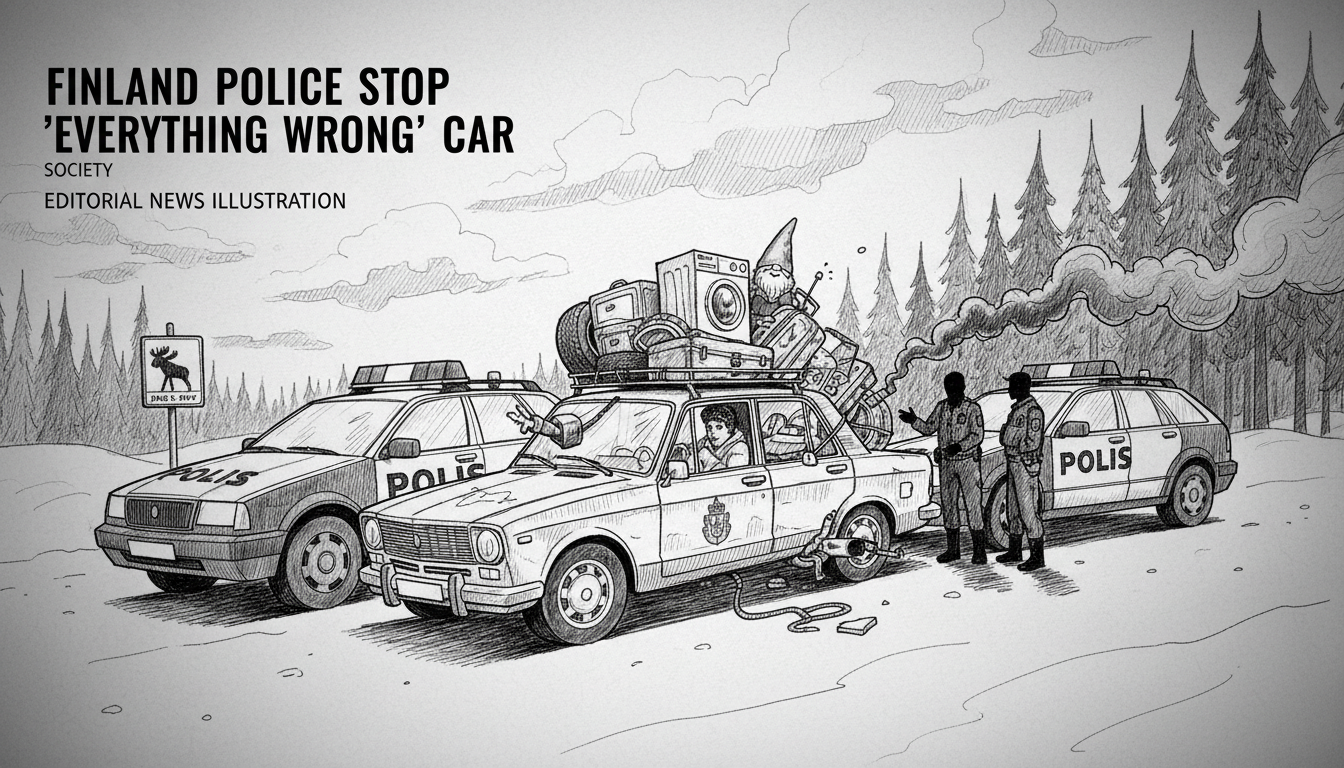
Finland traffic laws were flagrantly violated in a single vehicle stopped by police in Mäntyharju, Southern Savonia, last Saturday. The car, described by an officer as having 'nearly everything wrong,' presented a checklist of illegal modifications and statuses that experts say created a significant public safety hazard.
Itä-Suomen poliisin ylikonstaapeli Toni Reinikainen, the senior constable from the Eastern Finland Police Department, made the blunt assessment after his patrol pulled the vehicle over. The immediate visual cue was the presence of two sets of license plates mounted on the car. While one set was confirmed as the vehicle's legitimate registration plates, the origin and purpose of the second set became a key point of the police investigation.
Further checks revealed the vehicle's official status was 'poistettu liikennekäytöstä' – formally removed from traffic use. This administrative status means the car is not legally permitted to be driven on public roads. Compounding this, the mandatory vehicle inspection, known as 'katsastus,' had been neglected, leaving no recent official verification of the car's roadworthiness, braking systems, lights, or emissions.
A Mobile Catalogue of Violations
The combination of offenses found in this one stop is notable for its comprehensiveness. In Finland, the vehicle inspection system is a cornerstone of road safety. Cars over four years old must undergo an annual inspection at an authorized inspection station. The process checks brakes, lights, steering, suspension, chassis, and exhaust emissions. A valid inspection sticker is a legal requirement for operation.
Driving a car that has been deregistered, or 'removed from traffic,' is a serious offense. This status can be applied for various reasons, including a failed inspection that was not rectified, an owner declaring the vehicle permanently off-road, or as part of an insurance write-off process. Operating such a vehicle automatically invalidates insurance, creating massive financial liability in the event of a crash.
“When you see multiple violations of this nature stacked together, it moves beyond simple neglect or forgetfulness,” says Mika Virtanen, a former traffic police instructor and current independent road safety consultant based in Helsinki. “It indicates a deliberate attempt to operate outside the legal and safety frameworks designed to protect everyone.”
The Suspicious Signal of Dual Plates
While the deregistered and uninspected status posed clear safety risks, the dual license plates point to potential deliberate deception. Police have not disclosed the specifics of the second set of plates, but experts outline several possible scenarios.
The plates could be stolen from another vehicle, used to mask the car's true identity from automated traffic cameras that issue speeding or toll fines. Alternatively, they could be counterfeit or old plates from the same vehicle, kept to present a false appearance of validity during a casual glance.
“Multiple plates are a major red flag,” Virtanen explains. “In traffic safety, we talk about the 'broken windows' theory. A driver willing to engage in this level of identity obfuscation is often disregarding other rules—speed limits, right-of-way, sobriety laws. It’s a signifier of a driver who has chosen to separate themselves from the rules of the road community.”
The Eastern Finland Police Department has not released details on any potential charges or fines levied against the driver, as the investigation is likely ongoing. Penalties can be severe. Driving without a valid inspection can result in a fine. Operating a deregistered vehicle is a more serious traffic offense, often leading to a substantial fine and the immediate impoundment of the vehicle. Misusing license plates is a separate offense that can involve charges related to fraud or document forgery, depending on the circumstances.
Systemic Reliance on Compliance and Enforcement
The Finnish system operates on a high degree of voluntary compliance, supported by periodic enforcement. Vehicle owners receive official reminders for inspections. The police conduct roadside checks, but they cannot stop every car. This case highlights how the system relies on both the conscientiousness of the majority and the deterrent effect of random stops catching violators.
“This was a good catch by an observant patrol,” Virtanen notes. “It’s a tangible result of police work that directly removed a danger from the road. The driver was not just risking a fine; they were driving a machine whose basic safety had not been professionally verified in who knows how long, with no valid insurance to cover potential victims.”
The incident in Mäntyharju serves as a stark reminder of the legal pillars supporting road safety. The annual inspection is not a bureaucratic hurdle but a vital health check for a complex machine sharing space with vulnerable road users. Registration is the fundamental link between a vehicle, its owner, and the legal system, ensuring accountability.
Beyond the Traffic Stop: A Question of Mindset
While the legal consequences will unfold for the driver, the broader question this case raises is one of societal responsibility. Finland's roads are among the safest in the world, a status achieved through a combination of good infrastructure, strict laws, and a general cultural adherence to safety norms.
A vehicle in this condition represents a clear breach of that social contract. It prioritizes individual convenience over collective security. The risks extend far beyond the driver. Passengers, other motorists, cyclists, and pedestrians are all put in potential jeopardy by a car with possibly faulty brakes, defective lights, or a compromised steering system.
Will this single stop in Southern Savonia serve as a warning to others who might consider neglecting their vehicle's legal status? For the police, it validates the importance of proactive patrols and traffic monitoring. For the public, it underscores that the rules of the road exist for a reason, and that their enforcement is not merely about penalties, but about prevention. The next time a driver sees their inspection reminder, the image of a car with 'nearly everything wrong' might just be the nudge needed to book that appointment, ensuring their vehicle is safe not just for themselves, but for everyone they share the road with.