
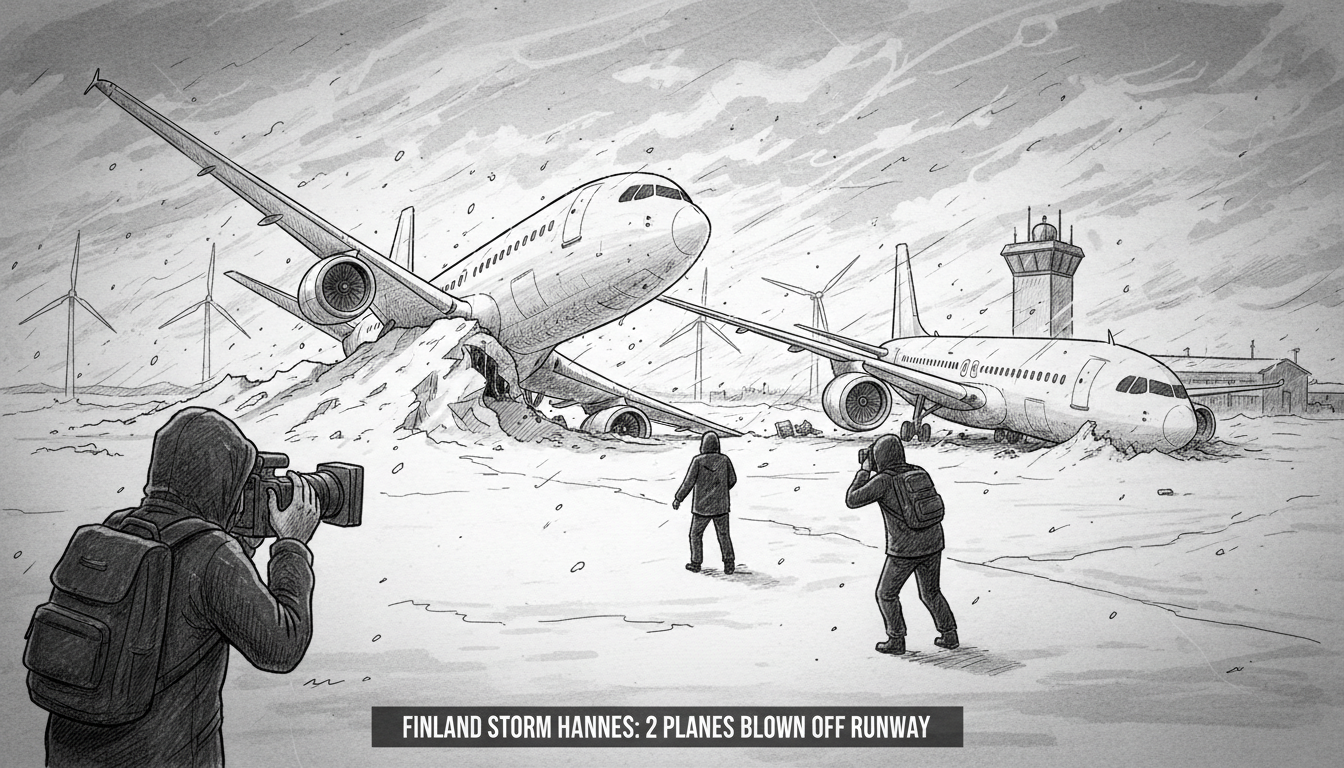
Finland storm Hannes forced two passenger planes off a runway at Kittilä Airport in Lapland on Saturday evening. Over 150 people were on board the aircraft, which were blown into a snowbank as the powerful storm battered northern Finland. Emergency services dispatched nine rescue vehicles to the scene, but preliminary reports indicate no injuries. The same storm, known as Johannes elsewhere in the Nordics, also left more than 80,000 households in western and northern Finland without power, highlighting the severe impact of Arctic weather on critical infrastructure.
A Harrowing Landing in Lapland
The incident occurred at Kittilä Airport (KTT), a vital transport hub for Finland's northern tourism region. The airport, located just five kilometers from the town center, is the country's fourth busiest by passenger numbers. It serves as a primary gateway for tourists seeking Lapland's famous winter landscapes and the home of Santa Claus Village. On a typical Saturday, the airport buzzes with travelers, but Storm Hannes transformed the scene into one of high-stakes emergency response. The fact that no one was injured is being described by local officials as "extremely fortunate" given the potential severity of such an event.
Finland's Transport and Communications Agency, Traficom, has launched an investigation into the circumstances. Early focus will center on the specific wind conditions at the time of the incidents, including potential wind shear and dangerous crosswinds that can make landing and ground operations perilous. Aviation meteorologists note that while Finnish pilots are extensively trained for winter conditions, storm Hannes produced exceptionally powerful and unpredictable gusts. This event will likely renew discussions about operational thresholds and safety protocols during extreme weather events at regional airports.
Widespread Power Outages and Arctic Resilience
Beyond the airport, Storm Hannes demonstrated its disruptive force across a wide geographical area. The loss of power for over 80,000 households underscores the vulnerability of even modern infrastructure to nature's fury. In Finland's vast and sparsely populated northern regions, restoring power can be a monumental task for utility companies. Crews must navigate treacherous roads and deep snow to reach damaged power lines, often in remote forested areas where heavy snow and ice accumulation can bring down cables.
Finland's energy sector has invested significantly in grid resilience, but complete protection against Arctic storms remains an engineering challenge. "Our networks are built to withstand severe weather, but the combination of hurricane-force winds and heavy, wet snow presents a worst-case scenario," an analyst from the Finnish Energy Authority said. The concentration of outages in western and northern Finland points to the storm's specific trajectory and intensity. For residents, a power outage in winter is more than an inconvenience; it poses immediate risks related to heating and communication in sub-zero temperatures.
The Context of Finland's Harsh Climate
This incident did not occur in a vacuum. Finland's geographical position subjects it to harsh winter conditions annually. Lapland, covering nearly one-third of Finland's land area but with a small fraction of its 5.5 million population, is particularly exposed. The region is no stranger to operational challenges, from maintaining road networks to ensuring reliable air travel for its communities and vital tourism industry. Airports like Kittilä are engineered with these conditions in mind, featuring advanced snow removal fleets and de-icing systems, but they cannot control the wind.
The storm, named Johannes by regional meteorological institutes, is part of a pattern of intense low-pressure systems that sweep across the Nordics. The differing naming conventions—Hannes in Finland—reflect local meteorological practices. Such storms are increasing concerns for climate scientists studying whether their frequency or intensity is changing. For emergency management experts, the response in Kittilä serves as a real-time test of preparedness protocols in a remote location. The rapid deployment of nine rescue units suggests plans were activated effectively, a necessity in an area where temperatures can be life-threatening.
Analysis: Safety Systems and Human Factor
The successful evacuation without injury points to robust safety procedures and likely calm crew responses. Passenger aircraft are designed to handle substantial stress, and pilots undergo rigorous training for adverse conditions. However, an aircraft being blown off a paved surface after landing is an extreme event. It raises technical questions about braking systems in icy conditions and the precise wind limits for ground operations. The investigation will scrutinize air traffic control decisions, weather data provided to the pilots, and the execution of emergency drills.
From a broader Nordic perspective, this event invites comparison with operational standards in neighboring countries like Norway and Sweden, which face similar climatic challenges. There is a continuous exchange of best practices among Nordic aviation authorities regarding winter operations. This incident will become a case study in that collaborative safety environment. Furthermore, the simultaneous crisis of mass power outages shows how a single storm can overwhelm multiple sectors, stretching regional emergency resources. It highlights the interconnectedness of transport, energy, and public safety infrastructure.
Looking Ahead: Preparedness in a Changing Climate
As cleanup and restoration efforts continue, the conversation is shifting toward long-term resilience. For the Finnish aviation authority, the investigation's findings will influence future guidelines. For energy companies, the storm provides data on grid weaknesses. For the municipality of Kittilä and the region of Lapland, there is a balance to strike between welcoming visitors to boost the local economy and ensuring their absolute safety during the volatile winter season. The region's economic health is closely tied to reliable transportation, making airport safety a paramount concern.
The events of this storm also resonate with everyday Finns, for whom coping with harsh winters is a way of life. There is a cultural expectation of preparedness—from individuals stocking emergency supplies to municipalities maintaining vast fleets of plows. This ingrained resilience likely played a role in the effective response. Yet, as this storm shows, there are always limits. The final word count for this incident will be tallied in the investigation reports, in the utility repair logs, and in the policy updates that follow. For now, the people of Kittilä and thousands without power are left with a stark reminder of nature's power, even in one of the world's most technologically advanced societies. The silent, dark landscapes of northern Finland this weekend posed a simple, profound question: how do we build a society that can not only survive but thrive in the face of such force?