
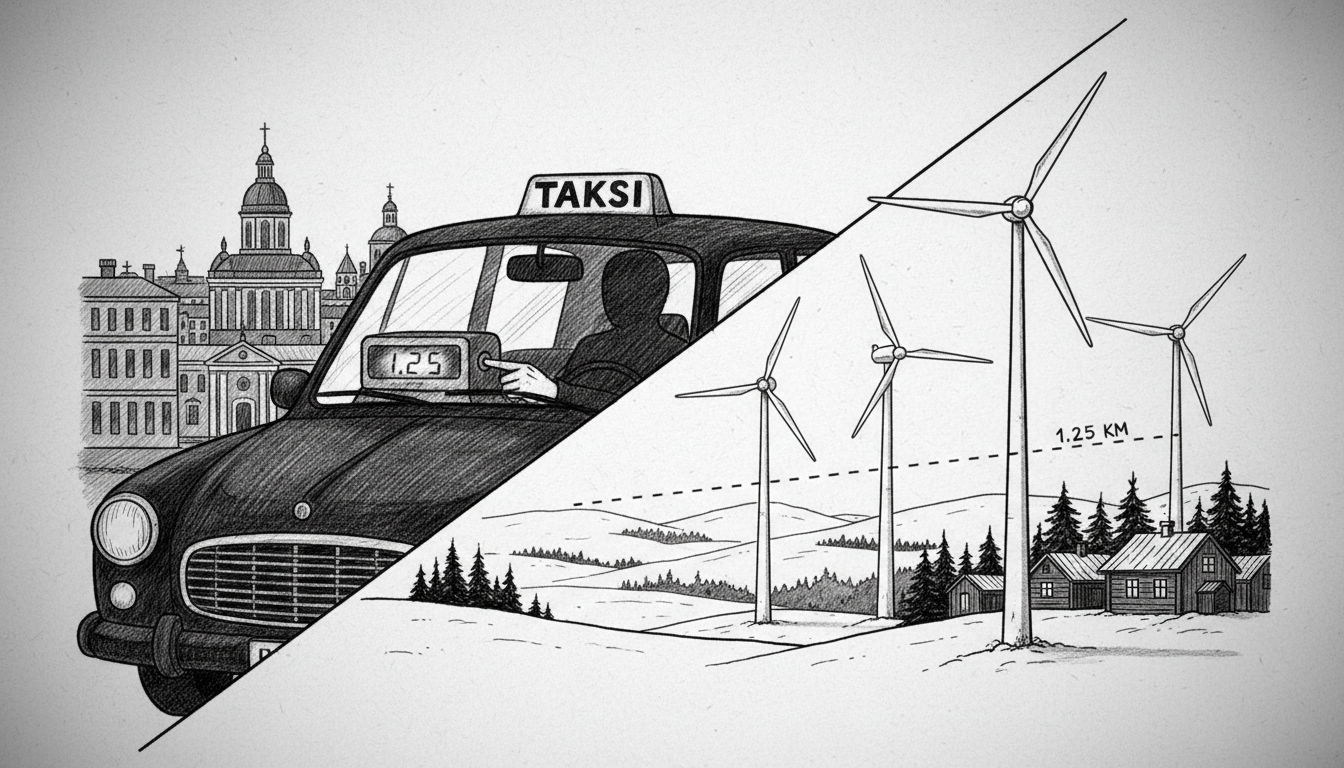
The Finnish government has reached a significant compromise on two contentious issues. All taxis will now require mandatory fare meters. Wind turbines built outside regional plans must maintain a 1.25-kilometer distance from residential areas. These unrelated policies were negotiated together in a political trade-off between coalition partners.
The taxi meter requirement represents a victory for the Finns Party. Each meter costs between 1,000 and 2,000 euros to install. This regulation particularly affects app-based services like Uber and Bolt. Their operating costs will likely increase as they adapt to the new equipment requirements.
Transport and Communications Minister Lulu Ranne strongly advocated for mandatory taxi meters. She stated in a release that this measure will combat gray economy activities in the transport sector. The minister celebrated restoring trust in the taxi industry and creating safer transportation services nationwide.
Meanwhile, the wind power compromise prevented stricter distance requirements. The Finns Party initially demanded turbines be located eight times their total height from settlements. This could have meant 2,000 to 2,800-meter buffers. Such restrictions might have canceled billions in renewable energy investments across Finland's technology sector.
Environment and Climate Minister Sari Multala emphasized the importance of clear rules for clean energy investments. The 1.25-kilometer requirement can be waived with 80% support from local property owners. Existing wind power areas remain exempt from the new distance regulations.
The political negotiations revealed classic coalition dynamics. Both parties conceded on some demands while securing their priority issues. The Finns Party obtained their taxi meter requirement. The National Coalition Party protected wind power investments with reasonable distance rules.
For Helsinki startups in transportation technology, these changes create both challenges and opportunities. The mandatory meter requirement adds compliance costs for ride-sharing platforms. However, it also levels the playing field between traditional taxis and app-based services.
Municipalities retain authority over local wind power decisions. The compromise maintains Finland's commitment to renewable energy expansion while addressing residential concerns. This balanced approach supports continued investment in the country's clean energy transition.
The taxi industry faces substantial operational changes beyond just meters. New vehicles must feature colored license plates specifically identifying them as taxis. Driver training requirements increase significantly with 21 hours for new drivers and 7 hours of supplementary training for existing professionals.
This political agreement resolves months of deadlock between coalition partners. The government aims to present the new taxi law to parliament during the spring session. Both measures reflect Finland's ongoing balancing act between regulation innovation and economic development.