
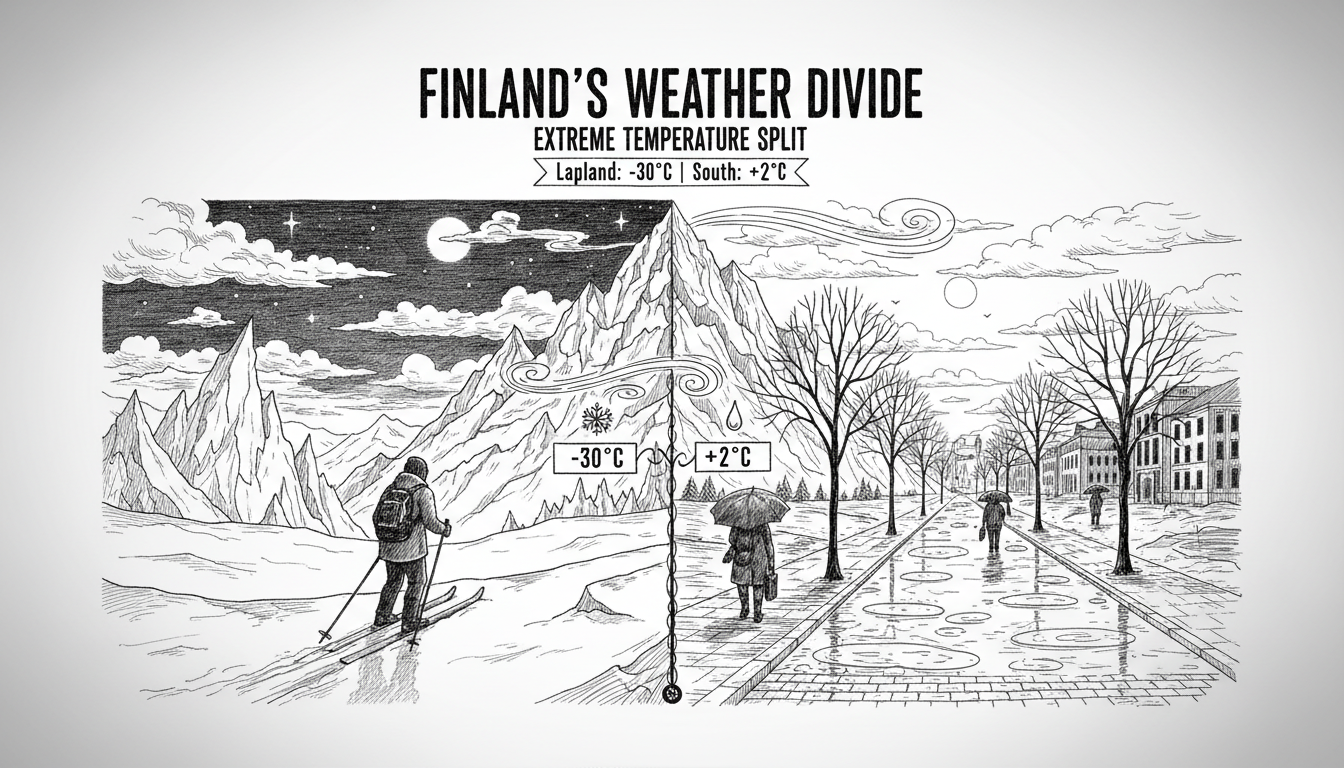
Finland faces a dramatic weather division this week with northern regions experiencing brutal cold while southern areas see near-thaw conditions. The Finnish Meteorological Institute reports temperatures ranging from -30°C in Lapland to just below freezing in southern regions, creating a stark national contrast. This temperature split represents one of the most pronounced regional weather divisions Finland has experienced in recent seasons.
Lapland's extreme cold sees temperatures plunging to -30.1°C in Enontekiö with consistent readings between -20°C and -30°C across the northern region. Meanwhile, southern and central Finland maintain temperatures between 0°C and -5°C with mixed precipitation falling as rain, snow, and sleet. The zero-degree line has climbed unusually northward, reaching heights in Northern Ostrobothnia and Kainuu regions.
Meteorologist Eetu Rimo stated in a weather briefing that the country remains clearly divided temperature-wise throughout the early week. Southern and central areas with variable cloudiness stay between zero and minus five degrees, while Oulu region experiences around minus ten degrees and Lapland maintains twenty to thirty degree below zero readings.
Midweek brings minimal temperature changes in southern Finland while Lapland sees increased cloud cover and slightly moderated cold between -15°C and -20°C. The most significant shift arrives later in the week when airflow turns southwestward, initiating a nationwide temperature moderation. Lapland's severe frost gives way to milder freezing conditions while southern and central regions could see temperatures rise above 5°C.
This weather pattern reflects Finland's unique geographical position where Arctic and Atlantic systems frequently collide. The current division demonstrates how northern latitudes create extreme seasonal variations even within a single country's borders. Such temperature splits occasionally impact transportation, energy consumption, and winter sports activities differently across regions.
The approaching moderation brings precipitation expected mainly as rain across most areas alongside potentially windy conditions. This weather development marks a typical Finnish winter transition where extreme cold periods alternate with milder Atlantic influences, creating the dynamic climate patterns characteristic of Nordic winters.