
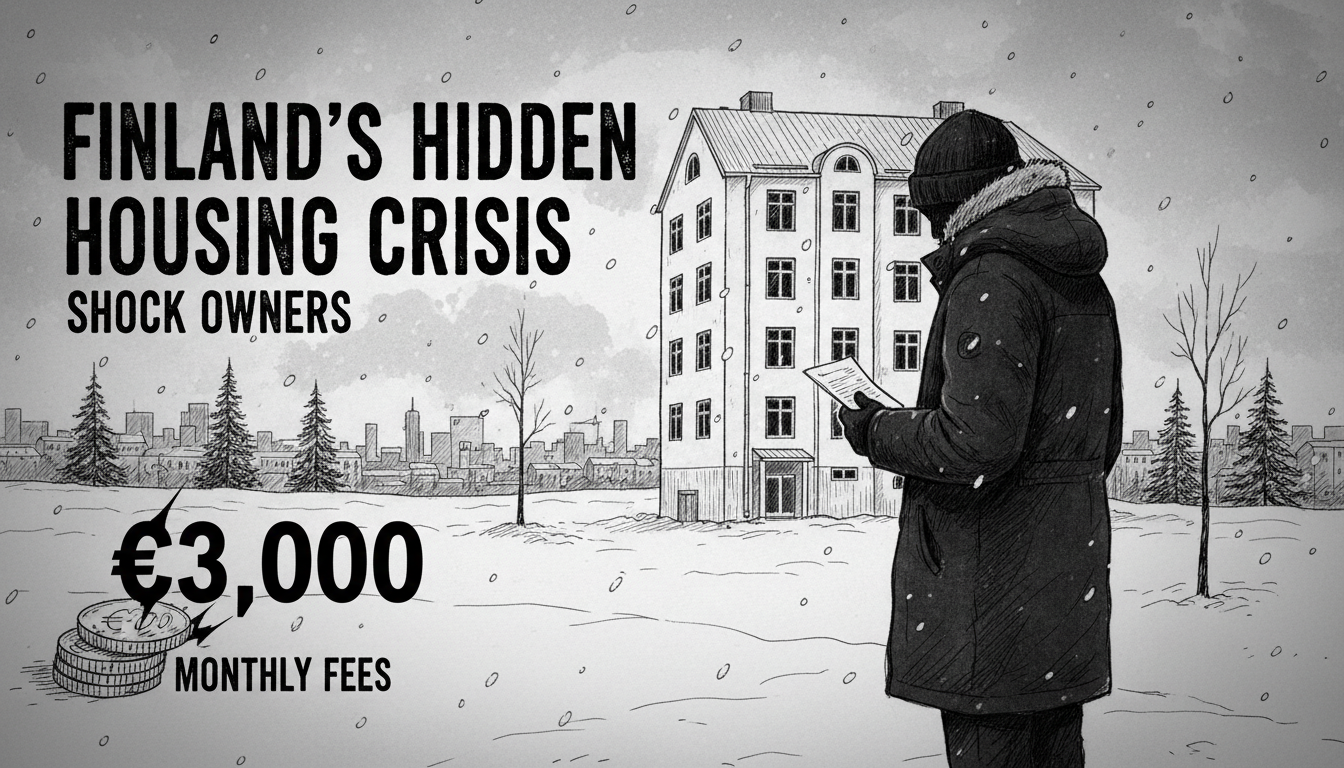
Finland's aging apartment buildings are creating a hidden financial crisis for thousands of homeowners, with monthly maintenance fees soaring to levels that threaten housing affordability. In Espoo, residents like Jari are now facing monthly charges of 3,000 euros after their housing company delayed critical repairs, a cautionary tale experts warn could repeat across the country.
Jari and his neighbors purchased their apartments with no indication of the financial storm brewing within their building's walls. The dream home transformed into a source of constant stress and staggering bills. "The housing company would have saved hundreds of thousands of euros if things had been handled on time," Jari stated, highlighting the core failure. What began as minor disagreements over maintenance escalated into protracted disputes, paralyzing decision-making while the building's condition deteriorated.
This scenario in Espoo is not an isolated incident but a symptom of a systemic issue facing Finland's housing stock. The nation's distinctive model of homeownership, where residents own shares in a housing company (asunto-osakeyhtiö) that owns the building itself, creates a collective responsibility for maintenance. When that collective fails to act, the consequences are severe and shared by all.
The Ticking Time Bomb in Finnish Buildings
The heart of the problem lies in the mandatory long-term repair plan (pitkän tähtäimen suunnitelma). Finnish law requires every housing company to maintain this 5-10 year roadmap for renovations and upkeep. However, creating a plan and acting on it are two different matters. In Jari's building, and in many others, necessary repairs identified in the plan were debated, delayed, and ultimately ignored until minor issues became major emergencies.
Real estate experts point to a dangerous pattern of financial underpreparation. "Many housing boards and residents underestimate the true cost of maintaining a building over decades," explains a Helsinki-based property consultant. "There's often a desire to keep monthly fees low in the short term, but this is a classic case of being penny-wise and pound-foolish. Deferred maintenance always costs more." The consultant emphasized that proactive, scheduled work is invariably cheaper than emergency repairs addressing rot, mold, or structural damage caused by neglect.
Statistics Finland data shows the average age of apartment buildings is increasing, meaning a growing wave of properties now require the kind of major renovations that bankrupted the budgets of Jari's housing company. A 2023 survey by the Finnish Real Estate Federation confirmed widespread anxiety, finding a significant portion of housing companies are deeply concerned about their ability to finance looming renovation projects.
When Dispute Leads to Financial Ruin
The Espoo case reveals how governance failures can compound technical problems. Disputes within housing companies often follow a predictable script: disagreements erupt over the scope of work, the choice of contractor, and most bitterly, the allocation of costs. Some residents may resist any fee increase; others may demand premium solutions. Without strong leadership from the elected board, paralysis sets in.
This internal conflict has a direct and severe financial impact. Legal fees from resident disputes add tens of thousands to the final bill. More critically, delay allows construction costs to rise annually, and inflation further erodes the purchasing power of any reserves set aside. The contractor hired for an urgent, large-scale repair commands a higher price than one secured for a planned project with competitive bidding.
Jari's experience shows the end result. The necessary renovations, once finally agreed upon, were so extensive and costly that the housing company had to take on substantial debt. This debt, combined with the increased operational costs of the renewed building, is now passed on to shareholders through the catastrophic monthly vastike of 3,000 euros. For many residents, especially those on fixed incomes, such an increase is simply unsustainable, forcing them to consider selling their homes in a distressed market.
A Nationwide Challenge with No Easy Fix
The Finnish model of housing ownership distributes both control and liability. There is no external landlord to blame; the residents collectively are the landlord. This creates a powerful democratic structure for managing shared property, but it also requires a high degree of cooperation, financial literacy, and long-term planning from all residents—a requirement that is often difficult to meet.
Experts argue that better education for housing company board members is crucial. Many board members are volunteers with little experience in large-scale property management or construction project oversight. Furthermore, auditors and inspectors could play a stronger role in sounding the alarm when a housing company's long-term plan is being ignored or its reserve fund is clearly inadequate for upcoming liabilities.
Some suggest legislative tweaks, such as stricter requirements for mandatory reserve fund levels tied to the building's age and condition, or clearer mechanisms to break decision-making deadlocks before a crisis occurs. However, any solution must balance necessary enforcement with the principle of resident self-governance that is central to the Finnish system.
Learning from the Espoo Nightmare
The story from Espoo serves as a stark national warning. For prospective apartment buyers in Finland, it underscores the necessity of due diligence that goes beyond inspecting the apartment itself. Savvy buyers must now scrutinize the housing company's recent annual reports, study its long-term repair plan, assess the health of its reserve fund, and even review minutes from recent meetings to gauge the level of cooperation among residents.
For current residents, the message is to engage proactively. Attending annual meetings, understanding the repair plan, and supporting sensible, timely maintenance is not just a civic duty but a financial imperative. The cost of disengagement, as Jari and his neighbors learned, can be financially devastating.
The crisis of soaring maintenance fees is ultimately a question about the sustainability of Finland's urban housing stock. As buildings age, the collective will and ability of residents to maintain them will be tested repeatedly. The experience in Espoo proves that failure is not just a matter of a leaky roof or a worn-out facade, but a threat to the very affordability and security of homeownership for thousands of Finns. The question now is how many other housing companies are currently on the same path, quietly debating their way toward a similar financial cliff.