
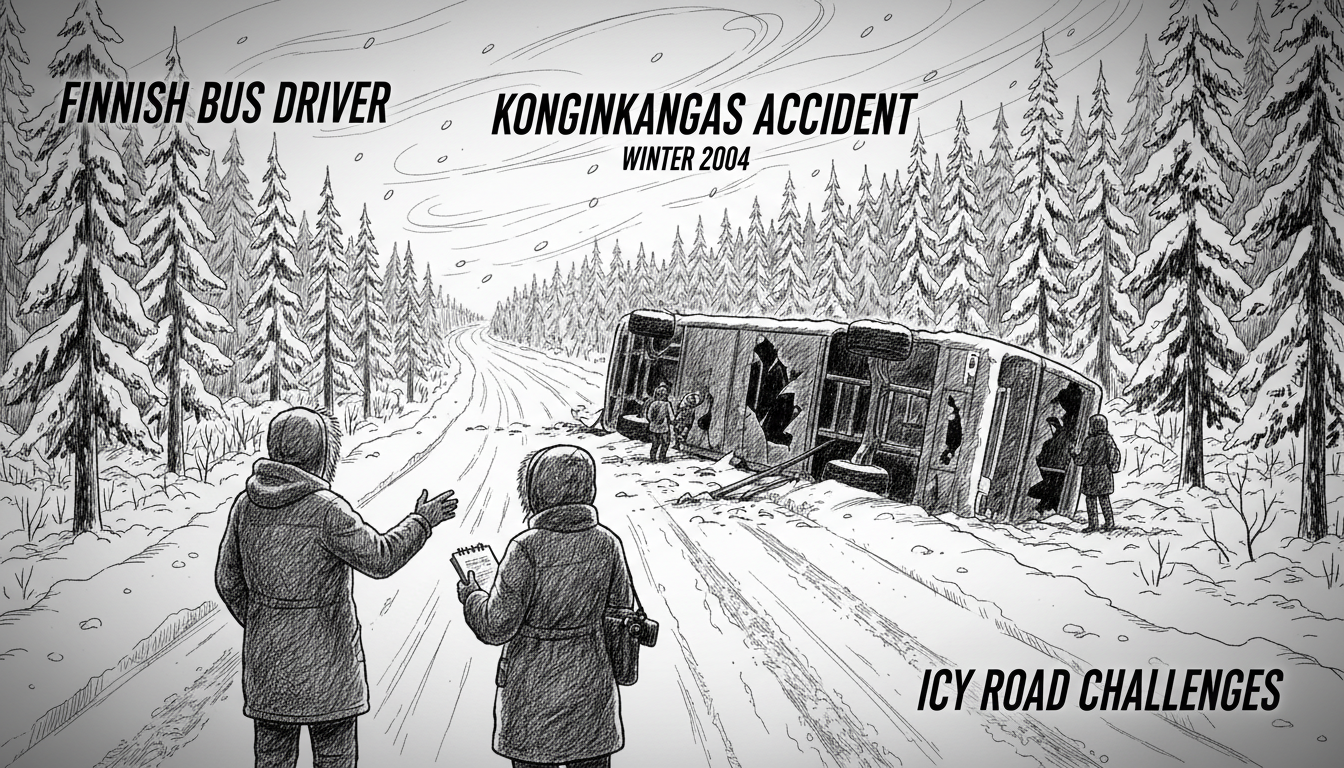
A bus carrying students and schoolchildren veered off the road and onto its side in Konginkangas, Äänekoski, on Monday morning. The driver, Alpo Leppänen, described a harrowing sequence of events on an icy, untreated section of Liimattalantie road. His account raises immediate questions about winter road maintenance standards in rural Finland during the volatile early spring period.
Leppänen stated the bus was traveling at barely 15 kilometers per hour when it began to slide sideways. He recalled the initial moment when the rear of the vehicle slid into a ditch. "I thought it would stop there," Leppänen said, "but the front of the bus did not stay on the road. I knew then that it was going to tip over." The accident occurred despite the driver's cautious speed, highlighting the extreme conditions.
The driver provided specific details about the road conditions. He noted that the initial stretch of Liimattalantie, starting from the Häkkiläntie intersection, was wet from melting ice on Monday morning. A longer, dangerously slippery section near 'Tervon Puutarha' was navigated successfully. However, the subsequent loss of tire traction was unavoidable. "After that, there was simply not enough friction left on the wheels," Leppänen explained in his statement.
This incident is not an isolated event in Finland. It occurs against a backdrop of ongoing national debate about municipal resource allocation for road maintenance, particularly on less-traveled rural routes. The Central Finland region, where Äänekoski is located, frequently experiences challenging freeze-thaw cycles in March and April. These conditions create 'black ice' – thin, nearly invisible layers of ice on asphalt – which are especially hazardous.
Finnish law mandates that public roads be maintained to a standard of safety corresponding to the season. The Finnish Transport Infrastructure Agency (FTIA) sets guidelines, but implementation often falls to municipalities. Accidents like this one prompt scrutiny of whether maintenance schedules are adequate and if gritting or salting operations are performed frequently enough on secondary roads used for school transport. The political dimension is clear, as funding for local infrastructure is a perennial issue in Eduskunta debates, with parties often clashing over taxation levels and service guarantees for rural areas.
For international readers, understanding the context is key. Finland's vast network of rural roads is essential for connectivity, but maintaining them through long winters is a significant financial burden. The safety of school transport is a deeply held priority in Finnish society. This accident will likely lead to a local authority review and possibly questions in the municipal council. The direct testimony from the driver provides crucial evidence for any investigation. It underscores the human factor in infrastructure policy, where budgetary decisions directly impact real-world safety. The coming days will show if this event triggers a wider examination of springtime maintenance protocols across the country.